
Tottenham's Struggles Under De Zerbi: A Blueprint for Scoring
Tottenham are four games into the Premier League season, £320million lighter after a summer of heavy investment, and still waiting for their first goal. Only Coventry City share that unwanted statistic.
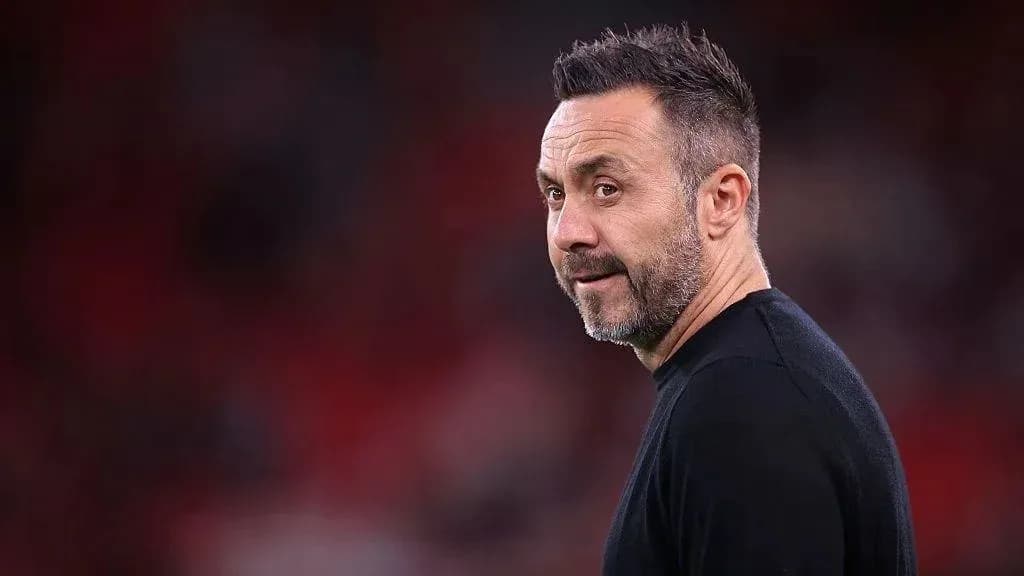
This is not what was sold when Roberto De Zerbi walked through the door.
The Italian has arrived with a clear plan and a track record. His Marseille side between 2024 and 2026 averaged 2.3 goals per game, ripping teams apart with vertical football and ruthless forwards. The early weeks at Spurs look very different on the scoreboard, but the blueprint is already visible. The problem is not the idea. It is the execution.
De Zerbi’s risk-heavy blueprint
De Zerbi has not abandoned his principles just because the Premier League has shifted since he left Brighton in 2024. He has simply adjusted the angles.
His teams invite pressure. They slow the game down, roll passes backwards, almost daring opponents to jump. When the press comes, they spring forward, punching passes through the lines or driving into the spaces left behind.
He summed it up neatly at a coaching seminar in 2020: “The stronger the pressure of the opponent, the more vertical [our] action becomes. [The fewer opponents behind], the easier it becomes to go and score.”
That is the theory. And even in this misfiring Tottenham side, there have already been flashes of it – forwards receiving in big spaces, facing fewer defenders, the pitch suddenly opening up. Turning those moments into goals, though, demands that every moving part is in sync.
Right now, they are not.
A 2-3-2-3 with moving parts
On the ball, Spurs usually resemble a 2-3-2-3. It is not always obvious at first glance, because of the constant rotation, but the spine is clear.
Two centre-backs. In front of them, a holding midfielder – most often Rodrigo Bentancur – anchoring the structure. That trio stays relatively fixed, providing the platform.
Ahead and around them, the picture shifts. Wingers, full-backs and central midfielders interchange zones, swapping lanes to preserve the overall shape. If one vacates a space, another is expected to fill it. The framework is rigid; the roles within it are fluid.
On top of that structure sit De Zerbi’s principles: play centrally, draw the opposition in, then attack the space they leave.
It worked devastatingly well at Marseille. It has not clicked yet at Tottenham. But the gap between “almost” and “actually” is smaller than the league table suggests.
Central corridors, crowded spaces
De Zerbi wants his teams to use the middle of the pitch, not skirt around it.
When Spurs’ centre-backs have the ball, that central focus lures opposition forwards and midfielders higher. As they step up, pockets appear between the lines for Tottenham’s attacking midfielders to receive. At the same time, defenders are dragged infield, freeing the flanks for direct wingers to attack once the ball is released wide.
To make that work, the players receiving in the middle must be comfortable under pressure. Not everyone is.
Sandro Tonali, for instance, is more dangerous when he can face forward and drive into space. De Zerbi has recognised that, rotating him at times with Archie Gray, who starts at right-back but moves into central areas in possession. It is not Gray’s natural role, yet the 20-year-old has coped in tight spaces and looks switched on to his manager’s demands.
The return of James Maddison changes the equation again. Back from a shoulder injury in the Carabao Cup tie at Liverpool, he gives De Zerbi a natural specialist between the lines, someone who thrives with defenders at his back and a split-second window to turn or slide a pass. His presence should help Spurs reach dangerous zones more often.
Still, this is not just about individual talent. Players need to internalise instructions that run directly against what they were asked to do under previous coaches.
Under Thomas Frank at the start of last season, Tottenham largely bypassed the centre, funnelling build-up down the flanks to reduce the risk of costly turnovers. De Zerbi is asking them to do the opposite: to be brave in the most congested part of the pitch. That kind of rewiring does not happen overnight.
The missing through ball
For all the talk of structure and philosophy, Tottenham’s biggest attacking problem so far is brutally simple: the final pass is not being played.
Spurs often break the opposition midfield cleanly. They lure the press, play through it, and suddenly find themselves running at a retreating back line. These are the moments De Zerbi builds his game around. These are the moments his Marseille forwards feasted on.
There are three steps from promise to payoff. First, the ball-carrier must see the right pass. Second, the movement ahead of the ball must offer that pass. Third, the technique has to match the idea.
The breakdown at Spurs has mostly come in step one. Players have either failed to spot the through ball or chosen not to risk it.
Omar Marmoush has made plenty of aggressive runs in behind. The service has not consistently matched his intent. Gray has tried to slide passes down the line, but the same boldness has not appeared as often in central channels.
The imminent return of Pedro Porro could be significant. With Spain this summer, as they went on to win the World Cup, he operated more centrally in possession and showed the creative instincts that made his name. Those natural tendencies fit De Zerbi’s demands. If he can bring that same vision and weight of pass into this Tottenham side, the forwards may finally see the kind of service De Zerbi’s Marseille attackers enjoyed.
Learning the runs
The ball is only half the story. The movement off it still needs sharpening.
At Marseille, De Zerbi’s wide forwards often made diagonal runs across the last line, attacking the space between full-back and centre-back. Those runs were regularly found by midfielders and defenders willing to play vertically. The result: repeatable patterns, repeatable chances.
Igor Paixao’s goal in Marseille’s 2-2 draw with Toulouse last season stands as a clear illustration – well-timed diagonal movement, a direct pass, and a simple finish once the structure had done its work.
Against Liverpool in midweek, there were hints of that at Spurs. Destiny Udogie repeatedly surged into promising positions down the left when the match became stretched. Andy Robertson has been impressive for Tottenham this season, but Udogie’s power and timing gave Liverpool problems and pushed Spurs into crossing areas against a disorganised back line.
Those are the situations De Zerbi wants to see more often. The patterns are there. The precision is not.
The final act: finishing the move
When an attacking team suddenly accelerates, defenders usually respond by sprinting back towards their own goal, desperate to protect the box. That panicked retreat opens up space at the top of the area for late-arriving midfielders or clever forwards who drop off the line.
Marmoush has tried to exploit that by peeling away and offering himself as the cut-back option. Too often, the ball has not reached him.
Some of this is chemistry. New combinations need time. Some of it is technical. Savio, a left-footed right-winger, is excellent at getting to the byline on his stronger side but less comfortable pulling the ball back on his weaker foot. On the other flank, left-footers Udogie and Robertson have produced clearer chances with their crosses.
At Marseille, both the right winger and right full-back were happy cutting the ball back on their right foot. Those deliveries were made to look even better by the movement of Pierre-Emerick Aubameyang, whose penalty-box craft at 37 turned half-chances into goals.
Tottenham do not yet have that same level of refinement in the area. The runs are not always synced with the cross. The cut-backs are not always on the right foot. The late arrivals are not always found.
But when you view Spurs through the lens of what De Zerbi is trying to build, their attacks do not look hopeless. They look half-finished.
The margins are fine. Marseille’s forwards were ruthless, tailor-made for this high-risk, high-reward approach. Tottenham’s new-look attack is still learning the choreography.
De Zerbi will not rip up his blueprint after four goalless league games. He will double down on the details. If his players catch up with his ideas – and if the final pass starts to appear as often as the space for it – the question will flip quickly.
From “Why can’t Spurs score?” to “How do you stop them when they do?”
Related News

Barcelona vs Sevilla: Expect Goals and a Barcelona Win

Roma vs Inter: A Title Race Showdown
Tottenham's Struggles Under De Zerbi: A Blueprint for Scoring

Mikel Arteta's Right-Back Dilemma: Managing Arsenal's Defensive Depth

Raphinha's Transformation Under Hansi Flick: A New Era for Barcelona
Tottenham's Scoring Struggles: De Zerbi's Challenge