
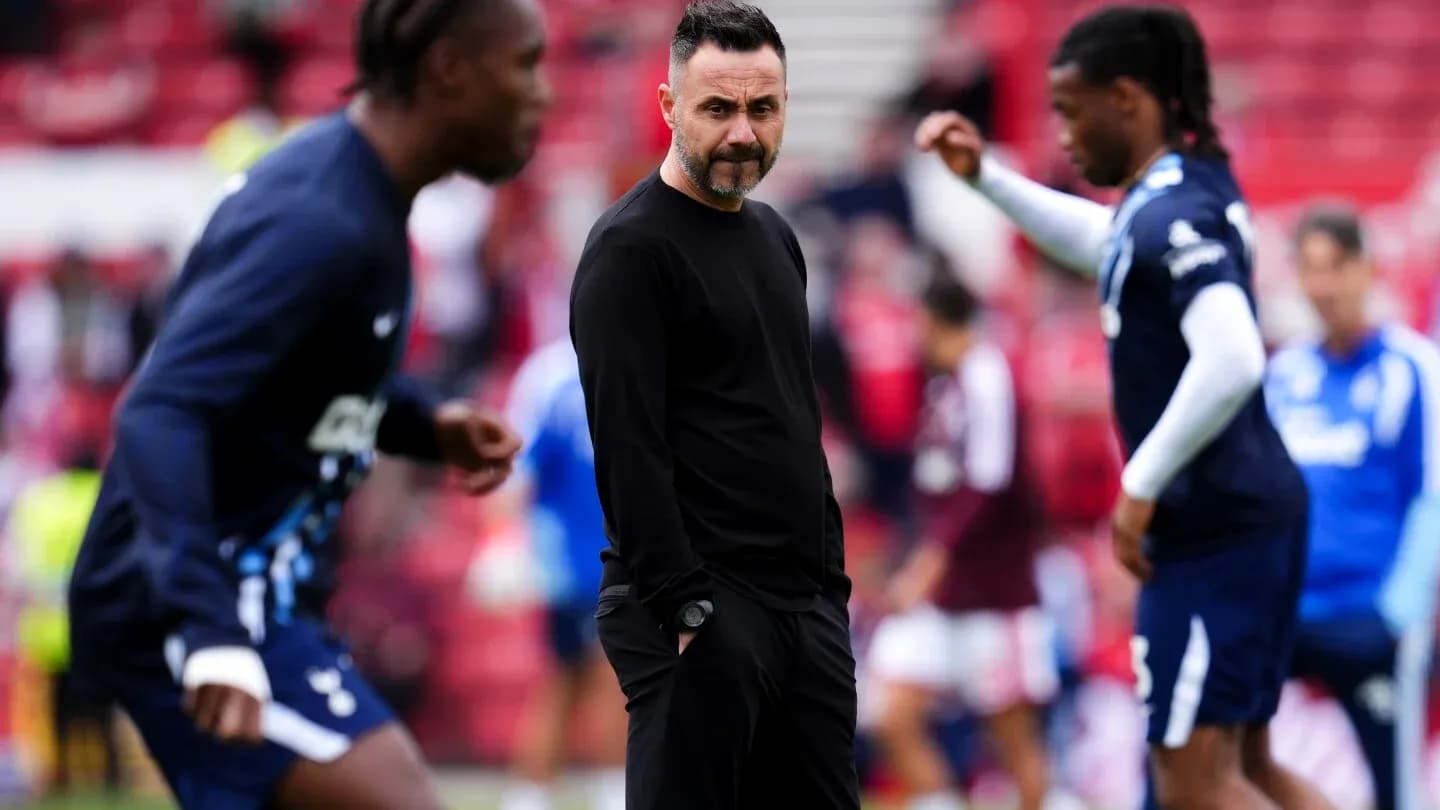
Tottenham's Goalless Draw: A Step Forward for De Zerbi
Tottenham finally stopped the bleeding on Saturday. They didn’t win, they didn’t score, but they did something they hadn’t managed all season: they didn’t lose.
A goalless draw at the City Ground against Nottingham Forest is not the sort of result that usually gets framed, yet for Roberto De Zerbi it carried a different kind of value. Three Premier League games, zero wins, zero goals. This was at least a foothold.
It was a bruising, bitty contest, full of collisions, loose touches and second balls. Spurs did not shrink. They scrapped, they ran, they kicked back. For a side still trying to work out exactly what they are under a new head coach, that edge mattered.
De Zerbi: “Disappointing for the result, very happy for the performance”
De Zerbi, only days into the job, cut a frustrated but upbeat figure afterwards.
“Disappointing for the result, but for the performance, very happy,” he said. “Considering we started working together on Thursday for the first time, we played well. I think we can improve in the last pass. If we improve in the last third, I think we can score many, many goals because we have the players with big qualities. Now it’s a tough moment to accept this result, because I think we played well.”
That last third is where the entire story currently falls apart.
“It’s not to unlock [the final third]. It’s the mistakes. We have to work in this part,” he continued. “I think we played very well with the ball, we found the solutions because they press [our defenders] with three, but one of our full backs was always alone and we found him always in 90 minutes. So in build-up, we played very well. In the last third, I think we can be… better. Much better.”
Spurs moved the ball with purpose through the first two phases. They escaped Forest’s press, found the spare full back, stepped into midfield. On the whiteboard, it all tracked. Then they reached that white rectangle at the end of the pitch, the one that decides everything, and the ideas ran dry.
Risk at the back, little reward up front
De Zerbi’s system is built on calculated risk. The back line is deliberately exposed, defenders invited to play on the edge because, when it clicks, the attacking payoff is worth the danger. When it doesn’t, you’re asking a lot of your centre-backs for not much in return.
Right now, Tottenham are living in that gap. The back four is under stress, but the attack is not cashing in.
Micky van de Ven, though, looks at home in the chaos. The Dutchman has started the season strongly alongside compatriot Jan Paul van Hecke, reading danger, stepping in, bailing Spurs out when the structure leaves them one-versus-one. Even in last week’s defeat to Newcastle, it was set pieces that cost them, not open-play disarray. Van de Ven, more than anyone else in this side, raises their floor.
The ceiling is another matter. With the way this attack is functioning, that ceiling feels very low.
De Zerbi knows the names on the teamsheet should add up to something more threatening. “We brought very, very good players,” he said. “But the team doesn’t adjust like the names on paper or Football Manager.”
Costly changes and a fragile balance
The Italian also pointed to a key moment after the interval.
“The second half, I’m sorry because the medical stuff pushed to change Savio and Udogie after 60 minutes,” he explained. “Kudus and Robertson played very well, but maybe two substitutions in that moment was not so good. But now we can’t take risk with injuries again. Savio is too important for us, the same Destiny. Maybe we lost some balance, some connection [when they came off].”
Up to that point, Spurs had looked relatively cohesive. The build-up was clean, the pressing structure intact. Once Savio and Destiny Udogie departed, the joins started to show. The replacements worked, but the relationships weren’t there. The attack, already blunt, lost what little rhythm it had.
Defensively, though, De Zerbi saw progress.
“I think today we defended very, very well,” he said. “We have to improve the physical condition [of some players], the connection between the players. We changed, I don’t know how many players in this transfer window.”
That churn is obvious. Spurs look like a squad mid-assembly, parts scattered across the table, the picture on the box still a guess.
The missing creator
Strip it back and the problem is simple. Tottenham cannot consistently create high-quality chances in central areas. They reach the edge of the box and run out of ideas.
Without a true no. 10, their possession naturally funnels wide. The ball goes to the flanks, the wingers square up their full backs, and the opposition has time to shuffle across, fill the box and wait. Forest did exactly that: an early high press to disrupt the rhythm, then a deep block with nine or ten red shirts around the penalty area.
Spurs, packed with dribblers but short on a pure playmaker, never really solved it.
De Zerbi insisted the squad has “players with big qualities,” and he’s right. On paper, this is an attacking group that should trouble most defences. But games are not played on paper, and right now Tottenham’s attacks feel like a collection of individual moves rather than a coherent plan.
The hope is that James Maddison, once fully fit and free from the long lay-off that has effectively stolen a year from him, can step back into that creative void. He is the closest thing in this squad to the missing link between midfield and attack.
The reality? Until he is back at his sharpest, or until someone else emerges to stitch this structure together, it may keep looking like this: solid enough at the back, well-drilled through midfield, and then a blur of bodies and blocked shots around that white rectangle, with the scoreboard stuck stubbornly on zero.
Related News
Cesc Fabregas Calls for Perfect Performance from Como Against Frosinone
Celtic vs Rangers: High Stakes in Scottish Premiership Showdown
Chris Davies Backs Luis Vazquez After Derby Miss
Spinazzola Injury Adds to Napoli’s Challenges Ahead of Fiorentina Match
FPL GW5: AllAboutFPL Founders Go All-In With Early Chips

Marco Palestra Returns to Training: Chelsea's €60m Signing Eyes Debut