
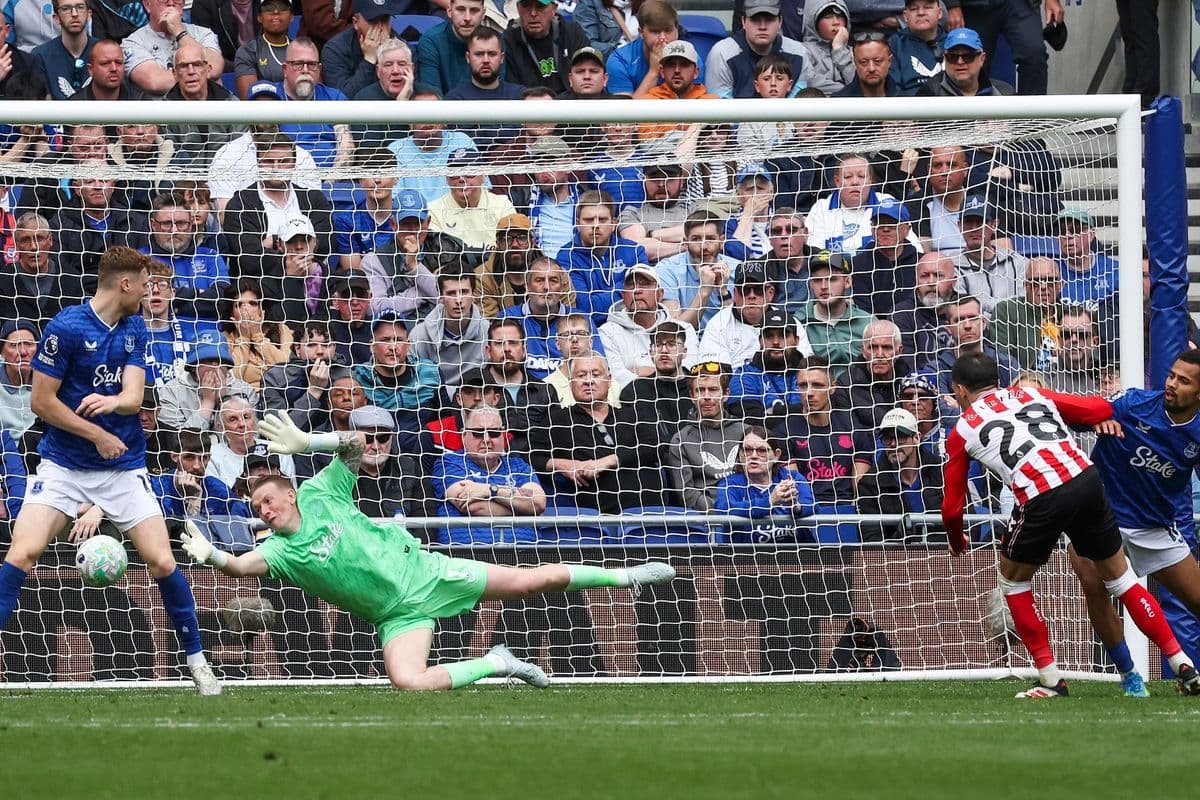
Sunderland’s Tactical Mastery in 3-1 Victory over Everton
Everton’s 1-3 home defeat to Sunderland at Hill Dickinson Stadium unfolded as a lesson in game management and structural adaptability. Both sides lined up in a 4-2-3-1, but where Everton’s possession (49%) and shot volume (10 total, 6 inside the box) suggested territorial control, Sunderland’s compactness and transition play turned a lower shot count (7 total, 5 inside the box) into superior efficiency and a decisive away performance.
Leighton Baines’ Everton tried to build from a stable back four of J. O’Brien, J. Tarkowski, M. Keane and V. Mykolenko, with Tim Iroegbunam and James Garner as a double pivot. Their task was to progress play through M. Rohl, K. Dewsbury-Hall and I. Ndiaye into Beto as the lone forward. Structurally, Everton’s 4-2-3-1 often resembled a 2-3-5 in possession: full-backs pushed, the pivots staggered, and the three attacking midfielders occupied the half-spaces and central pockets.
The opening phase showed Everton’s plan clearly. With 406 passes and 346 accurate (85%), they circulated the ball patiently, trying to drag Sunderland’s midfield pair of G. Xhaka and N. Sadiki out of shape. The breakthrough on 43 minutes, when M. Rohl scored from a M. Keane assist, was emblematic: a centre-back stepping into play, Everton compressing Sunderland deep, and the number 10 arriving in a dangerous central zone. At that point, Everton’s structure was rewarded, and the 1-0 half-time lead matched their territorial edge.
Second Half
However, the game’s tactical hinge came after the interval. Sunderland, under Regis Le Bris, had started with a disciplined 4-2-3-1: R. Roefs in goal behind a back four of L. Geertruida, N. Mukiele, O. Alderete and R. Mandava, screened by Xhaka and Sadiki. Their attacking line of T. Hume, E. Le Fee and N. Angulo behind B. Brobbey was set up to counter quickly once possession was regained. The early substitution on 23 minutes — L. O’Nien (IN) came on for O. Alderete (OUT) — hinted at a tweak, likely shifting the back line’s dynamics and adding more mobility or distribution from deep.
Sunderland’s comeback was built on sharper verticality. The equaliser on 59 minutes, B. Brobbey finishing from an E. Le Fee assist, exposed Everton’s rest-defence: with full-backs advanced and pivots stretched, the back line was attacked directly. Sunderland did not need high volume; they needed clarity of route. Their 430 passes with 365 accurate (also 85%) show they matched Everton’s technical level but chose their moments more selectively, especially in transition.
Le Bris’ substitution wave between 60 and 77 minutes was decisive. At 60', C. Talbi (IN) came on for T. Hume (OUT), refreshing the attacking band. Then at 77', a triple change re-armed the front line and midfield: C. Rigg (IN) for N. Angulo (OUT), H. Diarra (IN) for N. Sadiki (OUT), and W. Isidor (IN) for B. Brobbey (OUT). These moves injected energy and different profiles between the lines: Rigg’s creativity, Diarra’s dynamism, and Isidor’s direct threat against a tiring Everton defence.
The second Sunderland goal on 81 minutes, E. Le Fee scoring from a C. Rigg assist, underlined the impact of those changes. Rigg, just introduced, found the space Everton’s stretched double pivot could no longer cover, and Le Fee’s advanced positioning from midfield punished the home side’s inability to track late runners. Sunderland’s structure now resembled a fluid 4-2-3-1/4-3-3 hybrid, with Xhaka anchoring and the substitutes rotating aggressively around him.
Everton’s response was reactive rather than proactive. At 73', T. George (IN) came on for T. Iroegbunam (OUT) and T. Barry (IN) for Beto (OUT), effectively altering the attacking reference. Removing Iroegbunam weakened the screening in front of the defence at precisely the moment Sunderland were loading central zones with fresh legs. Later, at 88', S. Coleman (IN) replaced J. O’Brien (OUT) and D. McNeil (IN) replaced M. Rohl (OUT), but by then Sunderland already had the momentum and the lead. These late changes added experience and crossing threat but did not fundamentally change Everton’s structural vulnerabilities.
Defensively, Everton’s lack of goalkeeper saves (0) alongside Sunderland’s 3 saves for R. Roefs is revealing. Sunderland’s keeper had to actively preserve the lead — reflected in 0.02 goals prevented — while Everton’s J. Pickford faced few on-target efforts but conceded three times from Sunderland’s three shots on goal. That points to the quality and clarity of Sunderland’s chance creation compared with Everton’s more sterile pressure.
Discipline also shaped the tempo. Everton collected three yellow cards — Tim Iroegbunam (25' Foul), Jake O’Brien (47' Foul), James Garner (90+6' Foul) — reflecting the strain on their midfield and back line as they tried to halt transitions. Sunderland, with zero cards and only 9 fouls to Everton’s 14, maintained better control in duels and avoided breaking their own rhythm with stoppages.
Statistically, the xG figures — Everton 1.07, Sunderland 0.73 — confirm the tactical story: Everton created slightly better cumulative chances but lacked cutting edge and defensive security, while Sunderland outperformed their xG through superior game-state management and ruthless finishing. Both teams shared an identical pass completion rate (85%), but Sunderland used their marginal possession edge (51%) to dictate when and where the game became chaotic, especially after the hour mark.
In tactical terms, this match turns on Sunderland’s superior use of substitutions, compact mid-block, and vertical transitions from a 4-2-3-1 base, versus an Everton side whose attacking structure produced a good first half but whose changes eroded central protection and invited a clinical, late-game turnaround.
Related News
Bournemouth vs Liverpool Prediction: Key Stats and Betting Tips
Tottenham vs Aston Villa Predicted Lineups: Team News for Premier League Clash
Brighton vs Arsenal: Premier League Clash Preview
Manchester City vs Sunderland: Premier League Clash Preview
Tottenham vs Aston Villa: Early Relegation Battle
Brentford vs Chelsea Predicted Lineups: Team News and Match Insights