
Bournemouth vs Manchester City: Tactical Draw Analysis
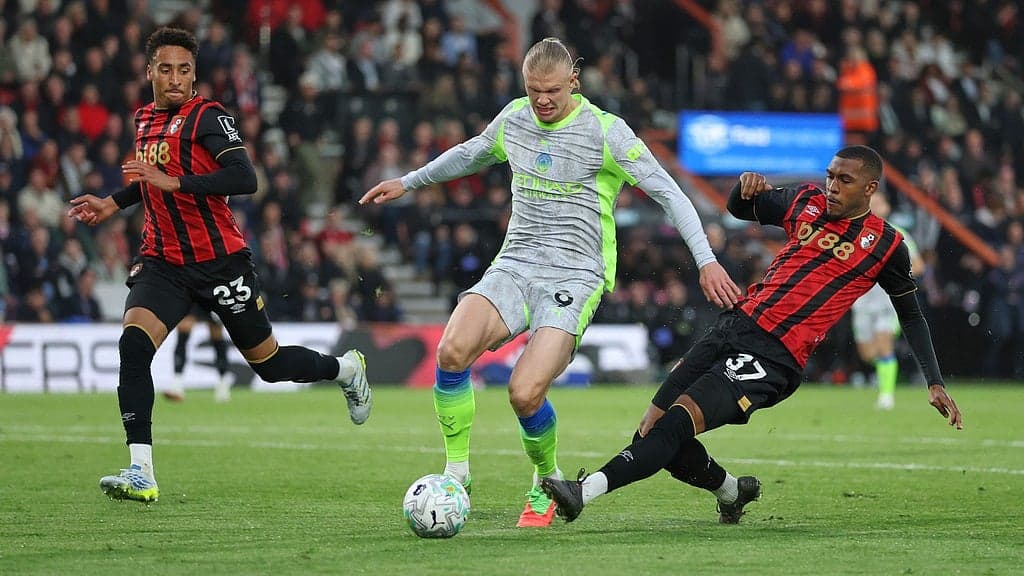
Bournemouth’s 1-1 draw with Manchester City at Vitality Stadium was a high-level tactical arm-wrestle, shaped by contrasting structures, game-state management, and differing approaches to risk. Bournemouth, in a 4-2-3-1 under Andoni Iraola, leaned into compactness, vertical transitions, and set-piece pressure. Manchester City, in Pep Guardiola’s 4-1-4-1, controlled territory and possession, but needed a late Erling Haaland equaliser to translate their structural dominance into the scoreboard.
Bournemouth’s shape was clear from the opening phase. D. Petrovic sat behind a back four of A. Smith, James Hill, M. Senesi and A. Truffert, with T. Adams and A. Scott forming a double pivot. Ahead of them, Rayan, E. J. Kroupi and M. Tavernier supported lone forward Evanilson. Out of possession, this often flattened into a 4-4-1-1: the wingers dropped alongside the pivots, while Kroupi stayed between lines to screen Rodri and jump onto City’s centre-backs when the trigger came.
The statistical profile underlines Bournemouth’s plan. With 45% of the ball and 431 passes (346 accurate, 80%), they accepted long spells without possession but were purposeful when they had it, generating 10 total shots and 1.99 xG. Six of those efforts came from inside the box, and three were blocked, showing they consistently reached dangerous zones rather than settling for hopeful efforts from range. Seven corners further illustrate their ability to convert rare pressure into set-piece volume.
The key attacking pattern for Bournemouth was the left-sided chain of Truffert, Tavernier and Kroupi. The opening goal at 39’ — E. J. Kroupi finishing from an A. Truffert assist — was the clearest expression of this: full-back overlap, wide midfielder drawing pressure, and the No.10 arriving into the box. That move reflected a deliberate strategy: pull City’s wide defenders narrow with central occupation, then attack the outer lanes with the overlapping full-back.
Defensively, Bournemouth walked a fine line between aggression and over-commitment. They committed 16 fouls and collected four yellow cards, three of them late as they tried to protect the lead. Tyler Adams’ booking at 37’ for “Argument” hinted at the emotional temperature in midfield, while James Hill’s 59’ yellow for “Foul” showed the cost of tight marking on Haaland and the attacking midfielders. In stoppage time, Justin Kluivert (90+3’, “Argument”) and Adrien Truffert (90+6’, “Foul”) were both booked as Bournemouth increasingly defended deep and reacted to City’s pressure rather than controlling duels on their own terms.
With the ball, Bournemouth’s 4-2-3-1 morphed into a 2-3-2-3 in settled possession: full-backs advanced, Adams dropped between centre-backs at times to help progression, and Scott pushed higher to connect with Kroupi. The 7-6 corner count and the high xG underline that they didn’t merely sit back; they used transitions and set pieces to create high-quality chances, and could argue they had enough to win the game outright.
Manchester City’s 4-1-4-1 was textbook Guardiola in structure: G. Donnarumma in goal, a back four of M. Nunes, A. Khusanov, M. Guehi and N. O’Reilly, Rodri as the single pivot, with A. Semenyo, B. Silva, M. Kovacic and J. Doku behind Haaland. With 55% possession and 527 passes (458 accurate, 87%), City controlled the rhythm and territory, but their 1.68 xG and 14 shots (10 inside the box, 6 blocked) show a game where Bournemouth’s low block forced them repeatedly into traffic.
The blocked shot count is revealing. Six City efforts were smothered by Bournemouth defenders, reflecting how often Guardiola’s side were compelled to shoot through a forest of bodies. Bournemouth’s compact 4-4-1-1 narrowed the central lane, so City’s wide players — especially Doku — were often funneled outside, then confronted by covering full-backs and doubling midfielders. When City did get through, D. Petrovic (Bournemouth) made three saves, exactly matching City’s five shots on goal minus Haaland’s successful effort.
City’s substitutions at 56’ were a clear tactical pivot. P. Foden (IN) came on for M. Kovacic (OUT), R. Cherki (IN) for B. Silva (OUT), and Savinho (IN) for A. Semenyo (OUT), turning the 4-1-4-1 into something closer to a 4-1-3-2 in possession, with Foden and Cherki both seeking pockets between Bournemouth’s lines and Savinho adding directness wide. Later, at 76’, O. Marmoush (IN) replaced J. Doku (OUT), adding a more vertical, penalty-box-oriented threat from the flank.
This wave of attacking substitutions tilted the momentum. City’s shot volume and box entries increased, and Bournemouth’s response — withdrawing E. J. Kroupi for J. Kluivert at 76’, then Rayan for D. Brooks at 84’ and Evanilson for E. Unal at 89’ — signaled a shift from proactive transition threat to pure game management. The late yellow cards for Kluivert and Truffert, combined with Bournemouth’s 16 fouls versus City’s 7, capture how the closing stages became about surviving waves rather than trading attacks.
In goal, G. Donnarumma (Manchester City) was less busy — making two saves against Bournemouth’s two shots on target — but his “goals prevented” figure of 0.29 mirrors Petrovic’s, suggesting both goalkeepers performed in line with, or slightly above, the quality of chances faced. That symmetry at 0.29 goals prevented each, combined with a 1.99 vs 1.68 xG split, underlines how finely balanced the match was despite City’s possession advantage.
Rodri’s late yellow card at 90+3’ for “Argument” encapsulated City’s frustration: territorial dominance, a late equaliser from Haaland at 90’, but not enough incision to fully crack Bournemouth’s structure. City’s 6-1 advantage in blocked shots and superior pass accuracy underline their control of the ball; Bournemouth’s higher xG, more corners, and the timing of their goal and bookings underline their control of the game-state for long stretches.
Tactically, the draw felt like the meeting point of two coherent plans: Bournemouth’s compact, vertically dangerous 4-2-3-1 against City’s possession-heavy, structurally flexible 4-1-4-1. The numbers — near-par xG, shared goals prevented, and a 1-1 scoreline — support the sense that, on the night, neither plan fully overwhelmed the other.
Related News
Brighton vs Arsenal Predicted Lineups: Team News and Match Insights
Manchester City vs Sunderland Predicted Lineups: Team News and Match Analysis
Bournemouth vs Liverpool Prediction: Key Stats and Betting Tips
Tottenham vs Aston Villa Predicted Lineups: Team News for Premier League Clash
Brighton vs Arsenal: Premier League Clash Preview
Manchester City vs Sunderland: Premier League Clash Preview