
Bournemouth vs Manchester City: Tactical Insights from a 1–1 Draw
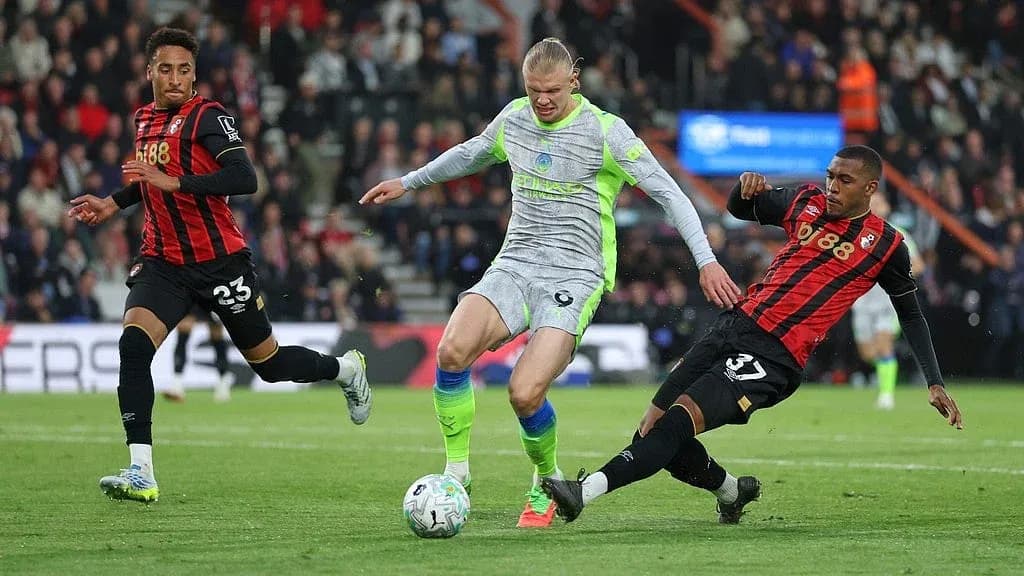
The Vitality Stadium under the lights, Anthony Taylor in charge, and a Bournemouth side that has quietly become one of the Premier League’s most awkward assignments hosting a Manchester City team still built to dominate. Following this result – a 1–1 draw after Bournemouth led 1–0 at half-time – the story of the evening is less about shock value and more about how Andoni Iraola’s evolving structure was able to bend but not break against Pep Guardiola’s machine.
Heading into this game, the table already framed the narrative. Bournemouth sat 6th on 56 points, with a goal difference of 4 (57 scored, 53 conceded in total across 37 matches), a Europa League place in their grasp. Manchester City arrived 2nd with 78 points and a formidable total goal difference of 43 (76 for, 33 against). One is a project punching above its financial weight, the other a perennial title contender; yet over 90 minutes, the gap in resources was blurred by clarity of structure and tactical discipline.
Bournemouth’s Structure
Iraola stayed loyal to Bournemouth’s seasonal identity: a 4-2-3-1 that has been used in 35 of their 37 league fixtures. D. Petrovic anchored the side in goal, shielded by a back four of A. Truffert, M. Senesi, J. Hill and A. Smith. In front, T. Adams and A. Scott formed a double pivot, with a line of three – Rayan, E. J. Kroupi and M. Tavernier – buzzing behind lone forward Evanilson.
This shape was not merely cosmetic. Bournemouth’s season data shows a team comfortable in controlled chaos: in total this campaign they have scored 57 league goals at an overall average of 1.5 per match, while conceding 53 at 1.4 per match. At home, they average 1.5 goals for and 1.1 against, with just 2 defeats in 19 home fixtures. That resilience underpinned the game plan: invite City into wide areas, compress the half-spaces where Bernardo Silva and J. Doku like to weave, and trust Petrovic plus a compact back line to deal with volume rather than clear-cut chances.
City’s Tactical Setup
Across from them, Guardiola deployed a 4-1-4-1, one of six different shapes City have used this season but also their most common, with 13 appearances. G. Donnarumma started in goal, behind a back four of N. O’Reilly, M. Guehi, A. Khusanov and M. Nunes. Rodri operated as the lone pivot, with a band of four – J. Doku, M. Kovacic, Bernardo Silva and A. Semenyo – supplying E. Haaland.
On paper, the “Hunter vs Shield” duel was brutally one-sided. Haaland came into the fixture as the league’s top scorer with 27 goals in total and 8 assists, firing 102 shots with 59 on target. City, as a collective, have averaged 2.1 goals per match overall, rising to 2.4 at home and a still-potent 1.7 on their travels. Yet Bournemouth’s defensive record at the Vitality – 20 goals conceded in 19 home matches – suggested they could at least slow the avalanche.
Absences and Tactical Adjustments
The absences added another layer of tactical nuance. Bournemouth were without R. Christie, missing through a red-card suspension, and Álex Jiménez, also suspended. Jiménez’s absence was particularly significant: he has played 31 league matches, defending aggressively with 69 tackles and 11 successful blocked shots, collecting 10 yellow cards along the way. Without him, Iraola turned to A. Smith on the right and leaned on Senesi’s authority to marshal the line. Christie’s suspension removed a high-energy, pressing midfielder – he has 27 tackles and 12 interceptions in limited minutes – forcing Bournemouth to rely more on Scott’s positional intelligence and Adams’ ball-winning to close City’s central lanes.
Discipline and Late-Game Tactics
Discipline was always going to be a subplot. Bournemouth’s season-long yellow card distribution shows a pronounced late-game surge: 26.44% of their yellows arrive between 76–90 minutes, with another 21.84% from 91–105. City, by contrast, spread their cautions more evenly, but still see 19.70% of yellows in the 46–60 and another 19.70% in the 76–90 window. This match duly tilted towards a tense, card-prone finale as Bournemouth tired and City chased, with Bernardo Silva – who has amassed 10 yellows in total this season – continuing to set the tone for City’s counter-press.
Bournemouth's Attacking Threat
If Haaland was the headline Hunter, Bournemouth’s answer lay in the fluidity of their attacking trio and the emerging quality of E. J. Kroupi. With 13 league goals this season at just 19, Kroupi has become Bournemouth’s sharpest edge, combining 21 key passes with 31 shots and 21 on target. His instinct to drift into the right half-space allowed Tavernier to underlap and Evanilson to pin Guehi and Khusanov, particularly in transitions where City’s full-backs were caught high.
Engine Room Battle
On City’s side, the “Engine Room” battle was defined by Rodri and Kovacic against Adams and Scott. Rodri’s single-pivot role allowed City to sustain pressure, but Bournemouth’s two-man screen was designed to deny him easy vertical lanes into Haaland’s feet. When City needed extra craft, Guardiola could turn to P. Foden or R. Cherki from the bench – Cherki, in particular, has 12 assists and 61 key passes this season – to add another line-breaking passer between the lines.
Statistical Overview
From a statistical prognosis standpoint, a draw feels like the meeting point of two opposing curves. City’s defensive solidity – 33 goals conceded in total at just 0.9 per match, with 16 clean sheets – usually suffocates mid-table sides. But Bournemouth are not a typical mid-table team: in total this campaign they have failed to score only 7 times, and at home they have lost just twice. Their Europa-chasing form (DWWDW in the five matches heading into this game) suggested they could match City’s own DWWDW run stride for stride, and so it proved.
xG numbers are not provided in the data, but the underlying patterns point to a contest where City likely edged shot volume and territory, while Bournemouth generated fewer but more targeted breaks. City’s away average of 1.7 goals for and 1.1 against hints they are slightly less ruthless on their travels; Bournemouth’s home averages and their compact 4-2-3-1 made that marginal drop-off count.
Following this result, the tactical takeaway is clear. Bournemouth’s 4-2-3-1 has matured into a structure capable of frustrating even the league’s most prolific Hunter, while City’s 4-1-4-1, for all its control, can still be dragged into a knife fight when denied central superiority. On this night at the Vitality, Iraola’s collective shield held just long enough to share the spoils with Guardiola’s juggernaut.
Related News
Bournemouth vs Liverpool Prediction: Key Stats and Betting Tips
Tottenham vs Aston Villa Predicted Lineups: Team News for Premier League Clash
Brighton vs Arsenal: Premier League Clash Preview
Manchester City vs Sunderland: Premier League Clash Preview
Tottenham vs Aston Villa: Early Relegation Battle
Brentford vs Chelsea Predicted Lineups: Team News and Match Insights