
Chelsea's Tactical Masterclass in 2-1 Win Over Tottenham
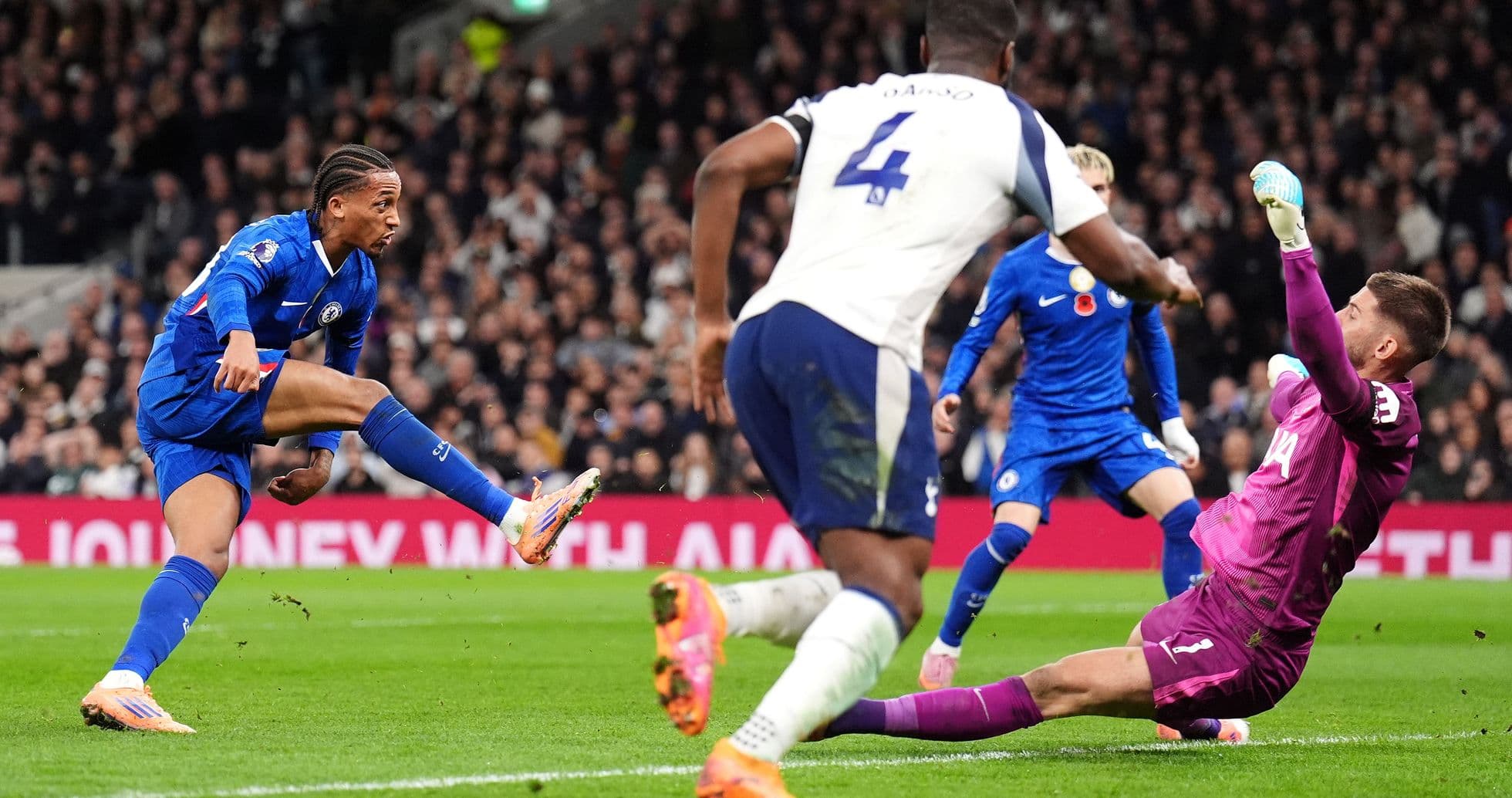
Chelsea’s 2-1 win over Tottenham at Stamford Bridge was a classic case of the side without territorial control executing a cleaner game plan in both boxes. Both teams lined up in a 4-2-3-1, but the way they used that structure diverged sharply: Chelsea turned theirs into a compact, counter-punching unit, while Tottenham leaned into a high-possession, territorial siege that never quite translated into efficient chance quality.
Out of possession, Chelsea’s double pivot of Andrey Santos and Moisés Caicedo sat very tight in front of the back four, prioritising central denial over aggressive pressing. Tottenham’s 56% possession and 538 passes (473 accurate, 88%) show they were allowed to circulate the ball, but largely in front of Chelsea’s block. The hosts accepted this trade-off, finishing with just 44% of the ball and 425 passes (355 accurate, 84%), but shaping those fewer sequences into more purposeful attacking moments.
First Goal
The first goal on 18 minutes encapsulated Chelsea’s offensive idea. With Tottenham’s full-backs high, Pedro Neto drifted into a half-space, receiving early and quickly releasing Enzo Fernandez between the lines. The move exploited the gap between Tottenham’s double pivot and centre-backs, an area Chelsea repeatedly targeted. Fernandez’s finish was one of only four shots on target all night for Chelsea, but it reflected a clear plan: attack quickly through the central lane once the initial press was beaten.
Tottenham's Defensive Structure
Tottenham’s defensive structure on paper mirrored Chelsea’s, with João Palhinha and Rodrigo Bentancur as a screening pair. In practice, their aggression without the ball undermined their control with it. Eighteen fouls to Chelsea’s eleven and three yellow cards — including bookings for Pedro Porro and Micky van de Ven for “Foul” — revealed a back line repeatedly forced into recovery defending. Destiny Udogie’s later yellow, also for “Foul”, underlined how often Chelsea’s wide players and Liam Delap were able to turn and run at a retreating defence.
Second Goal
The second Chelsea goal on 67 minutes highlighted the hosts’ superior occupation of the second line. With Tottenham pushing to equalise, Andrey Santos advanced from the pivot into the inside channel, combining with Enzo Fernandez. Tottenham’s midfield spacing was poor: one of the pivots stepped late, the other was pinned by Cole Palmer’s positioning between the lines. Santos arrived untracked to finish, a textbook third-man run that punished Tottenham’s inability to control the zone just outside their box.
Tactical Adjustments
From there, Roberto De Zerbi’s adjustments were aggressive but structurally risky. The triple substitution on 69 minutes — J. Maddison (IN) came on for R. Kolo Muani (OUT), D. Spence (IN) came on for D. Udogie (OUT), and P. M. Sarr (IN) came on for J. Palhinha (OUT) — tilted Tottenham even further towards a front-loaded, creative approach. Maddison’s introduction increased vertical passing and combination play around the box, while P. M. Sarr added late surges from midfield. That change bore fruit quickly: on 74 minutes, Sarr advanced into the right half-space and fed Richarlison, who finished to make it 2-1. It was Tottenham’s best expression of their 4-2-3-1 as an attacking platform, with the ten and advanced eight both breaking lines.
Efficiency Numbers
Yet the underlying efficiency numbers explain why Tottenham’s late pressure did not produce an equaliser. Both sides finished with nine total shots, but Chelsea managed four on target to Tottenham’s three. Spurs generated higher xG at 1.72 versus Chelsea’s 0.63, pointing to more, and on average better, shooting positions — particularly with eight shots inside the box to Chelsea’s four. However, the execution lagged behind the volume. Their final-third choices often defaulted to rushed crosses or hopeful shots rather than the extra pass to unbalance Chelsea’s back four.
Chelsea’s back line, anchored by Wesley Fofana and Jorrel Hato, was content to defend the box in numbers. Two blocked shots and a low shot volume conceded suggest that while Tottenham reached dangerous zones, Chelsea were usually able to get bodies in front of the ball or force attempts from suboptimal angles. When Tottenham did hit the target, R. Sanchez (Chelsea) made two saves. At the other end, A. Kinsky (Tottenham) also recorded two saves, but the goals prevented metric at -1.08 for both keepers underlines that each conceded more than post-shot models would expect, reflecting the high quality of the finishes rather than goalkeeping errors.
Late Substitutions
The flurry of late Chelsea substitutions — T. Chalobah (IN) came on for J. Acheampong (OUT) at 74', M. Sarr (IN) came on for W. Fofana (OUT) at 81', then A. Garnacho (IN) for P. Neto (OUT), D. Essugo (IN) for C. Palmer (OUT), and S. Mheuka (IN) for L. Delap (OUT) all at 89' — was primarily about game management and fresh legs to maintain compactness. The accompanying discipline tells its own tactical story: Jorrel Hato’s yellow for “Time wasting” at 79' and late bookings for Marc Cucurella (“Argument”), Liam Delap (“Foul”), and Dário Essugo (“Foul” at 90+2') show a Chelsea side fully committed to protecting their lead, even at the cost of increased risk of set-pieces.
Statistically, Tottenham’s profile — more possession, more passes, higher xG, more shots inside the box — is typical of a side on the front foot. But Chelsea’s ability to convert a modest xG into two goals, coupled with disciplined box defending and sharp transitional play, made their 2-1 win a product of tactical clarity rather than randomness. Tottenham controlled territory; Chelsea controlled the key moments.
Related News
Bournemouth vs Liverpool Prediction: Key Stats and Betting Tips
Tottenham vs Aston Villa Predicted Lineups: Team News for Premier League Clash
Brighton vs Arsenal: Premier League Clash Preview
Manchester City vs Sunderland: Premier League Clash Preview
Tottenham vs Aston Villa: Early Relegation Battle

Brentford vs Chelsea Predicted Lineups: Team News and Match Insights