
Sunderland's Struggles Against Huddersfield Before War
On the eve of war, Sunderland were worrying about something far more familiar – a shaky defence, a limping captain and a home defeat that stripped away early-season optimism.
Bill Murray had only just stepped into the manager’s office at Roker Park, replacing Johnny Cochrane in March 1939. He knew the place inside out, had played under Cochrane, had lived the standards that had brought Sunderland the league title in 1936 and the FA Cup in 1937. His mission was simple in theory, brutal in practice: restore a fallen giant that had slumped badly in Cochrane’s final campaign.
An opening-day win over Derby County in the 1939-40 season hinted that the climb might already have begun. Hope flickered. Then Huddersfield Town arrived.
Huddersfield expose Sunderland’s frailties
On 30 August 1939, Huddersfield walked away from Roker Park with both points and something more valuable: the sense that they were a side ready for the grind of a First Division season. Sunderland were not. Town’s organisation, discipline and balance under Clem Stephenson threw Murray’s problems into sharp relief.
From the first whistle, Sunderland’s back line looked unsure. Marking was loose, decisions hesitant. Attacks broke down before they had properly begun. The crowd of 16,315 did not need a tactical manual to see it.
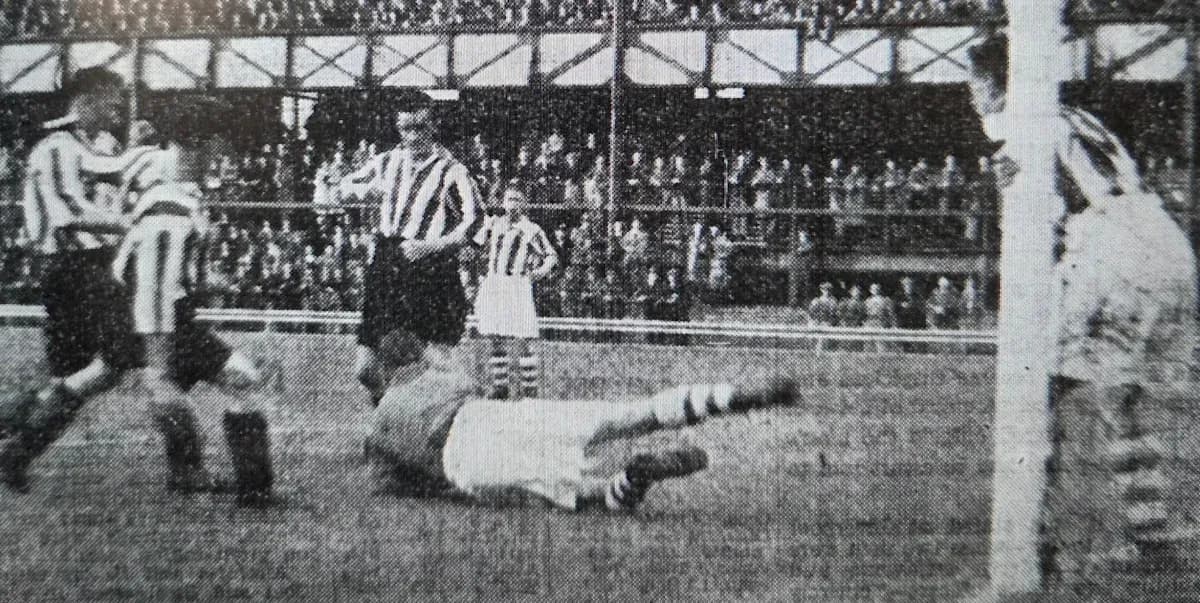
Huddersfield’s opener came early and came with controversy attached. A cross swung in, Billy Price rose to meet it, and his header flashed goalwards. Many in the ground were adamant the ball was going straight in, Price the clear scorer. The referee saw it differently, recording the goal as an own goal off Jimmy Gorman, who had challenged Price in the air. The debate did nothing to change the scoreboard: Sunderland 0, Huddersfield 1 after just four minutes.
The home side never really settled. Reports the next day pointed a finger at the officials for letting a string of borderline Huddersfield fouls go unpunished, challenges that broke up what little rhythm Sunderland could muster. Yet the more telling problem lay closer to home.
Raich Carter, the captain and creative heartbeat, took a knock and never moved with his usual glide. Once hampered, he could not dictate the game in the way Roker Park had come to expect. Worse, his teammates did not seize the moment. No one grabbed responsibility, no one filled the space Carter usually occupied between midfield and attack. The side looked strangely flat, almost waiting for him to recover rather than adapting without him.
Ironically, it was Carter who briefly dragged them level. On 33 minutes he found the equaliser, and for a spell the old noise returned to Roker Park. The game felt back in the balance. But the surge didn’t last. Huddersfield gradually reasserted control, their shape holding firm while Sunderland’s never quite snapped into focus.
The pressure finally told in the closing stages. Price, this time without any argument over the identity of the scorer, struck what proved to be the winner on 80 minutes. Sunderland had no response. When the whistle went, there were few complaints. The better side had won.
Only one home player escaped serious criticism in the following day’s press: goalkeeper Johnny Mapson. The consensus was clear – he could hardly be blamed for either goal. Around him, though, the performance underlined just how far Murray’s rebuild had to go.
Football under a gathering storm
Yet even as supporters filtered out into the Sunderland evening, grumbling about defending and a blunted attack, another question pressed in: how long would any of this matter?
Anyone who had bought a newspaper before heading to the match would have seen it immediately. The front pages were dominated not by football but by the tightening grip of international crisis and the looming prospect of a second world war.
The Sunderland Echo and Shipping Gazette carried reports of French radio being handed over to military control and ongoing, desperate diplomatic exchanges across Europe. One stark photograph showed workmen stacking sandbags in front of the Royal Infirmary. Another article laid out arrangements for helmets and respirators for local parents and children, with demonstration and collection points set up at schools across the town.
- Redby
- Hudson Road
- Cowan Terrace
- Thomas Street
- Commercial Road
- Hylton Road
- Diamond Hall
- High Southwick
- James William Street
- Barnes
were all named as venues where children would be fitted out, with specially adapted equipment prepared for infants. It was the language of preparation, of a city bracing for something far bigger than a football season.
Against that backdrop, Roker Park could never be a complete escape. Among the crowd that day were soldiers and sailors already called up for the emergency, uniforms visible on the terraces. They were given half-price entry, on the condition they used what was usually the “boys gate” to get in. Even that small detail carried a strange symbolism: grown men, about to be sent into a conflict that threatened to engulf the world, funneled through a turnstile meant for children.
The match they watched did little to lift the mood. Sunderland were beaten, subdued, their performance mirroring the unease of a community reading daily of evacuations, sandbags and gas masks. Yet some in that 16,315 would have looked around Roker Park and wondered if this might be their last visit for a long time. If so, they were determined to squeeze what they could from it.
War wipes the slate clean
Within days, events moved with brutal speed. By the time Sunderland travelled to Arsenal the following weekend, German forces had invaded Poland and a wider war felt unavoidable.
The match at Highbury went ahead, but even the kick-off time betrayed the new reality. It was pushed back to 17:00, later than originally planned, to ease the strain on public transport running on emergency timetables and to allow a hurried evacuation of children from nearby areas to be completed. Football carried on, but only just, and only in the shadow of something far more serious.
Soon, the results that had seemed so important – the win over Derby, the defeat to Huddersfield, the trip to Arsenal – were wiped from the official record. The 1939-40 season, launched with the usual hopes and arguments, simply vanished into the margins.
For Bill Murray, the job changed overnight. Instead of plotting how to tighten a back line or free Carter from the shackles of opposition markers, he found himself overseeing fitness training for troops based in County Durham. Roker Park, quickly earmarked as an evacuation zone, stood largely idle as a football ground for the next two years.
On that late August afternoon, Sunderland 1, Huddersfield Town 2 looked like a warning about a team in transition. Within a week, it was something else entirely – a final, fragile snapshot of peacetime football before the world, and the game, were forced to start again.
Related News

PSG's Senny Mayulu Injured During France U21 Match

Italy’s Giacomo Raspadori Withdraws from Nations League Ahead of France Clash

Holger Rune's First ATP Tour Match Since Achilles Injury Set at Japan Open

Liverpool Faces New Setback as Cody Gakpo Leaves Netherlands Match Early
Denmark's Brian Riemer Confirms Patrick Dorgu Injury Withdrawal from National Squad

Real Madrid Concerned as Konaté Exits France Camp with Knee Injury