
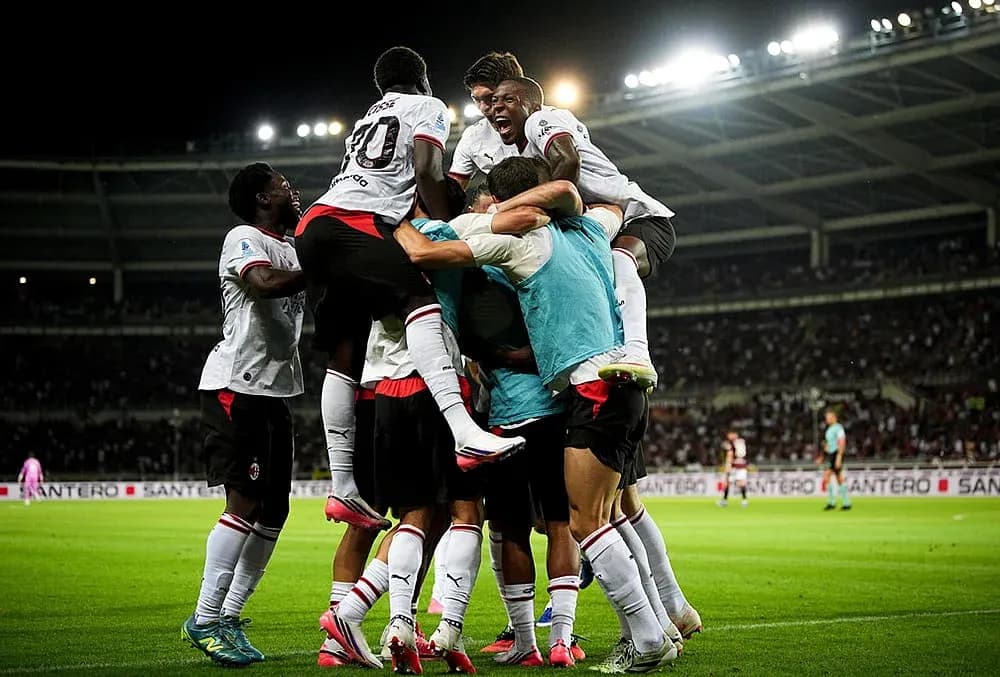
Serie A Opening Match: Torino vs AC Milan Tactical Analysis
Under the late-summer lights of the Stadio Olimpico Grande Torino, Serie A’s new season opened with a match that felt less like a curtain-raiser and more like a tactical manifesto. Torino and AC Milan mirrored each other on the board with matching 3-4-2-1 shapes, but the 2-1 scoreline to the visitors revealed how differently those systems were lived out on the pitch.
I. The Big Picture – Systems, Status, and Early DNA
Following this result, the standings tell a clear early story. Torino sit 13th with 0 points from 1 match, their overall goal difference at -1 after scoring 1 and conceding 2. At home they mirror that exactly: 1 played, 1 goal for, 2 against, no clean sheet. AC Milan, by contrast, step immediately into the top pack: 5th place, 3 points from 1 match, with an overall goal difference of +1 (2 scored, 1 conceded). On their travels, they are perfect so far: 1 away game, 1 win, 2 goals for and 1 against.
Torino’s seasonal profile after one game is stark. Overall they average 1.0 goal scored and 2.0 conceded per match, all of it at home so far. AC Milan’s numbers invert that balance: overall they average 2.0 goals scored and 1.0 conceded, entirely built on this away performance in Turin. No penalties have yet been awarded to either side this campaign, so the story is one of open-play structure rather than set-piece drama.
Both coaches doubled down on the 3-4-2-1 as their opening statement. Ignazio Abate’s Torino leaned into verticality and late attacking changes, while Ruben Amorim’s Milan used the same base shape to express control, width, and layered attacking rotations.
II. Tactical Voids – Absences and the Holes They Leave
Torino arrived with a notable handicap in depth and flexibility. F. Anjorin (hip injury) would have offered an extra creative or transitional option between the lines; his absence forced Abate to trust G. Gineitis and K. Fitz-Jim as the central engine in front of the back three. P. Pellegri’s knee injury stripped Torino of a different type of reference in attack, pushing G. Simeone into the lone striker role from the start and leaving D. Zapata and C. Adams as impact options from the bench. In goal, F. Israel’s shoulder injury meant there was no competition for D. Mascardi, while E. Comert’s suspension for a red card removed an experienced defensive piece from the back line, thrusting P. Comuzzo and S. Coco into prominent roles.
Milan’s absences were even more high-profile and reshaped the attacking hierarchy. R. Leao’s muscle injury and C. Nkunku’s inactive status removed two elite one‑v‑one and creative threats from the left and central channels. S. Gimenez’s ankle injury took away a penalty-box striker option, while F. Tomori’s absence forced Amorim to rely on a new-look back three of M. Gila, K. De Winter and S. Pavlovic. Y. Fofana’s inactive status further reduced the pool of midfield ball-winners.
Yet Milan’s squad depth softened those blows. A. Rabiot emerged from the bench to deliver both a goal and an assist, while Samuel Chukwueze carried a heavy creative load from the right, and A. Cisse stepped into the attacking spotlight as a starting forward.
Disciplinary patterns added another layer. Torino’s season card map is still blank, but Milan already show an edge in aggression: their only yellow card so far this campaign arrived between 46-60 minutes, a 100.00% concentration of their cautions in that window. R. Loftus-Cheek is both their leading yellow-card recipient and, intriguingly, also listed among the league’s red-card leaders, underlining how fine the line is in his game between force and excess.
III. Key Matchups – Hunter vs Shield, and the Engine Room
The “Hunter vs Shield” duel tilted Milan’s way. For Torino, the late introduction of C. Adams gave them their sharpest edge. In just 20 minutes, Adams scored once from a single shot on target, completing 11 passes at 72% accuracy and winning 1 of his 3 duels. He arrived as the chaos agent Milan had to solve, and his movement, combined with service from Gineitis, briefly threatened to flip the narrative.
On Milan’s side, A. Cisse and A. Rabiot formed a devastating one-two punch. Cisse, starting as one of the two attacking midfielders behind G. Ramos, delivered 1 goal from 3 shots, added 24 passes at 87% accuracy and won 6 of 10 duels. He played like a modern hybrid: part second striker, part presser, part link-man. When Rabiot stepped in from the bench, Milan’s attacking structure gained an extra layer of timing and control. In 34 minutes, he produced 1 goal and 1 assist, hit the target with his only shot, and created a key pass. His ability to arrive late in the box and still recycle possession made him the match’s quiet conductor.
Behind them, the “Engine Room” confrontation defined the tempo. Torino’s Gineitis worked tirelessly as the connective hinge. Over 90 minutes he completed 30 passes at 86% accuracy, contributed 1 assist, and won all 3 of his duels. Defensively, he added 1 tackle and crucially blocked 1 shot, underlining his box-to-box profile. Yet he and Fitz-Jim were often outnumbered or outmanoeuvred by Milan’s fluid midfield.
For Milan, Y. Musah and A. Jashari formed the central platform, with P. Estupinan and Chukwueze stretching the width. Chukwueze, in particular, was a constant problem: 2 shots (1 on target), 4 key passes and 2 successful dribbles from 2 attempts, plus 45 completed passes at 77% accuracy. His combination play with Loftus-Cheek on the right side repeatedly drew Torino’s back three out of shape.
Loftus-Cheek’s role was double-edged. As one of the two attacking midfielders, he attempted 3 dribbles (1 success), took 3 shots, and laid on 3 key passes with 20 completed passes at 100% accuracy. But he also collected Milan’s only yellow card, embodying the balance Amorim demands: aggressive occupation of half-spaces, but always on the brink of disciplinary risk.
IV. Statistical Prognosis – What This Match Says About the Season
With only one round played, the numbers are embryonic but revealing. Torino’s overall average of 1.0 goal scored and 2.0 conceded hints at a side whose attacking ideas are credible but whose defensive structure is still fragile, especially at home. The absence of any clean sheets and the fact that their biggest defeat overall is already a 1-2 at home underline that they will need to tighten the back three and protect Mascardi more effectively.
Milan, conversely, have opened with the profile of a serious contender. On their travels they average 2.0 goals scored and 1.0 conceded, suggesting a side capable of carrying threat away from San Siro without sacrificing basic solidity. They have yet to keep a clean sheet, but the balance of their 3-4-2-1 – with Chukwueze wide, Cisse and Loftus-Cheek between lines, and Rabiot ready to influence from the bench – gives them multiple scoring routes.
In xG terms, the evidence from shot volume, chance creation and key passes strongly implies Milan would have edged the underlying metrics as well. Chukwueze’s 4 key passes, Cisse’s 3 shots, and Rabiot’s goal-and-assist cameo point to a multi-source threat that is unlikely to be a statistical mirage. Torino, by contrast, leaned heavily on late impact from Adams and isolated moments from Simeone, rather than a sustained wave of chances.
Following this result, the tactical verdict is clear. Torino’s 3-4-2-1 is a brave blueprint but currently exposes their back line and demands near-perfect days from Gineitis and the wing-backs to hold. Milan’s mirrored system, however, is already functioning as a sophisticated, layered machine – one that, even without Leao and Nkunku, can travel to a hostile ground, bend the game to its rhythm, and leave with both the points and a convincing statistical footprint.
Related News
Napoli vs. Frosinone Stats: Head-to-Head Record and Historical Context
Inter vs Parma Stats: Head-to-head Record Ahead of October 2026 Match

David Alaba Set to Join Udinese in Surprising Serie A Transfer
AC Milan's Tactical Dominance Revealed in 3-0 Victory Over Lecce
Juventus vs Atalanta: Serie A Showdown Highlights
Frosinone's Tactical Mastery Secures 2–0 Victory Over Como