
Remembering John Thomson: Celtic's Prince of Goalkeepers
“Tragedy” gets thrown around carelessly in football. It’s used for late goals, lost finals, bad refereeing calls. On 5 September 1931, at Ibrox, the word finally met its true weight.
That afternoon, Celtic’s 22‑year‑old goalkeeper John Thomson went out to play an Old Firm league match and never came home. Many who knew him would say that two lives were effectively ended that day – Thomson’s, and that of Rangers forward Sam English, who carried the memory for the rest of his days.
From Fife pit village to Celtic’s number one
John Thomson was born on 28 January 1909, not in Cardenden as many still believe, but in Kirkcaldy. His association with the mining village came almost immediately; his family moved there during his first year, and Cardenden became the place that shaped him.
The pits framed his childhood and his first job. As a teenager he went down Bowhill Colliery, working as a labourer like so many boys around him. The mine offered wages, not escape. Football might.
He stood out at school level, but his name really began to circulate in the Juniors. Bowhill Rovers gave him his first platform, Wellesley Juniors his first real reputation. By 1925, local reporters were tipping this wiry, fearless youngster for the very top.
Trial games followed with Raith Rovers and Cowdenbeath. Neither moved. The decisive moment came in October 1926, when Celtic scout Steve Callaghan turned up at an East of Fife Cup tie against Denbeath Star to watch another goalkeeper. He left talking only about Thomson.
On 1 November 1926, Celtic signed the 17‑year‑old for £10. The story has passed into club folklore: the contract inked on top of a fuse box, the tramcar journey used to convince the shy Fifer that his future lay not in the Fife coalfield but in Glasgow’s east end.
A meteoric rise in green and white
Thomson’s Celtic debut arrived on 12 February 1927 at Dens Park. Celtic beat Dundee 2–1 and the teenager impressed supporters and staff alike. Yet what stuck with those close to him was his reaction to the goal he conceded. He blamed himself. He promised to be better.
That drive quickly bore fruit. He helped Celtic lift the 1927 Scottish Cup, a 3–1 win over East Fife in front of almost 80,000 at Hampden. Four years later he collected a second Scottish Cup medal, this time in 1931 after a 4–2 replay victory over Motherwell, following a 2–2 draw in the first match.
By then, Thomson had become a fixture. Between 1927 and 1931 he played 188 times for Celtic, adding three Glasgow Cup medals and cementing his status as the club’s first-choice goalkeeper.
Scotland soon followed. Between 1930 and 1931 he won four caps, keeping three clean sheets and conceding only once – an extraordinary record for a keeper so young. His debut in Paris brought a 2–0 win for Scotland. His final appearance, a 2–0 victory over England at Hampden in front of 131,000, underlined his stature.
He also represented the Scottish League XI four times. English clubs watched closely; Arsenal, in particular, were said to be eager to tempt him south.
Why the fuss? Thomson combined agility with a rare courage. This was an era when goalkeepers received little protection and collisions with onrushing forwards were part of the job. He never flinched. That bravery thrilled supporters and terrified his mother. After a serious injury against Airdrie in 1930, her fears hardened. She worried that one day he would not get up.
The Old Firm match that changed everything
On the morning of 5 September 1931, Thomson left his flat in Victoria Road, his Glasgow base, and headed across the southside towards Ibrox. Celtic against Rangers. Old Firm league duty.
By half-time, the game sat goalless. Thomson had been typically assured, steadying Celtic’s back line and giving his teammates the confidence to push forward against their Light Blue rivals.
Then, early in the second half, the moment that would define the day.
Sam English broke clear through the Celtic defence. Thomson surged from his line, throwing himself at the forward’s feet in a desperate attempt to smother the ball. Both men went full-blooded into the challenge. English’s knee or boot caught Thomson on the head.
Collisions like that were common then. At first, many in the crowd thought he was just dazed.
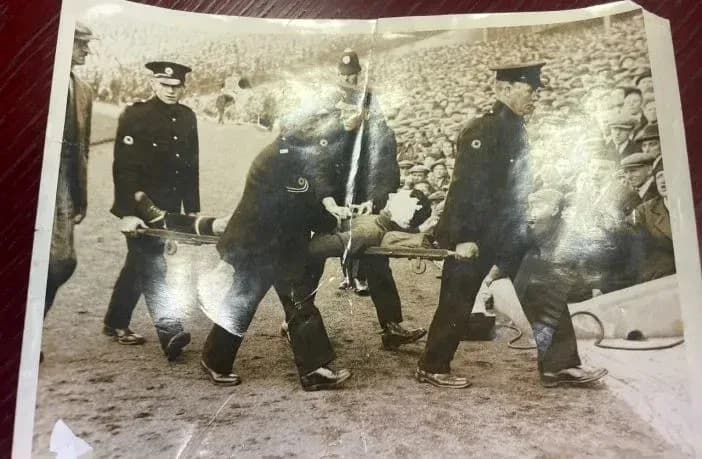
The mood turned quickly. Thomson lay motionless. Medical staff sprinted on. He was lifted onto a stretcher and carried away. In a decision that jars with modern sensibilities, the match went on. With no substitutes allowed, Celtic defender Chic Geatons, another Fifer, pulled on the goalkeeper’s jersey.
The game drifted to a 0–0 draw, but the football had lost all meaning.
A life lost, a game in shock
Thomson was rushed to the Victoria Infirmary. Doctors fought to save him but the damage was too great. He had suffered a fractured skull and severe brain injuries.
A car sped his parents from Fife to Glasgow. Shortly after they arrived at the hospital, their son died. He was 22.
An inquiry later ruled the death accidental. Those who saw the incident – officials, players, witnesses – agreed: English had done nothing malicious. Both men had committed fully to the ball. The outcome was a terrible twist of fate.
Scottish football reeled. Celtic fans mourned. Rangers supporters mourned. Neutrals mourned. A memorial service at Trinity Church in Glasgow’s west end drew such a crowd that police had to help the Celtic and Rangers teams, including Sam English, through the throng to get inside.
Cardenden says goodbye
On 9 September 1931, Cardenden buried its most famous son. Around 40,000 people attended the funeral, with thousands travelling from Glasgow. Some walked the 55 miles to Fife.
His Celtic teammates carried the coffin. Their grief was visible, raw.
The gravestone that marks his resting place carries the line:
“They never die who live in the hearts they leave behind.”
The words have become inseparable from his story, repeated down generations of Celtic supporters who make the journey to that quiet corner of Fife.
The tragedy did not end with Thomson. Sam English continued his career but never escaped the shadow of that day. He faced taunts from opposition fans despite the fact that Thomson’s parents publicly forgave him and insisted he bore no blame.
A legacy that refuses to fade
Celtic struggled in the months after his death, on the pitch and off it. Eventually, Canadian goalkeeper Joe Kennaway took over the position, but nobody at the club truly replaced John Thomson.
His memory wove itself into Celtic’s identity. Poems and songs were written in his honour and still echo around the club. Writers returned to his story again and again. Supporters kept visiting Cardenden, some tying charity events and fundraising efforts to his grave.
Decades on, the details of the match may blur, the old black‑and‑white photographs may fade. The central truth does not.
John Thomson died playing for Celtic. For a club and support that still call him their “Prince of goalkeepers”, the loss of that young man will always matter more than any result, any trophy, any argument over footballing glory.
Related News
Chelsea's Defending Crisis: From Thrilling Offense to Sobering Defeat
Chelsea Faces Late Injury Blow with James and Joao Pedro Out

FC Groningen Dominates PEC Zwolle in 3-0 Victory
Brentford 3-0 Chelsea: Igor Thiago Ends Drought as Bees Surge
Parma vs Genoa: Serie A Strugglers Seek First Win

Everton vs Ipswich Town: Moyes’ Men Seek Momentum Against Newcomers