
Raphinha's Transformation: From Ballon d’Or Snub to Champions League Star
Raphinha was supposed to be yesterday’s story.
A winger with fragile hamstrings, a World Cup wrecked, a Ballon d’Or snub that felt like the closing of a window rather than the start of something new. Sixty goal contributions in 2024-25, then the body gave way: 125 days out, the total slashed to 29 the following season. The kind of drop-off that usually gets remembered as a peak, not a platform.
Hansi Flick never bought that version.
He dragged Raphinha inside, away from the touchline and into the heart of Barcelona’s attack, and watched the Brazilian tear the script in half.
From Ballon d’Or snub to Champions League statement
Raphinha didn’t even make the 30-man shortlist for this year’s Ballon d’Or. For Flick, that omission was an insult, not an oversight.
“He is far too good not to be on that list, but we can’t change it,” the Barça coach said, speaking with the calm of a man who already knew what was coming.
Minutes earlier, Raphinha had ripped Feyenoord apart in the Champions League.
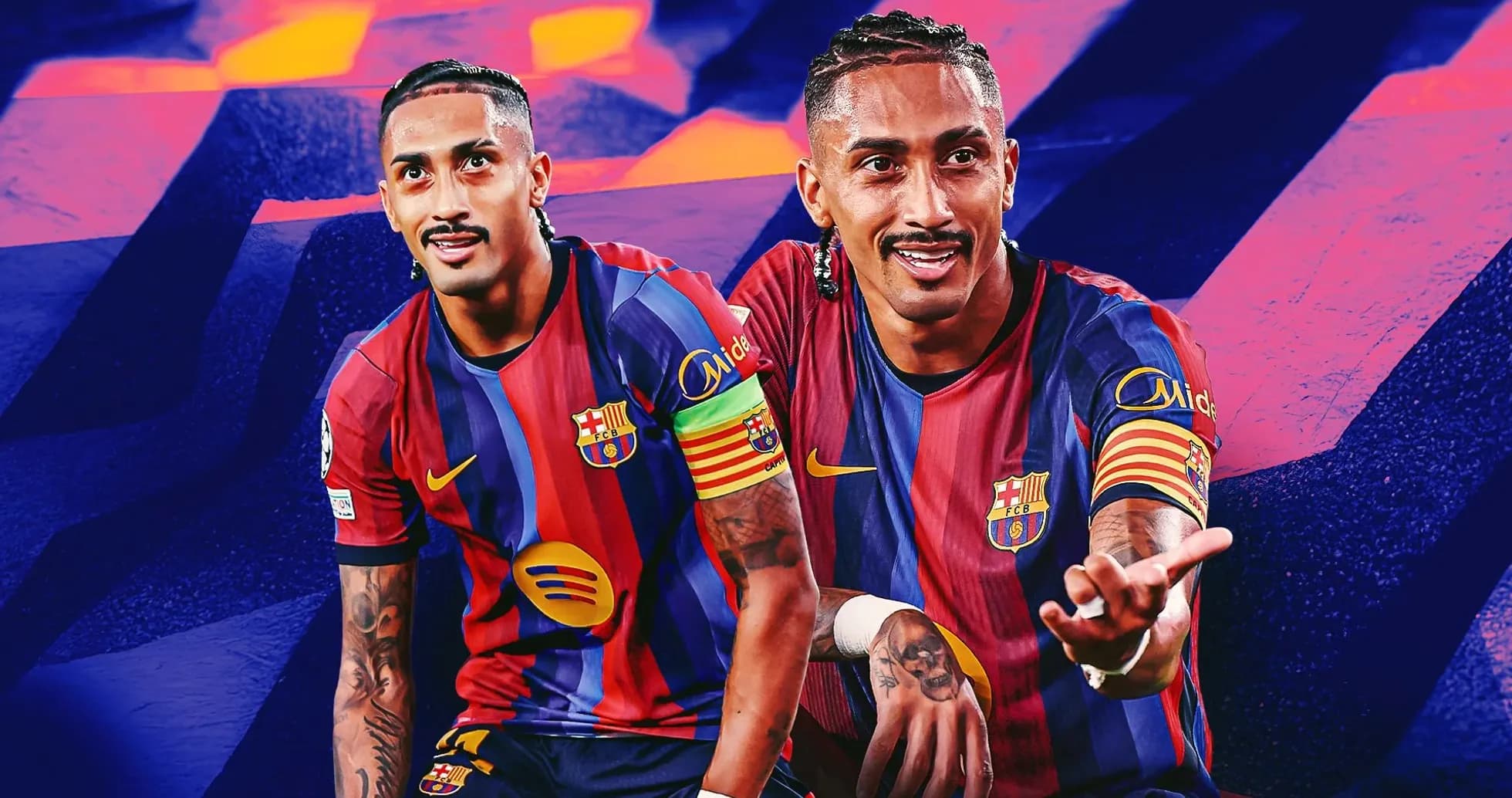
His first goal was pure theatre. He collected a slightly wayward pass from Lamine Yamal, danced past one defender, surged into the box, shaped to shoot, then simply removed the ball from the picture. The dummy left two more Feyenoord players on the turf, staring at empty space, while Raphinha rolled the finish into the corner as if he’d slowed time.
The second was a centre-forward’s masterclass. He initially moved towards Dani Olmo as the Spaniard picked up the ball in the centre-circle, then exploded in the opposite direction, shaking off his marker. Olmo’s pass hit him in stride. One touch to set, one to flash the ball across the helpless goalkeeper.
Barça won 5-1. Raphinha took Player of the Match. And suddenly the man who once hugged the left touchline looked like the most dangerous No.9 in Europe.
“Rapha has played fantastic,” Flick said. “He’s on another level – he’s unbelievable.”
Right now, the numbers agree.
A start no Barça forward has matched in 60 years
Raphinha already has 11 goals this season. No Barcelona player in the last six decades has started a campaign like that.
Not even Lionel Messi.
Messi hit 10 in his first seven games of 2012-13 and reached nine by the same stage in two other seasons. Ronaldo Nazário got to nine in 1996-97. Raphinha has gone past them.
His transformation through the middle is the hinge on which this new Barça attack swings. Robert Lewandowski gave them a classic reference point with his back to goal. Ferran Torres offered sharp movement and timing in behind. Raphinha brings something else: a roaming, restless focal point for Flick’s fluid system.
The 29-year-old drifts between the lines, always on the half-turn, always looking to drag centre-backs into places they don’t want to go. His acceleration and close control rip little holes in defensive blocks. His passing and awareness stitch Barça’s attacks together.
He creates space for Yamal and Anthony Gordon to stay wide and isolate full-backs. Then, when defenders finally glance towards the wings, Raphinha is already darting into the blind spot, one step ahead, demanding the killer ball.
Hat-trick, high press and a team built in his image
Racing Santander felt the full force of it in La Liga.
Barça smashed them 7-2. Raphinha walked off with the match ball.
Two of his goals came from the penalty spot. The middle one told the story of his new role. Again, Olmo found a pocket, again he looked up, and again Raphinha was exactly where a top striker should be – ghosting between centre-backs, waiting for the pass. One touch to control, a half-volley steered into the corner. No fuss, no wasted motion.
On the ball, he makes the game look easy. Off it, he makes it look exhausting.
Barça’s press starts with him. He sprints, doubles back, closes angles, forces hurried clearances and bad decisions. He sets the intensity Flick demands. When your captain is the one running hardest, everyone else has to follow.
It’s no surprise, then, that Flick is quietly relieved the club never pushed through a deal for Julián Álvarez. The front line is humming without another big-name striker. With Raphinha leading the press and the line, Barça can spend their money elsewhere in the next windows.
Chasing a ghost: the Ronaldo benchmark
Barcelona know what a Brazilian phenomenon looks like. Romário, Rivaldo, Ronaldinho, Neymar – each lit up Camp Nou in their own way. Yet one season still towers above the rest.
Ronaldo’s.
In 1996, a 20-year-old Ronaldo arrived from PSV for a then-world record $19.5 million and tore La Liga to pieces. Forty-seven goals in 49 games. Copa del Rey, UEFA Cup Winners’ Cup, Supercopa de España. Thirty-four league goals, the Pichichi Trophy, the European Golden Shoe, and the 1997 Ballon d’Or.
He didn’t just score. He terrorised. That solo run against SD Compostela, the hat-trick in the 4-3 comeback against Atlético Madrid in the Copa del Rey – those were the nights that turned him into ‘R9’.
“He is the most spectacular player I’ve ever seen,” Sir Bobby Robson said. Laurent Blanc added: “I’ve never seen anyone with that velocity and power. He was like a freight train coming at you with a ball at his feet.”
Ronaldo was a fixed spearhead. Raphinha is more of a moving storm. But the instincts are similar: ruthless finishing, direct running, a refusal to waste chances or touches. The comparison is no longer outlandish. If Raphinha sustains this level, matching Ronaldo’s output over a season is no longer a fantasy – and the trophy haul could be even heavier.
Mindset of a captain, hunger of a rookie
What makes it all more dangerous is that Raphinha doesn’t act like a star who’s arrived.
“I will never say I am performing well; I always strive to improve everything I can,” he said after the Racing rout. “I am happy with the goals, and with the win, and that is the most important thing, but we have to keep improving.”
He also made it clear how comfortable he feels in this new central role, and how much of that is down to Flick.
“He is the coach who changed the way I think and how I see myself,” Raphinha said. “I am extremely grateful.”
That relationship has already altered Barça’s internal hierarchy. A year ago, it looked likely Raphinha would be sold. Two underwhelming seasons under Xavi, no guaranteed starting spot, a club in need of funds – the exit door seemed obvious.
Flick slammed it shut.
When Marc-André ter Stegen left on loan to Ajax in the summer, Flick didn’t hesitate. He handed the armband to Raphinha, making him the first Brazilian captain in Barça’s history. It felt bold at the time. It looks inspired now.
He plays like a man who understands what it means. He snarls into duels, sprints after lost causes, drags his team up the pitch when games drift. The younger players see a captain who doesn’t hide and doesn’t coast. That matters.
Depth, protection and a frightening partnership
The most striking part of all this? Barça are not overly dependent on him, at least not structurally.
Gordon, Karim Adeyemi and Gabriel Jesus have all settled quickly after their summer arrivals. Flick has also promoted 18-year-old Egyptian striker Hamza Abdelkarim from Barça B, adding another profile to his front line.
“Raphinha, Gabby and Hamza are three different profiles, but there are other ways we could play,” Flick has said. “Anthony and Karim can also play in this position (as striker). Or Dani Olmo. Dani has showed us in last two years he can play there – the same with Fermin [Lopez]. We have a lot of options.”
Those options give Flick the freedom to protect his captain. Raphinha has been subbed early in the Champions League win over Feyenoord and in league victories over Athletic Club and Racing. After last season’s hamstring problems, no one at the club wants to test his limits again.
The same caution applies to Yamal, who has moved closer to Raphinha on the pitch and looks even more devastating for it. Their understanding is almost telepathic. The moment a centre-back shifts his body towards Yamal, the teenager slips a pass into the channel, trusting that Raphinha is already on the move behind the line.
There’s no visible ego clash. Yamal seems content to let Raphinha take centre stage as the main man, while Flick’s dressing room hums with a collective energy that feels more important than any single star.
Raphinha stands at the centre of it all – captain, goalscorer, first presser, reference point and role model. The latest in a long line of Brazilian artists at Camp Nou, but one writing his story from a different position and with a different responsibility.
Ronaldo’s lone season in blaugrana remains the gold standard. The question now is simple: if Raphinha keeps this up, how long before his name is etched alongside R9’s in Barcelona’s Hall of Fame – and how much silverware will be sitting beside it?
Related News
Derby Weekend in the EFL: Tension and Rivalries
Raphinha's Transformation: From Ballon d’Or Snub to Champions League Star
Xabi Alonso Keeps Chelsea Guessing Ahead of Brentford Clash
Sam Hutchinson: From Chelsea Wonderkid to Heart Attack Survivor
Barcelona vs Sevilla: Expect Goals and a Barcelona Win
Arsenal Injury Update: Arteta Comments on White and Mosquera Ahead of Brighton Clash