
Raphinha's Transformation Under Hansi Flick: A New Era for Barcelona
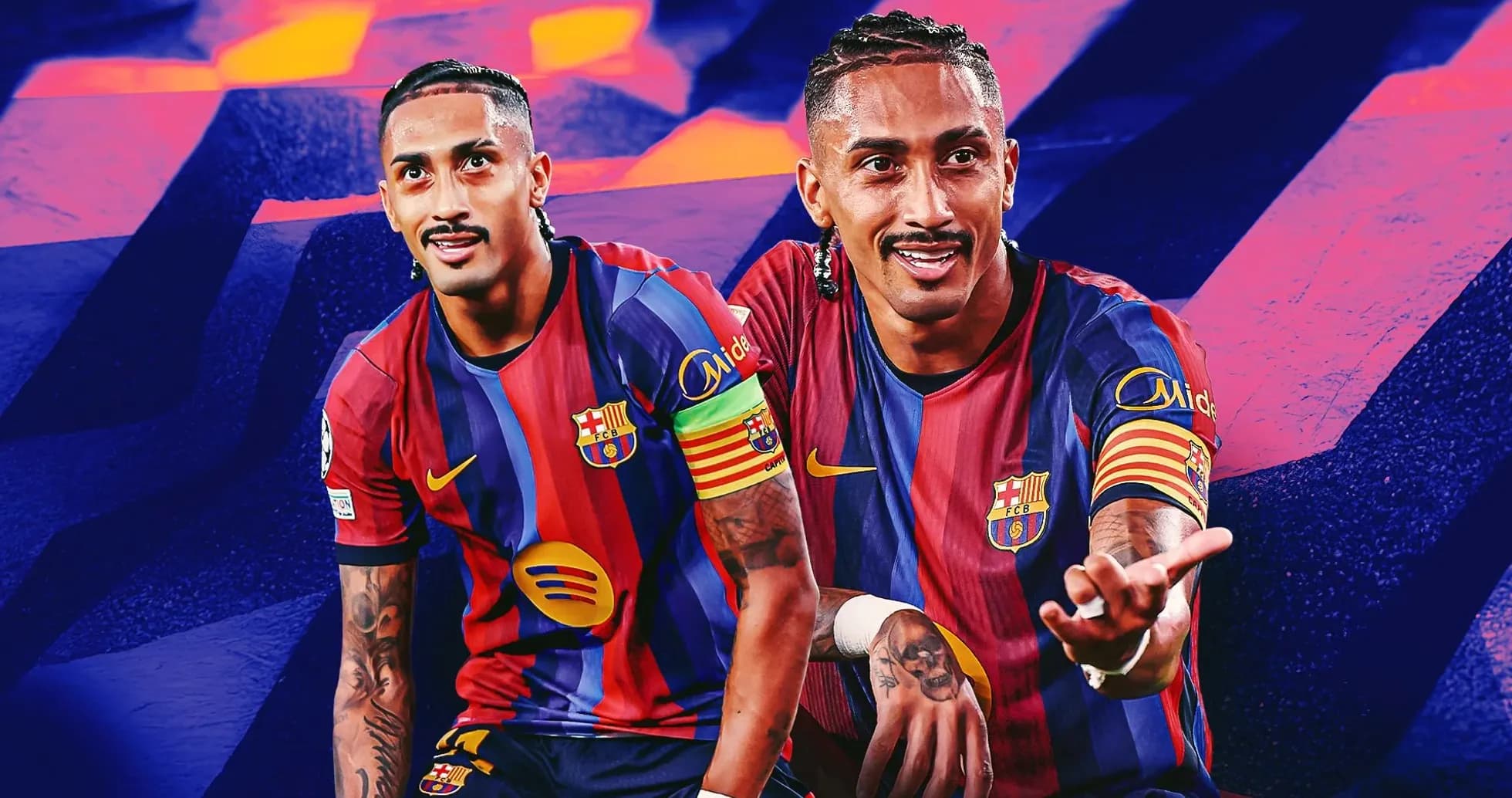
Raphinha’s reinvention under Hansi Flick is turning into the story of Barcelona’s season – and maybe of European football’s, too.
Twelve months ago, he was a winger with bad hamstrings, a Ballon d’Or near-miss and a World Cup wrecked by injury. Now he is the heartbeat of Flick’s new Barça, a roaming centre-forward who scores like a No.9 and works like a No.6.
From sidelined star to central force
Raphinha’s 2024-25 campaign was Ballon d’Or material: 60 goal contributions, constant menace, one of Europe’s most decisive wide men. It still wasn’t enough to get his hands on the trophy.
Then came the crash. Persistent hamstring problems stole 125 days of his season, cut his output to 29 goal contributions and shredded his World Cup. The spotlight moved on. The Ballon d’Or list did too – this year he didn’t even make the 30-man shortlist.
That snub hit a nerve at Barça. Flick didn’t bother hiding it.
“He (Raphinha) is far too good not to be on that list, but we can’t change it,” the coach said, speaking with the conviction of a man who has seen something shift in front of his own eyes.
Because Flick hasn’t just revived Raphinha. He has rebuilt him.
No longer chained to the touchline, the 29-year-old has been pushed into the middle. From there, he drifts between the lines, darts into channels, links with the wingers and finishes like a natural striker. The move has detonated his season.
A Champions League statement
The clearest proof came in the Champions League opener against Feyenoord, where Raphinha didn’t just score twice – he owned the night.
His first goal was pure theatre. A slightly loose pass from Lamine Yamal should have killed the move. Instead, Raphinha danced around one defender, drove into the box, shaped to shoot, then sold an outrageous dummy that left two more Feyenoord players on the turf. With the path finally clear, he rolled the ball into the corner as if it were a training drill.
The second was straight from a centre-forward’s manual. He initially checked towards the ball when Dani Olmo picked it up near the centre-circle, then spun and burst away in the opposite direction. One sharp, vertical pass from Olmo, one clean stride, one ruthless finish across the keeper. Textbook movement. Cold execution.
Barça ran out 5-1 winners and Raphinha walked off with the Player of the Match award. It felt like a declaration: he wasn’t just back in Europe, he was back to being unplayable.
“Rapha has played fantastic,” Flick said afterwards. “He’s on another level – he’s unbelievable.”
Right now, the numbers agree.
Chasing history in a legendary shirt
Raphinha already has 11 goals this season – a mark no Barça player has reached this quickly in the last 60 years. Not Lionel Messi. Not Ronaldo. No one.
Messi hit 10 in his first seven games of 2012-13, and reached nine at the same stage in two other seasons. Ronaldo matched nine in 1996-97. Raphinha has gone past them.
That explosion is why Barça suddenly look like a different beast. Robert Lewandowski brought classic hold-up play. Ferran Torres stretched defences with his runs in behind. Raphinha gives Flick something else entirely.
He roams. He sprints into half-spaces, drops short, spins away, drags centre-backs into places they hate. His speed and technique unhinge defensive structures, creating room for Yamal and Anthony Gordon to isolate full-backs out wide. When that space opens for him instead, he attacks it first, faster and harder than the defenders reading the play.
The Racing Santander game in La Liga underlined all of that. Barça won 7-2. Raphinha left with the match ball.
Two of his goals came from the spot, but the one in between was a masterclass in timing. Olmo again pulled the strings, lifting his head as Raphinha ghosted between Racing’s centre-backs. No dramatic run, no arm waving – just a subtle drift into the blind spot. The pass arrived, Raphinha cushioned it with one touch and then guided a half-volley into the corner. Simple to the eye. Anything but simple to execute.
On the ball, he makes the game look slow. Off it, he never stops.
Barça’s press starts with him. He harries centre-backs, chases lost causes, forces hurried clearances. That relentlessness is exactly what Flick demands from his front line. The coach wanted intensity and dynamism with a clinical edge. Raphinha is delivering all three.
Somewhere in the background, the club’s failed pursuit of Julian Álvarez suddenly looks like a blessing.
The Brazilian benchmark: R9’s shadow
Barcelona know what a Brazilian superstar looks like. Romario, Rivaldo, Ronaldinho, Neymar – the lineage is rich. Yet one season still towers over the rest: Ronaldo’s year of chaos in 1996-97.
Arriving from PSV for a then-world record $19.5m fee at just 20, Ronaldo ripped La Liga to pieces. Forty-seven goals in 49 games. Copa del Rey, UEFA Cup Winners’ Cup, Supercopa de España. Defenders bounced off him. Goalkeepers were reduced to props.
He took the Pichichi with 34 league goals, claimed the European Golden Shoe and topped the 1997 Ballon d’Or vote. The highlights reel from that season alone could fill a museum: the slaloming solo run at SD Compostela, the hat-trick in the 4-3 Copa del Rey comeback against Atlético Madrid.
“He is the most spectacular player I’ve ever seen,” Sir Bobby Robson said. Laurent Blanc called him “a freight train coming at you with a ball at his feet.”
Ronaldo – ‘R9’ to the world – was a fixed spearhead, the pure reference point at the tip of the attack. Raphinha is more fluid, more hybrid. Yet the similarities are hard to ignore.
He shares Ronaldo’s directness, that instinct to knife through a defence in seconds, and the same cold eye for goal. If he sustains this level, matching his compatriot’s output over a season no longer sounds fanciful. With the right support, he might even turn it into something greater in terms of trophies.
A captain reborn by Flick
The mindset is already there. After his hat-trick against Racing, Raphinha refused to indulge in self-congratulation.
“I will never say I am performing well; I always strive to improve everything I can,” he said. “I am happy with the goals, and with the win, and that is the most important thing, but we have to keep improving.”
He spoke of feeling “comfortable” through the middle and pointed directly to Flick for reshaping his game.
“He is the coach who changed the way I think and how I see myself,” Raphinha added. “I am extremely grateful.”
That relationship has changed the course of his Barça career. Under Xavi, Raphinha never fully convinced. Two underwhelming seasons, flashes of quality, but no guaranteed place. By the summer of 2024, a departure felt likely.
Flick blocked that path. He saw potential, not a failed signing. He gave Raphinha responsibility, trust and a central role in his project.
When Marc-André ter Stegen left on loan for Ajax, Flick didn’t hesitate. He handed Raphinha the captain’s armband permanently. The first Brazilian ever to wear it at Barça.
So far, the gamble looks inspired. Raphinha leads by volume and by example: snarling in the press, sprinting back to cover, demanding the ball when the game drifts. Younger players see a star who works like a squad player. That matters in a dressing room full of talent.
Firepower everywhere – but one clear leader
On paper, losing Lewandowski and Torres, then allowing Marcus Rashford to return to Manchester United, should have weakened Barça’s attack. Instead, the front line is humming.
Raphinha is the focal point, but he is not alone. Gordon, Karim Adeyemi and Gabriel Jesus have all settled quickly. Flick has also promoted 18-year-old Egyptian striker Hamza Abdelkarim from Barça B, adding another profile to his forward mix.
“Raphinha, Gabby and Hamza are three different profiles, but there are other ways we could play,” Flick said. “Anthony and Karim can also play in this position (as striker). Or Dani Olmo. Dani has showed us in last two years he can play there – the same with Fermin [Lopez]. We have a lot of options.”
That depth is crucial for one reason: Raphinha’s body has betrayed him before. Flick is determined not to let it happen again.
The Brazilian has been substituted early in the Feyenoord match and in league wins over Athletic Club and Racing, the minutes carefully managed. The message is clear – Barça will not burn their captain out in September and October.
The same caution applies to Yamal. The teenager looks even more dangerous when he plays closer to Raphinha, their understanding sharpening with every game. One glance, one subtle movement, and they carve teams open.
The pattern is already familiar. A centre-back shifts his body towards Yamal, wary of the dribble. In that instant, the youngster slips a pass into the channel, trusting that Raphinha has already darted into the blind spot. Most of the time, he has.
Yamal seems content to let the Brazilian carry the spotlight. Flick, for his part, has a dressing room full of stars and no visible ego problem. The collective edge is obvious. The squad looks like it believes it can do something big, and that belief is being forged on the training ground as much as on matchdays.
At the heart of it all stands Raphinha – captain, finisher, first presser, and the sharpest symbol of Flick’s new Barça.
The club’s Hall of Fame already has a place for R9. If Raphinha keeps this up, how long before he’s sitting right beside him?
Related News
Tottenham's Struggles Under De Zerbi: A Blueprint for Scoring
Mikel Arteta's Right-Back Dilemma: Managing Arsenal's Defensive Depth
Raphinha's Transformation Under Hansi Flick: A New Era for Barcelona
Tottenham's Scoring Struggles: De Zerbi's Challenge
Maty Ryan Dropped from Socceroos Squad for Brazil Matches
Celtic's Defensive Chaos Exposed Again by Ferencvaros in Europa League