
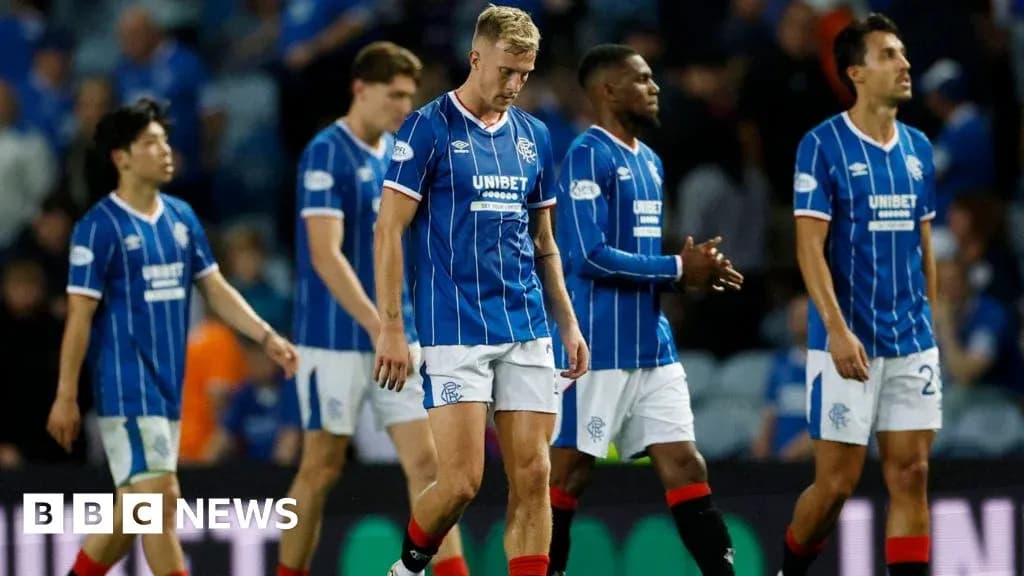
Rangers' Financial Struggles and Fan Loyalty Under Threat
The warning landed like a punch.
“Be very careful – as much as we're loyal, if this rot continues, the atmosphere in the crowd will lead to people not turning up and buying what you're selling us.”
One shareholder, one microphone, 800 Rangers investors listening. The words were sharp, the applause even sharper. It was a message aimed straight at the club’s new US owners – and it came four days before those same fans watched Rangers limp out of the Europa League with a 1-1 draw against Jagiellonia Bialystok at Ibrox.
The timing could hardly have been worse.
A stuttering start, a restless crowd
Under Derek McInnes, Rangers have stumbled out of the blocks. Four games, two draws, two defeats. A Europa League exit at home to modest opposition. A team that looks unsure of itself, and a manager still trying to work out what works and what very clearly doesn’t.
The football is faltering. The finances cannot afford to.
Inside the boardroom, there will be no illusions. The new consortium needs the support of those shareholders and the wider fanbase every bit as much as McInnes needs points. If supporters decide they are no longer “buying what they’re selling”, the numbers simply stop adding up.
Rangers have been here before. Previous regimes discovered, expensively, that loyalty has limits. Once trust goes, revenue follows it out the door.
Winning fixes a lot of problems. It fills seats, drives commercial deals, makes investors bolder. It also opens the door to the money that really matters in Scottish football.
Europe and the transfer market: the two lifelines
Strip away matchday income and the financial engine for clubs like Rangers comes from two places: Europe and player trading.
Over the last five years, Rangers have brought in around £18m from European participation alone. In their most recent accounts, that was roughly 19% of total turnover. That is not a side income. That is a pillar of the business.
The Europa League exit bites hard. To reach similar figures this season, Rangers would need to go all the way and win the Europa Conference League.
Kieran Maguire of the Price of Football website set out the brutal arithmetic: “For every pound you make in the Europa Conference League, you can make £2 in the Europa League and £7 in the Champions League.
“And of course in the Conference League you're only playing three home games as opposed to four in the Europa League, so there will be a loss of matchday income as well.
“On the positive side, if you do qualify for the Europa Conference League stage, you should have a better chance of progressing further.”
First, of course, Rangers must get there. They still have to beat Czech side Jablonec over two legs to even reach the league stage and give themselves the chance to go deep in the competition.
Even if they do, the numbers are sobering. The club could be staring at a shortfall of around £8m from European football compared with recent seasons. For an English Premier League side, that might be inconvenient. In Scotland, it is a problem that needs solving.
That throws the spotlight onto the other major lever: player trading. It is a lever Rangers have not pulled well for some time.
Reports suggest the club recently rejected an offer in the region of £22m for striker Youssef Chermiti, only for the forward to suffer a serious injury that may rule him out for the rest of the season. A fee of that size would have gone a long way towards softening the financial blow of their Europa League exit. Instead, it now sits in the “what if” column.
Behind Chermiti, Nico Raskin is widely viewed as the next most valuable asset. The Belgian midfielder is currently valued at around £14.5m by Transfermarkt. Cashing in on him would bring in significant funds, but it would also rip out a key part of the team and create another hole to fill in a squad already criticised for its churn.
Investment, promises and uneasy questions
The board has not been idle. A recent share issue raised £16m in fresh capital, with the clear message that the money would be used to strengthen the team. At the same time, the club has unveiled plans to refurbish Ibrox and upgrade the training ground – projects that will not come cheap.
Layer that on top of a recruitment drive that has seen more than 20 players arrive in the past 12 months, and the picture becomes more complicated. Supporters are entitled to ask where the money has gone, and whether the squad on the pitch reflects the investment off it.
The new consortium – many of whose members remain unnamed publicly – injected an initial £20m when they took control a year ago. With European income dipping and costs stacking up, it looks increasingly likely they will need to reach into their pockets again before the year is out.
Whether they are willing to do so at the required scale is an open question. The mood music from the club is that recent poor results have not altered their long-term financial outlook or their ambition to win regularly and do it sustainably.
But ambition and delivery are different things. And the fans have already heard the apologies.
Loyalty under strain
That shareholder’s warning hangs over everything.
Yes, the owners have admitted mistakes. Yes, they have promised to learn from them. Yet apologies only carry weight if supporters can see evidence of change – in performances, in recruitment, in clear, coherent decision-making.
Chris Jack of the Rangers Review summed up the tension when he spoke to BBC Scotland News.
“You cannot knock the loyalty and support the Rangers fans have given the club over many, many years, but every individual fan or fan base has a breaking point.
“They're going to have a point where they say 'actually, I don't fancy it this afternoon and it's time for the club, the players and the manager to give me something.'”
For years, anger has been the default setting at Ibrox when things go wrong. Anger at boards, at managers, at players. Anger, at least, is active. It still turns up.
Now, in some corners, that anger is starting to cool into something more dangerous: apathy.
In football, apathy is toxic. It empties seats, kills atmosphere, flattens commercial value. It is the one cost this ownership group cannot afford to ignore.
The warning has been delivered, loudly and in person. The question now is simple: will Rangers act before their most valuable asset – their own support – decides it has had enough?
Related News
PSG's Senny Mayulu Injured During France U21 Match
Italy’s Giacomo Raspadori Withdraws from Nations League Ahead of France Clash
Holger Rune's First ATP Tour Match Since Achilles Injury Set at Japan Open
Liverpool Faces New Setback as Cody Gakpo Leaves Netherlands Match Early
Denmark's Brian Riemer Confirms Patrick Dorgu Injury Withdrawal from National Squad
Real Madrid Concerned as Konaté Exits France Camp with Knee Injury