
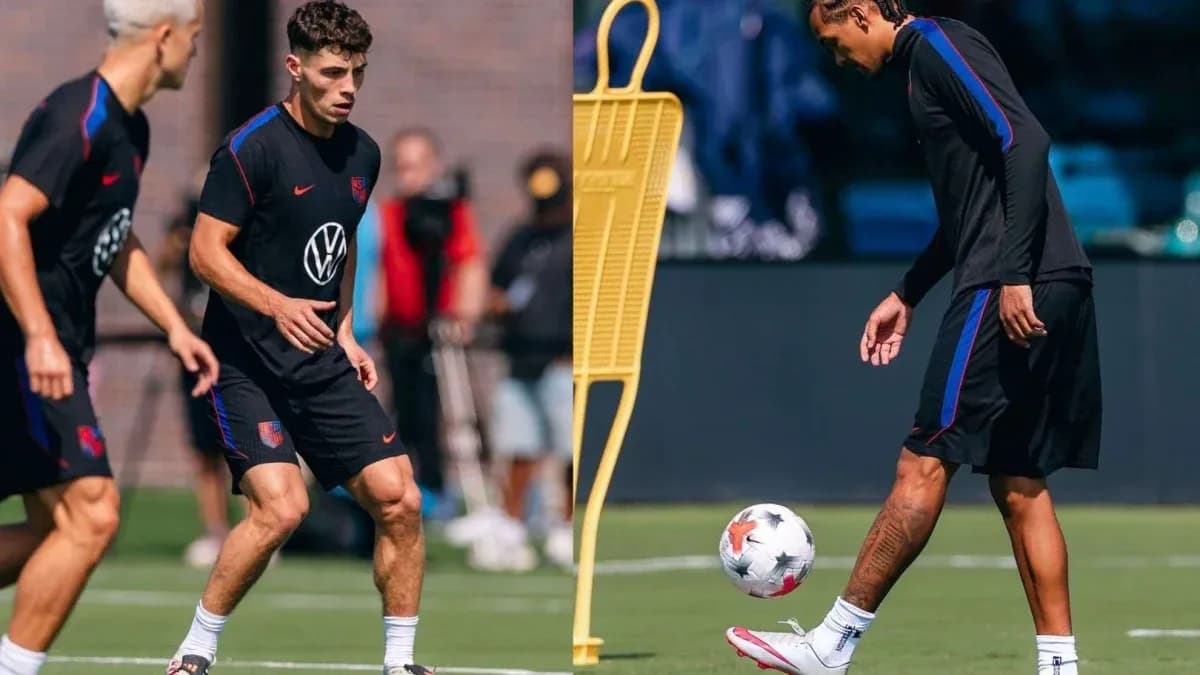
Mauricio Pochettino Faces Crucial Test with U.S. Men’s National Team
Mauricio Pochettino is about to get his first real look in the mirror.
Over the next few weeks, the U.S. Men’s National Team will run through a four-game gauntlet that should strip away any illusions about where this project stands. Friendlies against Peru and Chile in late September set the stage. Then come Mexico and Canada in early October, two games that always cut closer to the bone than the word “friendly” suggests.
This isn’t just a schedule. It’s an examination.
Pepi out, Downs in
The latest roster twist underlines the balancing act Pochettino faces.
Ricardo Pepi, a key part of the attacking pool, is out after picking up an injury in PSV Eindhoven’s 3-2 defeat to FC Twente, a match in which he was forced off. His absence opens a door, and Pochettino has chosen Damion Downs to walk through it.
Downs, 22, arrives from St. Louis City SC, where he’s on loan from Southampton. It’s not a token call-up. It’s a chance for a young forward with a growing résumé to stake a louder claim.
The dual U.S.-German citizen already has a moment on the national-team stage. During the United States’ run to the 2025 Concacaf Gold Cup final, he buried the winning penalty in the shootout against Costa Rica in the quarterfinals. One kick, high pressure, no fuss.
Before that, he helped FC Köln climb back to the Bundesliga in the 2024-25 campaign, chipping in 10 goals and five assists in Germany’s second division. Those numbers turned heads in Europe. Now he’s back in Major League Soccer, and the timing could not be better.
When the U.S. meets Chile at Energizer Park, Downs will be operating in surroundings he knows well. For a young striker trying to convince a new manager, that familiarity is no small advantage.
A squad that can’t stay small
For years, the U.S. leaned heavily on a tight circle of regulars. The names hardly changed. The depth chart felt static.
Pochettino is trying to break that habit.
One of his early priorities has been to widen the pool and inject real competition into every line of the team. Pepi’s injury is a setback, but it also becomes a test case. Can someone like Downs turn a short-notice opportunity into something more permanent? Can others, across the pitch, prove they’re more than cover?
Across this four-match window, the coaching staff will see players in different roles, under different types of pressure. The results will matter, but so will the answers to quieter questions: Who can be trusted off the bench in a tight qualifier? Who can handle a hostile crowd? Who can carry out a complex game plan on short notice?
For a national team still shaping its identity, finding those reliable contributors beyond the first-choice XI might define the cycle as much as any single scoreline.
Pochettino’s imprint
Pochettino has never hidden what he wants his teams to look like.
At club level, his sides have been built on high pressing, sharp transitions and relentless work without the ball. They hunt. They sprint. They suffocate opponents in bad areas of the pitch.
Transferring that style to international football is never straightforward. National teams live on borrowed time: a few days together, then everyone disappears back to their clubs. Patterns that take weeks to drill at Tottenham or Southampton must be compressed into a handful of training sessions.
That’s why this stretch matters. Peru and Chile won’t roll over and let the U.S. rehearse. They’ll press back, disrupt rhythm, force the Americans to solve problems on the fly. Exactly the kind of friction Pochettino needs.
These are the games where pressing triggers get tested, where defensive lines learn how brave they can be, where midfielders find out how much running this version of the U.S. actually demands.
North American reality checks
Then come the neighbors.
Mexico and Canada no longer sit in separate tiers from the United States. They share the same stage, the same ambitions, and often the same tournaments. That turns every meeting into a measuring stick.
The October 3 clash with Mexico at State Farm Stadium will do what USA–Mexico always does: cut through noise and expose reality. Form charts, FIFA rankings, tactical whiteboards — they all fade when the whistle goes.
These matches reveal something deeper: how organized a team really is under stress, how quickly it can adjust mid-game, how much edge it carries in duels that feel bigger than a friendly date on a calendar.
Canada, too, brings a different kind of challenge: pace, physicality, and a group that has grown used to seeing itself as a regional power, not an upstart. For Pochettino, those 90 minutes will say a lot about whether his ideas can stand up when the intensity spikes and time on the ball disappears.
Across all four games, the scoreboard will tell one story. Pochettino will be reading another: Who fits this system, who grows inside it, and who gets left behind.
The window won’t define his entire tenure. But by the time Mexico walks off the pitch in Glendale, we should know a lot more about what kind of team the United States is becoming — and which players, like Damion Downs, are ready to be part of it.
Related News
Morocco Call-Up: Ilias Akhomach Replaces Brahim Diaz
Estevao Returns to Brazil: A Privilege After Injury Setback
Arsenal's Late Victory Over HB Koge in Champions League
Estevao Returns to Brazil National Team After World Cup Heartbreak
Manchester United Faces Crisis as Sesko Injury Deepens Challenges
Arsenal and Oranje Collaborate to Safeguard Jurrien Timber