
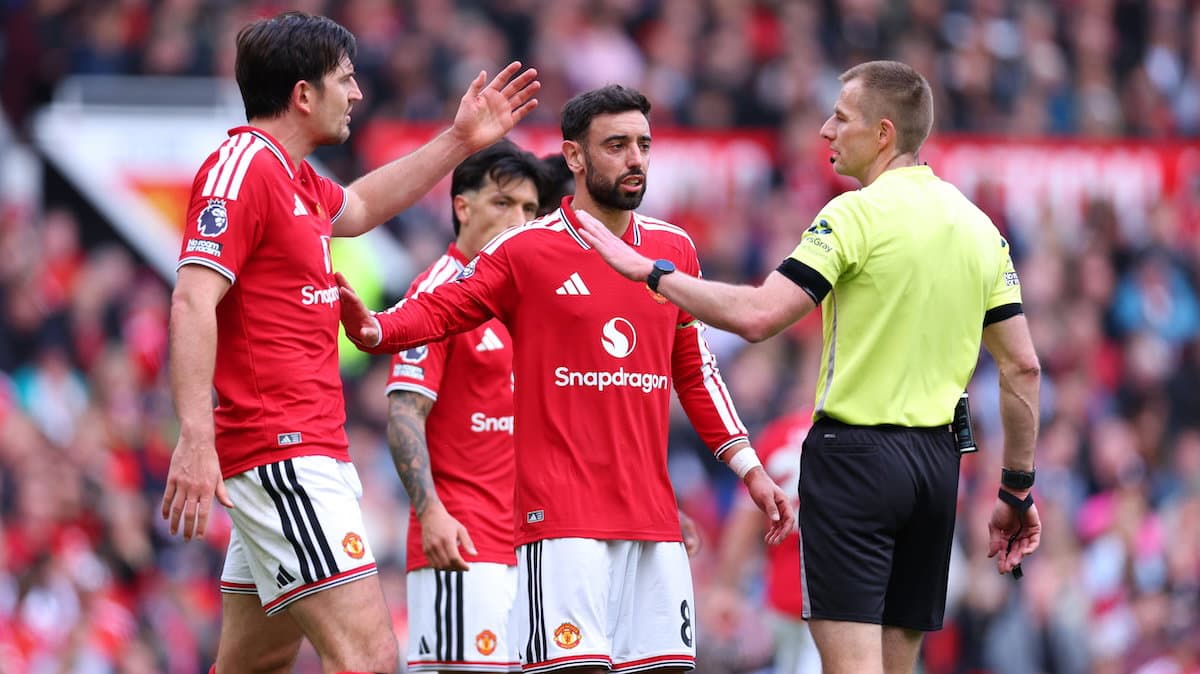
Manchester United's Tactical Domination in 3-2 Win Over Nottingham Forest
Manchester United’s 3-2 win over Nottingham Forest at Old Trafford was defined by control through volume rather than control through the ball. Despite having 49% possession to Forest’s 51%, Michael Carrick’s side generated 29 total shots to 11, and an overwhelming xG of 4.19 against 1.75. The tactical story is of a United side using an aggressive 4-2-3-1 to dominate territory and chance creation, against a Forest 4-4-2 that was compact but ultimately overrun in key zones.
Out of possession, United’s 4-2-3-1 pressed high on Forest’s first line. B. Mbeumo led the line, with M. Cunha, B. Fernandes and A. Diallo locking onto Forest’s back four and wide midfielders. The double pivot of Casemiro and K. Mainoo stayed narrow, blocking central access into N. Dominguez and E. Anderson. This forced Forest to build wide or go long into C. Wood and Igor Jesus. The outcome is visible in the shot profile: Forest managed only 11 shots (4 on target), almost all from inside the box, often in transition or after United’s defensive line was stretched.
In possession, United’s full-backs were central to the plan. L. Shaw and D. Dalot pushed high, turning the structure into something close to a 2-3-5 in sustained attacks. Shaw’s early goal on 5 minutes underlines this: from the left flank he was already arriving in advanced zones, benefiting from the high starting position and Forest’s narrow 4-4-2 block. With 21 of United’s 29 shots coming from inside the box, the width and overlapping runs of the full-backs repeatedly pinned Forest’s wide midfielders deep and forced their back four to defend the area in front of M. Sels.
The key creative hub was the triangle of Mainoo, Fernandes and Cunha between the lines. Mainoo’s role as the more progressive of the double pivot allowed Fernandes to drift into pockets and receive facing goal, while Cunha, nominally starting as the left-sided No.10, often moved inside to form a second striker line next to Mbeumo. Cunha’s goal on 55 minutes, later confirmed by VAR at 57 minutes, reflected this freedom: he attacked central spaces rather than hugging the touchline, arriving in the box as Forest’s centre-backs were occupied by Mbeumo’s movement.
United’s passing profile supports this dominance: 427 total passes, 376 accurate (88%), a slightly lower volume than Forest’s 447 passes but with more penetration. Forest’s 375 accurate passes (84%) were often in deeper zones, recycling under United’s press rather than breaking lines. United’s 7 corners to Forest’s 6 further show how sustained pressure tilted the pitch towards Sels’s goal.
Defensively, United’s back four of Dalot, H. Maguire, L. Martinez and Shaw played on the front foot. Maguire and Martinez held a relatively high line, compressing the space in midfield and allowing Casemiro to step out aggressively, which is reflected in his 78th-minute yellow card for “Foul” as he tried to break up a Forest transition. The risk in this approach appeared in Forest’s goals: Morato’s strike on 53 minutes and M. Gibbs-White’s on 78 minutes both came when United’s structure was briefly disorganised and Forest could attack the space behind or between defenders.
S. Lammens’ role in goal was more about sweeping and distribution than shot-stopping. He made 2 saves, with goals prevented measured at 0.01, underscoring that Forest’s chances, while not numerous, were relatively high-quality when they did break through. At the other end, M. Sels faced 8 shots on target and made 5 saves, with the same 0.01 goals prevented. United’s high xG of 4.19 against only 3 actual goals scored indicates both a degree of wastefulness in finishing and decent work from Sels in narrowing angles.
Forest’s 4-4-2 under Vitor Pereira was designed to be compact and counter-punch. The front pair of Wood and Igor Jesus tried to pin United’s centre-backs and offer an outlet for direct balls, while Gibbs-White and Anderson provided creativity from the half-spaces. The assist data is revealing: E. Anderson assisted both Morato and Gibbs-White, highlighting how Forest’s best moments came when he could escape United’s midfield pressure and deliver from advanced zones. However, with only 3 blocked shots and 11 total attempts, Forest struggled to generate sustained pressure.
The substitutions around the 70th minute were a tactical attempt by Pereira to refresh the front line and add vertical threat. T. Awoniyi (IN) came on for C. Wood (OUT), I. Sangare (IN) for N. Dominguez (OUT), and D. Bakwa (IN) for O. Hutchinson (OUT), signalling a shift towards more physicality in midfield and more direct running up front. Later, J. McAtee (IN) for Igor Jesus (OUT) and Cunha (IN) for L. Netz (OUT) at 84 minutes adjusted the left flank and central creativity, but by then United’s 3-1 lead via B. Mbeumo’s 76th-minute goal, assisted by Fernandes, had given Carrick a platform to manage the game.
Carrick’s own changes were about energy and control. J. Zirkzee (IN) for B. Mbeumo (OUT) and P. Dorgu (IN) for M. Cunha (OUT) at 80 minutes, followed by M. Mount (IN) for Casemiro (OUT) at 81 minutes, shifted United towards fresher legs up front and a more mobile midfield to see out the match. Mount’s introduction in particular aimed to maintain pressing intensity without the risk of a second yellow for Casemiro.
Discipline-wise, United finished with 2 yellow cards (Casemiro and Luke Shaw, both for “Foul”), Forest with 1 (Elliot Anderson, also for “Foul”), totalling 3. Shaw’s booking at 90+3 and Anderson’s at 90+4 underline how both sides were stretched in the closing stages, with late tactical fouls used to break rhythm.
Statistically, the verdict is clear: United’s higher xG, shot volume, and box entries point to a deserved 3-2 win, even if the scoreline was tight. Forest’s slightly higher possession and comparable passing volume did not translate into territorial control or chance creation. United’s 4-2-3-1, with aggressive full-backs and a fluid attacking midfield, imposed the game in the most dangerous zones, while Forest’s 4-4-2 offered sporadic threat but could not contain the sustained pressure around their own box.
Related News
Brighton vs Arsenal Predicted Lineups: Team News and Match Insights
Manchester City vs Sunderland Predicted Lineups: Team News and Match Analysis
Bournemouth vs Liverpool Prediction: Key Stats and Betting Tips
Tottenham vs Aston Villa Predicted Lineups: Team News for Premier League Clash
Brighton vs Arsenal: Premier League Clash Preview
Manchester City vs Sunderland: Premier League Clash Preview