
Konstantelias and Karetsas Shine on Bundesliga Debuts for Dortmund
Niko Kovac had barely stepped off the pitch before he nailed the story of Borussia Dortmund’s opening night.
"These are two lads who can and will give us a different dimension here, and they showed that today," he told Sky after the 2-0 win over Hamburger SV. He didn’t need to say much more. Signal Iduna Park had already seen it with its own eyes.
Two Greek debutants. One electric first half. And then, just as Dortmund seemed to have found something truly new, a silence that cut through the noise.
A New Pulse in Dortmund’s Attack
Giannis Konstantelias and Konstantinos Karetsas didn’t just slot into the Bundesliga on Saturday. They lit it up.
On their league debuts, the pair brought exactly what Dortmund have often lacked at home in recent seasons: spectacular football that actually serves the team. Not tricks for the cameras, but tempo, courage and ideas in the tightest spaces.
Kovac had hinted at it before kick-off. "The personnel give you what many perhaps also demand: spectacular things. We have improved that again this year. I hope these lads, who are technically very strong, show their abilities."
They did. And then some.
Both came from smaller European leagues, both arrived as creative signings rather than marquee superstars. Yet they immediately offered something that even Julian Brandt, now at Ajax, rarely managed in this form. Like Brandt, they see passes, drift between the lines and link play. Unlike him, they explode from a standing start.
They don’t wait for the game to open up. They rip it open themselves.
Konstantelias and Karetsas constantly received the ball in traffic, turned, and suddenly the pitch looked bigger. They were more proactive than their predecessor, more insistent, repeatedly generating new match situations out of nothing.
Konstantelias Dazzles – Then Crumples
For 45 minutes, Dortmund’s new No. 10 was the centre of everything.
Konstantelias had already teased his talent in the Super Cup defeat to Bayern Munich. Against HSV, he turned promise into production. His close control at full speed stood out, as did his balance and the ease with which he glided past opponents. He hunted without the ball too, snapping into tackles and, after half an hour, winning one in midfield that sent the Südtribüne into raptures.
Then came the moment that seemed to crown his night.
Shortly before the break, Konstantelias made it 2-0 and celebrated his first Bundesliga goal for BVB. The shot took a deflection off a Hamburg defender, but the idea was pure invention: a no-look effort aimed at the near corner, the kind of finish that screams confidence rather than caution.
"First half top, it was perfect. We implemented everything we wanted to implement," defensive leader Waldemar Anton told Sky, almost purring over Dortmund’s display. Konstantelias, after barely 100 minutes in black and yellow, already looked like a new fan favourite.
You could picture the weeks ahead. More nutmegs, more combinations, more noise.
Then the noise changed.
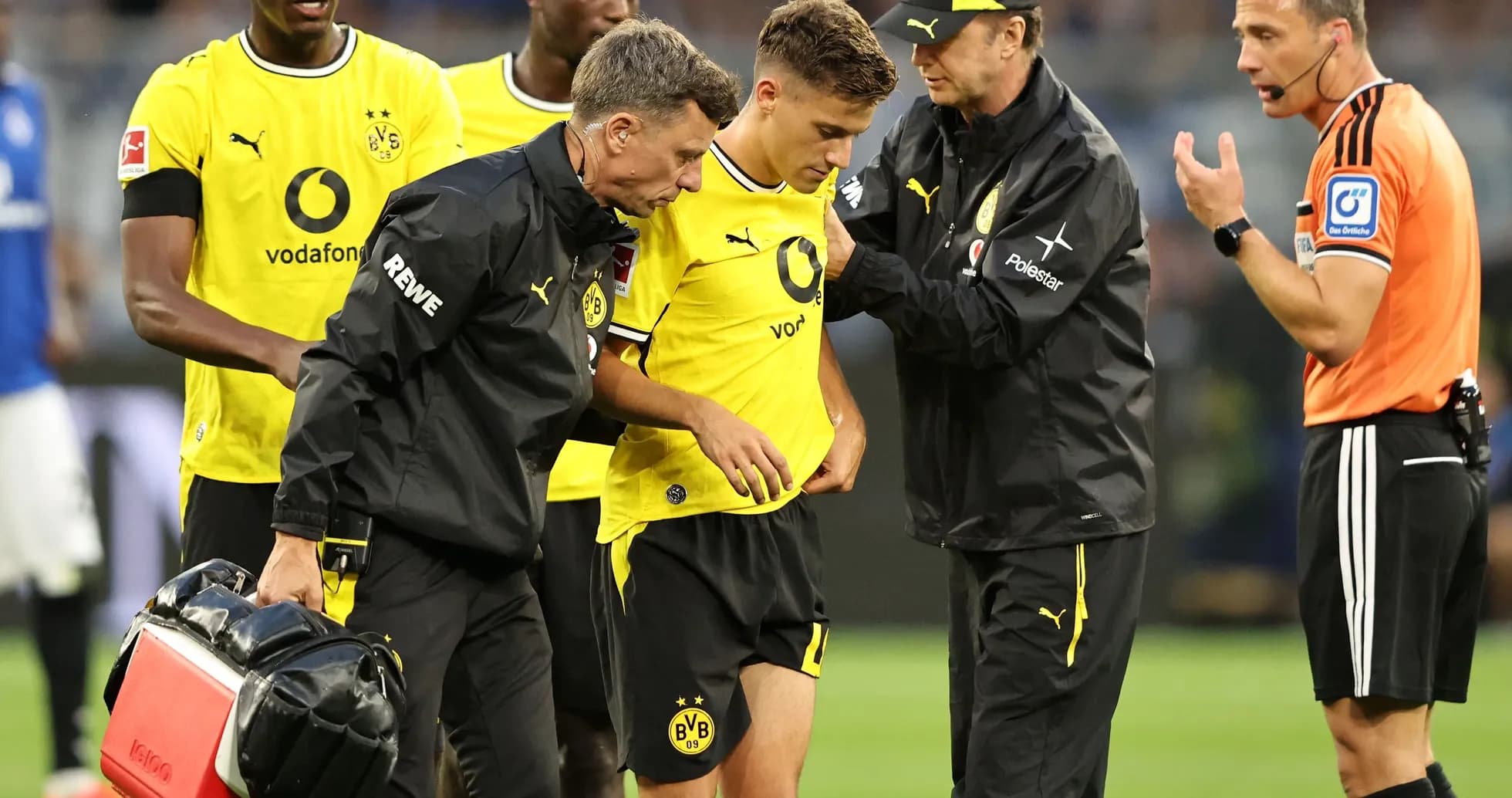
Just after narrowly missing his second goal, Konstantelias twisted awkwardly in a challenge and went down. He clutched his knee. He didn’t get back up quickly. When he left the field in the 54th minute, his expression said more than any scan could.
Fear of the Worst
The tone from the club afterwards was sober, almost resigned.
"Of course, we should be a little bit careful today about what we communicate. But we are certainly concerned about a more serious injury," sporting director Ole Book told Sky. Asked directly about a possible cruciate ligament tear, he didn’t hide. "That concern is there."
Kovac sounded no more optimistic. "We have to talk about something more than that. We will have the examination on Sunday. But at least it doesn't sound good from what the doctor told me," the coach admitted.
If the detailed tests confirm those fears and Konstantelias is ruled out for months, Dortmund will have lost far more than a new signing. They will have lost the player who, in barely over an hour of league football, had already altered the rhythm of their attack.
The price tag – 26 million euros – suddenly looks like a footnote. The impact was obvious. With Konstantelias on the pitch, Dortmund’s attacking play flowed. Without him, it stuttered.
HSV improved after the break, but that wasn’t the only reason BVB lost control. With Konstantelias off, a huge chunk of mobility and creativity walked down the tunnel with him.
"When Dortmund play from right to left, play into the spaces in between, then first of all you do a lot of chasing and don't really manage to get into the press. That was our problem," HSV captain Nicolai Remberg explained. He was talking about the first half. He was talking about the Greeks.
Two Greeks, One New Idea
Alongside Konstantelias, compatriot Karetsas was the other tormentor in yellow.
The pair constantly rotated, drifting into pockets, dragging Hamburg’s midfield out of shape. Their touch was immaculate, their passing sharp and daring. Dortmund’s play between the lines reached a level that has too often been theory rather than reality in recent years.
"Brutal," was Anton’s verdict on the duo. "The mobility they have, how dangerous they are, that is a great quality at that age and we need that for the future as well. I am glad we have them with us."
Which is why the potential loss of one of them cuts so deep. Karetsas suddenly faces the prospect of continuing without his ideal partner. Dortmund, meanwhile, are left with a question that can’t be dodged: how do you replace a player who changed your attacking structure almost overnight?
Book didn’t hide how much Konstantelias had already meant to the group. "I felt incredibly sorry for the lad. He has had a great presence here from day one, also in the dressing room. We all already like him very much. When you then play such a good first half and have to be substituted and something more serious is feared, it is just unbelievably annoying."
Searching for Solutions
Kovac’s first answer on Saturday was pragmatic rather than poetic.
For Konstantelias, he sent on Marcel Sabitzer, a more defensively minded option. The Austrian did his job, but he couldn’t replicate the verve of the man he replaced. He was never going to.
On paper, Samuele Inacio looks like the closest profile in the squad. The 18-year-old is an attacking midfielder with flair, someone who can also inject tempo from tight spaces. But his cameo against HSV ended almost as soon as it began – a lightning red card, a quick walk back to the bench, and a reminder of how raw he still is.
Is he ready to fill Konstantelias’ role in the short term? That’s a gamble rather than a plan.
Maximilian Beier is the more experienced alternative. He offers pace, movement and a goal threat, but using him centrally would force Kovac to abandon his idea of deploying the Germany international on one of the flanks. That, in turn, opens a new gap out wide.
And the clock is ticking.
The summer transfer window closes on Tuesday, 1 September, at 8pm. Officially, Dortmund are calm. "Depending on how serious the injury actually is, we will align our next steps accordingly. But one thing is certain: over the next three days, we are not planning anything," said sporting managing director Lars Ricken.
That’s the line. For now.
The Sancho Question
If the worst fears are confirmed, Dortmund’s board will have to decide quickly whether the answer lies inside the club or outside it.
Said El Mala, once the preferred option before the Konstantelias deal, is off the table after extending his contract with 1. FC Köln. That door is shut.
One name, though, refuses to go away.
Jadon Sancho.
The Englishman would be a natural fit in terms of profile. Like Konstantelias and Karetsas, he can create dynamism from a standing start, take defenders out of the game one-on-one and shift the tempo with a single touch. Speculation about a third Dortmund spell has never fully disappeared, even if it cooled significantly after the Greeks arrived.
At BVB, Sancho played the best football of his career. Since his contract at Manchester United expired, he has been without a club and would be available on a free transfer. From a financial perspective, the risk looks manageable, though he would have to accept a substantial pay cut.
The sporting risk is different. Can the 26-year-old ever rediscover the level he once showed in this stadium? His recent loans at Chelsea and Aston Villa were largely disappointing. The sparkle that once made him one of Europe’s most exciting wingers has flickered, not burned.
Dortmund now stand at a crossroads they didn’t expect to reach this early in the season. They have seen what their new attacking idea can look like with Konstantelias and Karetsas at its heart. The question is brutal and simple:
If the scans bring bad news, do they trust the squad to keep that idea alive – or do they call the man who once made this place his stage and ask him to do it all over again?
Related News
PSG's Senny Mayulu Injured During France U21 Match
Italy’s Giacomo Raspadori Withdraws from Nations League Ahead of France Clash
Holger Rune's First ATP Tour Match Since Achilles Injury Set at Japan Open
Liverpool Faces New Setback as Cody Gakpo Leaves Netherlands Match Early
Denmark's Brian Riemer Confirms Patrick Dorgu Injury Withdrawal from National Squad
Real Madrid Concerned as Konaté Exits France Camp with Knee Injury