
Jurgen Klopp's Bold Start as Germany National Team Coach
Jurgen Klopp did not ease himself into the Germany job. He tore straight into it.
In his first major act as national team head coach, Klopp named not one but two separate squads for the upcoming Nations League fixtures, summoning 44 players for four games against the Netherlands, Serbia and Greece. It is a clear reset, a hard break from what came before.
Two squads, one statement
Germany will effectively field two different national teams over the international window. One group will contest the first two matches: a trip to Amsterdam to face the Netherlands on Thursday, September 24, followed by Greece in Augsburg on September 27. The second squad will then take over for the game against Serbia in Munich on October 1 and the return meeting with Greece in Thessaloniki on October 4.
The numbers tell their own story. Of the 44 players called up, 16 are uncapped. Said El Mala of Köln is among them, as are Freiburg trio Max Rosenfelder, Philipp Treu and Derry Scherhant, plus Celtic midfielder Mika Baur. This is not gentle evolution. It is an open audition.
Some decisions, though, cut the other way. Stuttgart forward Deniz Undav has been left out, with Klopp putting that omission down to fitness concerns. At the other end of the hierarchy, he has made one thing absolutely clear: Joshua Kimmich will be a midfielder under him. No more shuttling out to right-back, as under Julian Nagelsmann. The armband stays, the role changes.
Nagelsmann’s resignation after Germany’s World Cup last-32 exit to Paraguay left a vacuum. Klopp has wasted no time filling it with his own ideas.
Clear roles, fresh recalls
Marc-Andre ter Stegen, on loan at Ajax from Barcelona, has been confirmed as first-choice goalkeeper. That ends any ambiguity around the position. Behind him, Klopp has dipped back into the pool of players who had drifted from the national picture.
Karim Adeyemi returns. So does Leeds United midfielder Anton Stach. Brentford forward Kevin Schade is back as well. The message is obvious: previous status does not guarantee future selection, but the door is wide open for those who can convince the new coach.
The split-squad approach also hints at Klopp’s priorities. He wants intensity in every game, not a tired core group limping through a congested schedule. He wants to see as many players as possible under match pressure, not just on the training pitch.
A cap, a flag, and a fractured country
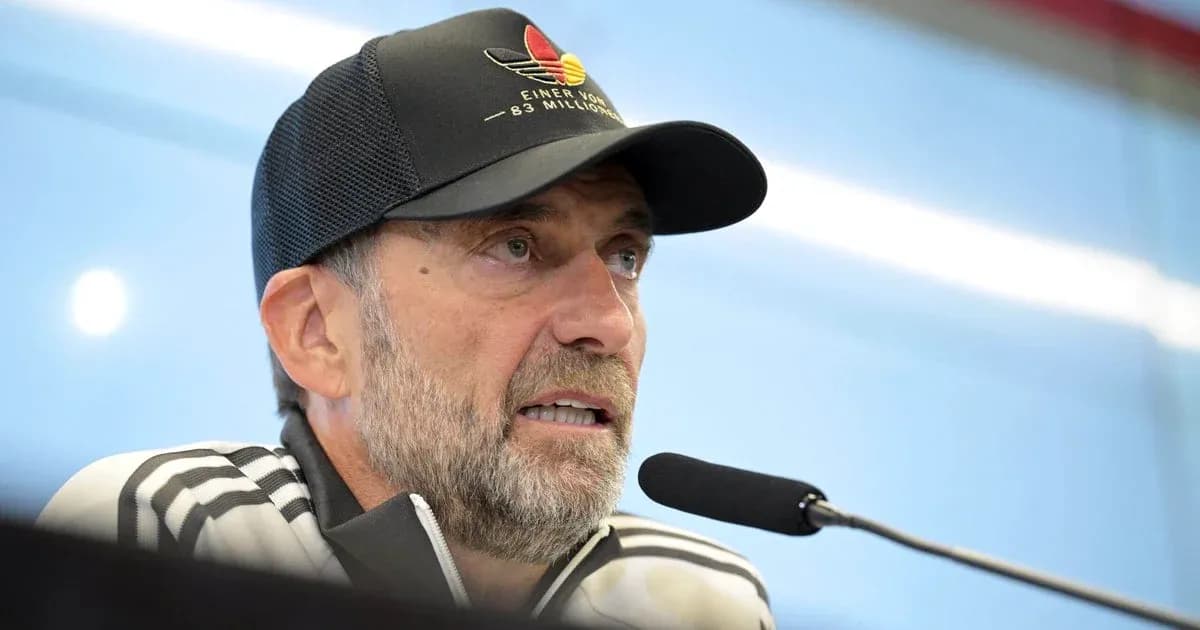
Yet the most striking image from his first squad announcement was not on the teamsheet. It was on his head.
Klopp arrived at the press conference in a baseball cap emblazoned with the words “one of 83 million” in the colours of the German flag. It was not a fashion choice. It was a message.
Germany is in the middle of a turbulent political spell. The far-right Alternative für Deutschland (AfD) recently secured more than 43 per cent of the vote and a majority in the Saxony-Anhalt state election, underlining a broader surge in support, particularly across parts of eastern Germany. Their anti-immigration, nationalist rhetoric has found fertile ground in regions hit by industrial decline, and their rise has been a source of deep anxiety and anger.
Klopp chose his moment to respond.
“We need to rediscover the fun in all of this,” he said when asked about the cap. “I hope I won’t have to talk about political matters in the future. But I want to reclaim the flag for us. So that people feel happy and fortunate to live in this wonderful country.
“I don’t want to leave national pride to the wrong people. It fills me with pride to do this job. When we spend time focused on football, it’s meant to foster a sense of community and make us feel better. We have to create that atmosphere. But we also need people who embrace it.”
The symbolism runs deep. In Germany, questions of patriotism and the meaning of the flag are never simple. The legacy of national socialism still shapes how national symbols are viewed, and in a modern, increasingly multicultural society, those symbols can be twisted or claimed by groups with very different agendas.
That is the space Klopp has stepped into. His cap is an attempt to say that the flag does not belong to extremists, that pride in the national team and the country can exist without sliding into exclusion or hate.
Football in the middle of a bigger argument
Germany is a federal state built from regions with their own identities and their own views on what the country is – and what it should become. That patchwork now sits over a political landscape marked by division, competing narratives and a constant fight over who gets to define “Germany”.
Klopp cannot solve that with a squad list or a cap. He knows that. But he clearly believes the national team can still be a place where a different kind of togetherness is possible, even if only for 90 minutes at a time.
So his first act as head coach is not just about 44 names and two squads. It is about who they play for, what the flag above them represents, and whether Germany can still find common ground in a game that once bound it together.
Related News
Jurgen Klopp's Bold Start as Germany National Team Coach
Séamus Coleman Eyes Future with Republic of Ireland
Community Guidelines for Respectful Football Debate
Nathan Broadhead Ruled Out of Wales’ Nations League Campaign
Republic of Ireland Squad Changes for UEFA Nations League
Juventus Faces NEC in Europa League: Anxiety and Opportunity