
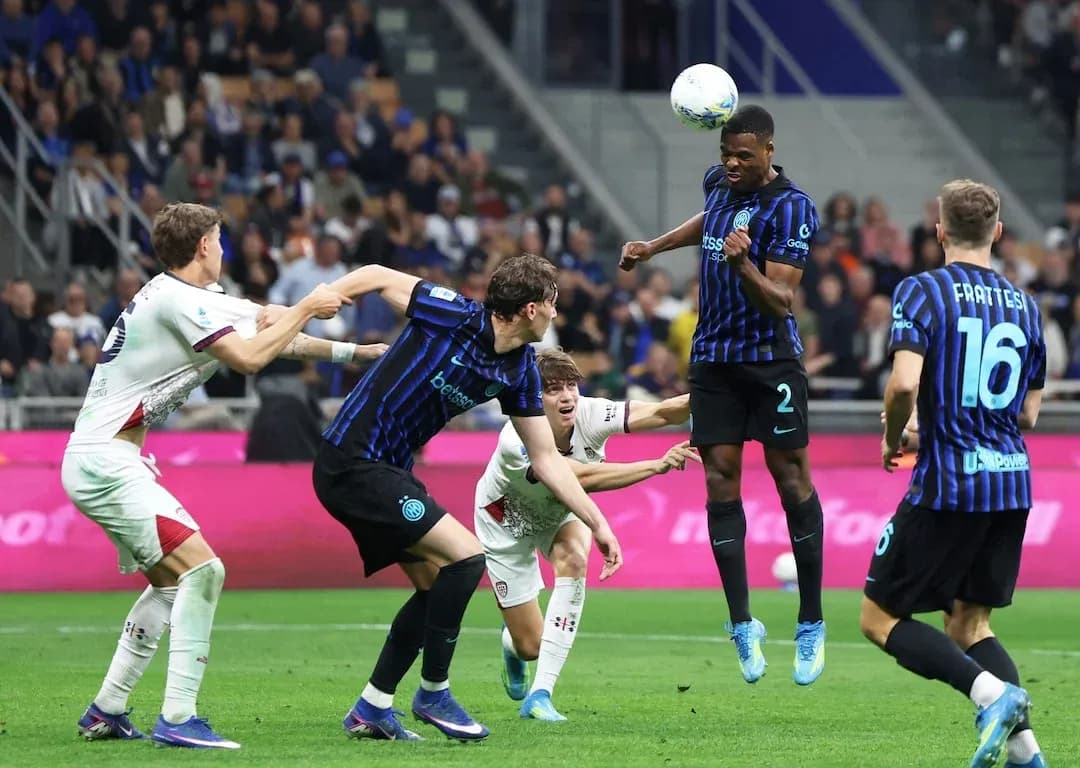
Inter Secures Narrow Victory Over Cagliari in Serie A Clash
Under the late-summer lights of the Unipol Domus, this finished 1–0 to Inter, but the story of the night was written long before the final whistle. It was a clash between a Cagliari side still defining its Serie A identity and an Inter machine that already looks tuned for a title push.
Heading into this game, the table framed the narrative starkly. Cagliari sat 12th with 3 points from 2 matches, their overall goal difference perfectly balanced at 0 after scoring 1 and conceding 1. At home, though, the picture was harsher: 1 match, 0 points, 0 goals for and 1 against. On their travels they had been efficient, winning 1–0, but the Unipol Domus remained an unsolved puzzle.
Inter arrived in Sardinia as early pacesetters. Second in the league with 6 points from 2 games, they had an overall goal difference of +4, built on 5 goals scored and just 1 conceded. At home they had already produced a 4–1 win; away, they were more pragmatic, a 1–0 success underlining their ability to control risk. This match would follow that away template almost to the letter.
Tactical Setup
Tactically, Fabio Pisacane stayed loyal to his blueprint. Cagliari lined up in a 4-2-3-1, with E. Caprile in goal and a back four of J. Pedro, A. Deiola, J. Rodriguez and A. Obert. In front of them, A. Romano and H. Winks formed the double pivot, asked to both screen and build. Ahead, a technical band of three – M. Adopo, D. Maldini and J. Fazzini – floated behind lone striker P. Mendy.
The absences mattered. R. Idrissi and Y. Trepy were both ruled out through injury, trimming Pisacane’s options for wide disruption and late-game energy. It forced Cagliari to lean heavily on Fazzini and Maldini between the lines, rather than rotating profiles or adding a pure runner to stretch Inter’s back three.
Cristian Chivu’s Inter, meanwhile, arrived with their now-familiar 3-5-2. J. Martinez started in goal, shielded by a high-calibre defensive trio: B. Pavard on the right, M. Akanji central, A. Bastoni on the left. Across midfield, F. Dimarco and Luis Henrique provided width, with N. Barella, H. Calhanoglu and P. Sucic forming a technically dominant central triangle. Up front, L. Martinez and F. Esposito led the line.
Chivu also had to navigate absences. D. Spence and M. Spinacce were both unavailable, but Inter’s depth softened the blow; the core of their structure remained intact, and the bench – featuring the likes of P. Zielinski, H. Mkhitaryan, C. Jones, A. Diouf, Carlos Augusto and M. Thuram – offered multiple tactical pivots.
Match Dynamics
The match quickly became a study in territorial control versus defensive resistance. Inter’s season numbers hinted at what was coming: overall, they averaged 2.5 goals for per game and only 0.5 against, with a clean sheet already secured away from home. Cagliari, by contrast, had overall averages of 0.5 goals for and 0.5 against, underlining their fine margins and limited attacking punch.
In the “Hunter vs Shield” duel, Inter’s attacking spear was multifaceted. Hakan Calhanoglu, already on 2 league goals with a rating of 8, is more than a deep playmaker; his 2 shots, both on target, and 3 key passes in the season so far show a player who can dictate tempo and finish moves. Behind the forwards, his 125 successful passes at 91% accuracy and 3 interceptions illustrate how he knits defence and attack, pressing and recycling in equal measure.
Ahead of him, F. Esposito has emerged as a modern target-runner hybrid. With 1 goal and 1 assist in 2 appearances, 6 shots (3 on target) and 15 duels contested – 9 of them won – he offers constant vertical threat and physical presence. His understanding with L. Martinez, who has already taken 7 shots this campaign, forces back lines to defend both depth and feet.
Cagliari’s shield, though, is not without merit. Overall, they concede just 0.5 goals per game, and have already kept a clean sheet away. The central pairing of Romano and Winks was tasked with narrowing lanes into Calhanoglu and Barella, while Deiola and Rodriguez had to hold an aggressive but disciplined line against diagonal runs from Esposito and the underlaps of Sucic.
Yet the disciplinary and rhythm data suggested where cracks might appear. Cagliari’s yellow-card pattern shows a pronounced spike between 46–60 minutes, with 50.00% of their cautions arriving just after half-time, and another 25.00% in the opening 15 minutes. That hints at a side that starts emotionally and then struggles to reset intensity after the break. Inter, by contrast, distribute their cautions more evenly: 33.33% in each of the 0–15, 31–45 and 46–60 minute windows. They know how to manage tempo and risk across phases.
Midfield Battle
In the “Engine Room” duel, Calhanoglu and Barella versus Romano and Winks was always likely to tilt blue and black. Barella’s energy, Calhanoglu’s range of passing and Sucic’s third-man movements gave Inter a 3v2 in central zones. For Cagliari, Winks’ ability to take the ball under pressure and Fazzini’s dribbling – 4 attempts, all successful so far this season – were their best tools to break the press. But with Fazzini already carrying 1 yellow card in the league and having committed 3 fouls, there is a fine line between bravery and overreach.
Out wide, Dimarco and Luis Henrique targeted the channels outside Cagliari’s full-backs. With Cagliari failing to score at home so far and already having “failed to score” once overall, Inter could afford to keep their wing-backs high, trusting Akanji, Pavard and Bastoni to handle transitions. Akanji’s defensive numbers – 8 duels contested with 7 won, 4 interceptions and 95% passing accuracy – underline why Chivu can leave him exposed in large spaces.
From the bench, the contrast in resources was stark. Cagliari’s options – G. Aurelio, N. Cavuoti, I. Sulev, J. Liteta, A. Akarakiri, M. Felici, R. Kofler, A. Fadera, G. Borrelli, Kevin and R. Ciervo – offer enthusiasm and some verticality, but little proven Serie A end-product. Inter, on the other hand, could introduce Diouf, already with 2 assists in just 75 minutes and a 94% passing accuracy, or Zielinski and Mkhitaryan to reassert control if the game state demanded it.
Conclusion
Statistically, the prognosis before a ball was kicked pointed towards a narrow Inter win, driven more by control than chaos. Inter’s overall clean-sheet rate, with 1 shutout in 2 games and only 1 goal conceded, married well with Cagliari’s overall 0.5 goals-for average and their failure to score at home. With neither side having taken or missed a penalty this season, there was little expectation of set-piece volatility to tilt the balance.
Following this result, the script held true. Inter’s structure, depth and midfield superiority suffocated Cagliari’s attempts to turn the Unipol Domus into a fortress. For Pisacane, the task ahead is clear: preserve the defensive discipline that has kept overall goals against at 0.5 per game, but find a way to unlock more from Maldini, Fazzini and Mendy in the final third. For Chivu, this was the confirmation that his 3-5-2 can win in multiple registers – spectacular at San Siro, ruthless and minimalist on their travels.
Related News
Fiorentina vs Napoli Prediction: Key Stats and Betting Tips
AS Roma vs Inter: Serie A Showdown on 19 September 2026
Inter’s Dominance in 5–3 Win Over Udinese
AS Roma vs Inter Prediction: Key Stats and Betting Tips
Lazio and AC Milan Battle to a 2–2 Draw: Early Serie A Insights
AC Milan vs Lecce Stats: Head-to-Head Record and Historical Context