
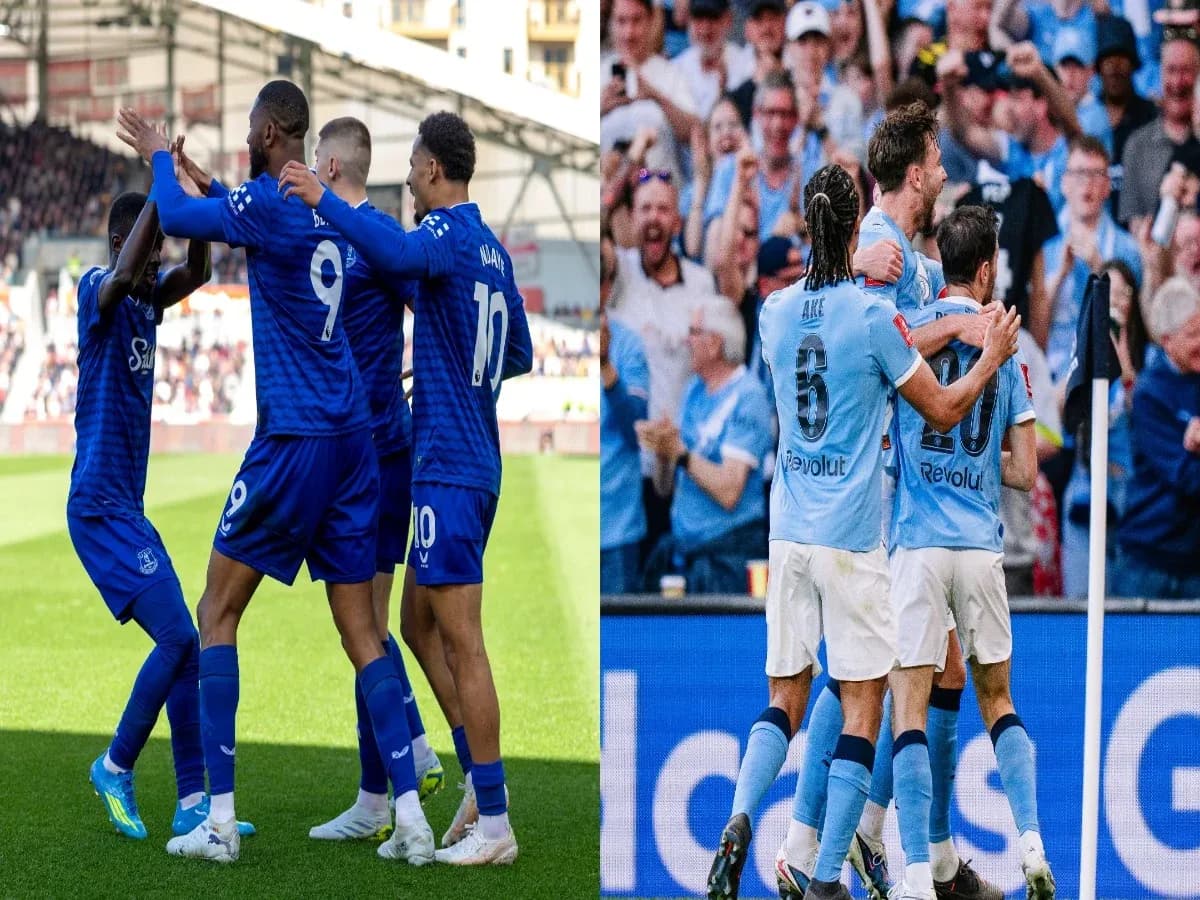
Everton vs Manchester City: A Chaotic 3–3 Premier League Draw
Everton and Manchester City produced a chaotic 3–3 draw at Hill Dickinson Stadium in Round 35 of the Premier League, a match that inverted every expectation the numbers suggested. City dominated the ball with 75% possession and built a 20–14 shot advantage, yet Everton’s vertical 4-2-3-1, fuelled by direct running and second balls, generated the higher xG (2.77 to 1.37) and a three-goal surge after the break. In a game where City’s control met Everton’s intensity, the tactical story was of a low-possession side repeatedly punching through an expansive structure, only for City’s quality to salvage a point in added time.
The scoring opened on 43' when Manchester City’s left-sided rotation finally broke Everton’s compact block. J. Doku, starting as the left midfielder in City’s 4-2-3-1, drifted into the half-space to receive from R. Cherki. With Everton’s right side pulled narrow by Cherki’s positioning between the lines, Doku isolated his full-back and finished a “Normal Goal” to make it 0–1, a just reward for City’s territorial control before the interval.
The disciplinary tone shifted right on halftime. At 45', Michael Keane was booked for a foul, a reflection of Everton’s need to break City’s rhythm with aggressive defending. After the restart, the physical edge increased: Beto saw yellow for a foul on 48', then James Tarkowski followed on 53' for another foul, both centre-backs forced into riskier interventions as Everton pushed up their line and left more space behind.
The match turned with a substitution vector on 64': T. Barry (IN) came on for Beto (OUT). Everton immediately gained more mobility in the front line, and Barry’s impact was explosive. On 68', he scored Everton’s first, a “Normal Goal” that came from Everton attacking quickly after regains, exploiting the space behind City’s advanced full-backs. That equaliser destabilised City’s rest defence.
Five minutes later, Everton’s right-back J. O'Brien struck. On 73', he made it 2–1, finishing after a delivery from J. Garner. The move underlined Everton’s emphasis on full-back surges once City’s first line was broken, with O'Brien arriving from deep into the box to convert.
City’s frustration surfaced at 74', when Gianluigi Donnarumma was booked for “Argument”, a dissent yellow that captured the psychological swing as Everton overturned the deficit. In the same minute, Pep Guardiola sought to restore control: P. Foden (IN) came on for A. Semenyo (OUT) at 74', adding creativity between the lines. One minute later, at 75', M. Kovacic (IN) replaced Nico (OUT), giving City a more progressive passer at the base.
Everton, however, struck again before City’s changes could settle. On 81', Barry scored his second, another “Normal Goal” to make it 3–1. His brace epitomised the danger of Everton’s transition play against a City side committing numbers forward and leaving channels unprotected.
City’s response was immediate and structured. On 83', E. Haaland finished from a Kovacic assist, reducing the deficit to 3–2. The goal came from a classic City pattern: Kovacic stepping into advanced zones to feed Haaland’s movement in the box, exploiting the fatigue in Everton’s centre-backs after prolonged defending.
Everton’s disciplinary load increased further on 86', when Jake O'Brien received a yellow card for a foul, underlining how often Everton’s back line had to engage in emergency defending as City chased the equaliser.
Guardiola made a final attacking adjustment on 87': O. Marmoush (IN) came on for B. Silva (OUT), a shift from a technical midfielder to a more direct forward profile, pushing City into an even more aggressive attacking shape.
Everton, by contrast, used stoppage time substitutions to add legs and defensive energy. At 90+2', N. Patterson (IN) came on for M. Rohl (OUT), and C. Alcaraz (IN) replaced K. Dewsbury-Hall (OUT), indicating a move toward fresh defensive work in wide and central zones. At 90+6', H. Armstrong (IN) entered for T. Iroegbunam (OUT), another energy injection in midfield to contest second balls.
Yet City’s relentless pressure told at the death. On 90', J. Doku struck again, assisted by M. Guehi, to make it 3–3. The equaliser reflected City’s insistence on using their centre-backs, particularly Guehi, to step into advanced areas and overload the flanks, with Doku once more exploiting a tired defensive line.
Tactically, Everton’s 4-2-3-1 was built around compactness and directness. J. Pickford, with only 1 save recorded, was protected by a deep and narrow back four of V. Mykolenko, M. Keane, J. Tarkowski and J. O'Brien. The double pivot of T. Iroegbunam and J. Garner stayed close to the centre-backs, screening passes into Haaland and Cherki while also providing the platform for quick vertical transitions. With only 200 total passes and 69% accuracy, Everton showed no interest in long possession chains; instead, they prioritised fast progression into the attacking midfield band of M. Rohl, K. Dewsbury-Hall and I. Ndiaye behind Beto, and later Barry.
Barry’s introduction fundamentally changed Everton’s attacking dynamic. His mobility and willingness to attack space behind City’s defence transformed loose clearances and second balls into genuine chances. Both of his goals came from Everton’s ability to turn City’s structural risk—high full-backs, advanced eights—into exploitable gaps. O'Brien’s goal further underlined the licence given to full-backs to attack when Everton broke City’s first press.
City’s 4-2-3-1, with Donnarumma behind a back four of N. O'Reilly, M. Guehi, A. Khusanov and M. Nunes, was possession-heavy and positionally aggressive. Donnarumma’s 3 saves and goals prevented figure of 0.74 highlight that he was exposed to high-quality chances despite City’s territorial control. In midfield, Nico and B. Silva formed the initial double pivot, but City frequently morphed into a 2-3-5 in possession, with full-backs high and wide, Cherki and Doku occupying half-spaces, and Haaland central. This created sustained pressure—reflected in 610 passes at 90% accuracy and 9 corners—but also left them vulnerable to Everton’s transitions.
The substitutions reinforced those trends: Kovacic’s entry for Nico added vertical passing and contributed directly to Haaland’s goal, while Foden’s introduction for Semenyo aimed to sharpen final-third combinations. Marmoush for Silva was a late gamble to add another penalty-box threat.
Statistically, the verdict is stark. City’s 75% possession and 20 shots suggest dominance, yet their xG of 1.37 aligns closely with their three goals, indicating they finished near expectation rather than overwhelming Everton with clear chances. Everton, by contrast, generated 2.77 xG from only 25% of the ball, a testament to the quality of their chances in transition and set attacking patterns.
Disciplinary management was a key factor. Everton collected four yellow cards—Michael Keane (45', foul), Beto (48', foul), James Tarkowski (53', foul), Jake O'Brien (86', foul)—all for defensive actions, reflecting the strain of constant defending. City’s lone booking, Donnarumma’s 74' yellow for “Argument”, captured their frustration as control failed to translate into a secure result.
Overall Form favours Everton’s resilience and offensive efficiency under pressure, while the Defensive Index exposes both teams: Everton for conceding three despite limiting City’s xG, and City for allowing three goals and 2.77 xG despite their structural control. The 3–3 draw ultimately feels like a meeting point between City’s systemic dominance and Everton’s tactical clarity in exploiting every weakness that dominance created.
Related News
Tottenham vs Aston Villa Predicted Lineups: Team News for Premier League Clash
Brighton vs Arsenal: Premier League Clash Preview
Manchester City vs Sunderland: Premier League Clash Preview
Tottenham vs Aston Villa: Early Relegation Battle
Brentford vs Chelsea Predicted Lineups: Team News and Match Insights
Brighton vs Arsenal Prediction: Key Stats and Betting Tips