
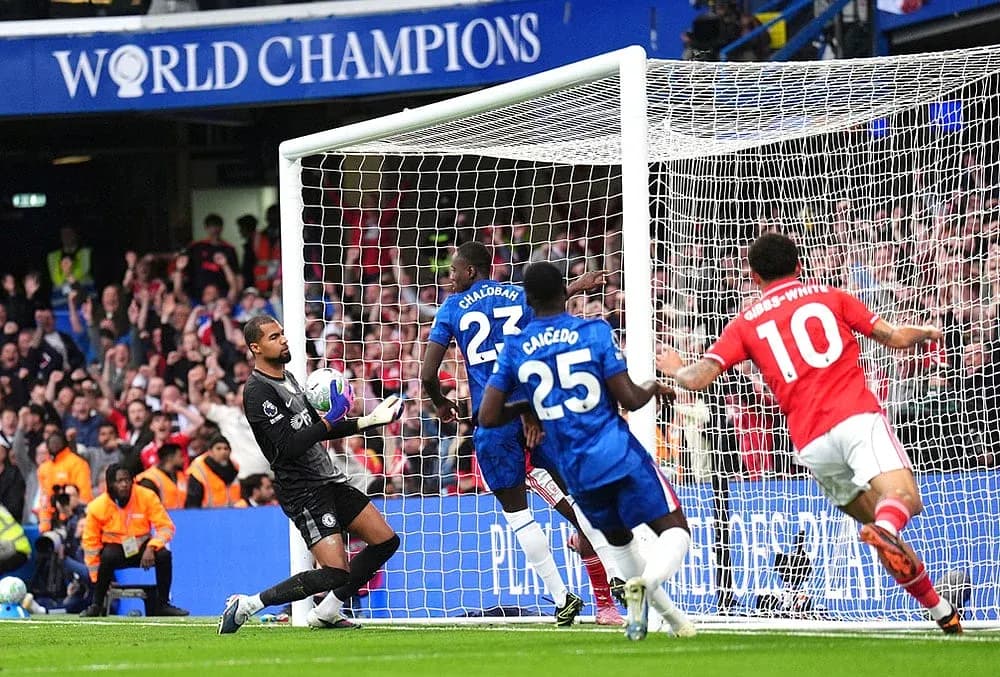
Chelsea's Tactical Fragility Exposed in Defeat to Nottingham Forest
Stamford Bridge felt restless as the afternoon light faded over west London. Following this result, a 3-1 home defeat to Nottingham Forest, Chelsea’s season-long contradictions were laid bare: a side that looks statistically solid in the aggregate, yet brittle in key moments; a team ranked 9th with 48 points and a positive goal difference of 6 (54 scored, 48 conceded overall), undone by an opponent fighting for survival and growing sharper by the week.
Forest arrived in London 16th in the Premier League on 42 points, their overall goal difference a narrow -2 (44 for, 46 against). On their travels they had been quietly dangerous, with 7 away wins from 18 and 26 away goals at an average of 1.4 per game. That away edge, and their recent form line of WWWDW heading into this game, translated into a performance of conviction and clarity that Chelsea simply could not match.
I. The Big Picture – Structures and Season DNA
Calum McFarlane stayed loyal to Chelsea’s season-defining 4-2-3-1, the shape they have used in 30 league matches. Robert Sánchez in goal, a back four of Malo Gusto, Trevoh Chalobah, Tosin Adarabioyo and Marc Cucurella, with a double pivot of Romeo Lavia and Moisés Caicedo. Ahead of them, Cole Palmer floated as the central creator, flanked by Enzo Fernández and J. Derry, with Joao Pedro leading the line.
On paper, this setup fits Chelsea’s profile: overall they score 1.5 goals per game, with 1.3 at home and 1.8 away, and concede 1.4 per game (1.3 at home, 1.4 away). The structure is meant to provide control through Caicedo and Lavia, progressive passing from Enzo, and final-third incision from Palmer and Joao Pedro.
Vitor Pereira, though, took a bolder route than Forest’s usual 4-2-3-1, rolling out a 4-4-2 at Stamford Bridge. Matz Sels was shielded by a back four of Z. Abbott, Cunha, Morato and Luca Netz. In midfield, D. Bakwa and J. McAtee offered width, with Ryan Yates and Nicolás Domínguez inside, while Igor Jesus and Taiwo Awoniyi formed a bruising, mobile front two.
This more direct, twin-striker system leaned into Forest’s away identity: 26 away goals at 1.4 per game, built on quick transitions and a willingness to commit runners beyond the ball. It also exploited a Chelsea defence that, while only conceding 48 overall, has often been exposed when forced to defend space rather than a set block.
II. Tactical Voids – Absences and Discipline
Both sides were missing important pieces, and the absences shaped the tactical story. Chelsea’s wide and attacking depth was thinned by the non-availability of A. Garnacho (inactive), J. Gittens (muscle injury), M. Mudryk (suspended) and P. Neto (inactive). The result was a starting trio behind Joao Pedro with only one true wide natural in Derry, forcing Enzo and Palmer into hybrid roles between half-space and touchline.
For Forest, the defensive and wide rotation was even more severe. O. Aina, W. Boly, John Victor, Murillo, D. Ndoye, I. Sangaré and N. Savona all missed out, stripping Pereira of options both in central defence and in the defensive midfield screen. That made Morato’s leadership and Yates’s industry essential; Forest could not afford a chaotic, card-heavy game.
Across the season, Chelsea’s disciplinary profile hinted at a latent volatility that reappeared here. Their yellow cards spike late: 22.35% of bookings come in the 76-90 minute window, with another 20.00% between 61-75. Red cards are spread alarmingly evenly, with a particular flare between 61-75 (28.57%). Caicedo himself embodies that edge: 10 yellows and 1 red in the league, plus 46 fouls committed. Forest, by contrast, tend to do their damage in the middle phases: 23.21% of yellows between 46-60 and another 23.21% from 61-75, with a solitary red in the 31-45 window.
In a match that turned on Forest’s fast start and Chelsea’s frantic chase, that discipline gap mattered. Chelsea’s need to force the game after going 2-0 down by half-time (0-2 at the break) played straight into Forest’s hands.
III. Key Matchups – Hunter vs Shield, Engine Room Battles
The “Hunter vs Shield” duel centred on Joao Pedro against a Forest defence that has conceded 25 away goals at 1.4 per game. Joao Pedro’s season numbers are elite: 15 league goals and 5 assists, 48 shots with 28 on target, plus 29 key passes. He is Chelsea’s top scorer and joint-creator, a constant duel presence with 367 total duels and 176 won.
Yet Forest’s back line, anchored by Morato and protected by the tireless Yates, managed to funnel Joao Pedro into crowded zones. Without Mudryk’s depth-running or an extra natural winger to stretch the back four, Joao Pedro often dropped into Palmer’s territory, congesting the central lane rather than destabilising it. Forest’s ability to survive those central overloads and still spring Awoniyi and Igor Jesus the other way was the game’s tactical hinge.
In the “Engine Room”, Caicedo and Lavia were tasked with dictating tempo against Yates and Domínguez. Caicedo’s season is a study in controlled aggression: 1,877 passes at 92% accuracy, 83 tackles, 14 successful blocks and 56 interceptions. He is Chelsea’s metronome and destroyer, but his high-card profile (10 yellows, 1 red) means he walks a tightrope.
Forest’s pair did not try to outplay him; they tried to outfight and outrun him. By forcing second balls and launching quick, vertical attacks, they pulled Chelsea’s double pivot into transitions rather than settled possession. Every time Chelsea’s structure stretched, the Forest front two found space between Chalobah and Adarabioyo, exploiting a back line that, while technically secure, is less comfortable when repeatedly defending the channels.
IV. Statistical Prognosis – xG Shape and Defensive Solidity
Even without explicit xG data, the season numbers sketch the expected shot-quality map. Heading into this game, Chelsea’s overall scoring rate of 1.5 per match against Forest’s overall concessions of 1.3 suggested a home side likely to generate a solid but not overwhelming xG, perhaps in the 1.3–1.7 band. Forest’s away attack at 1.4 goals per game, against a Chelsea defence conceding 1.3 at home, pointed to a live away threat in the 1.0–1.4 xG range.
The 3-1 full-time scoreline reflects Forest outperforming that baseline, not just in finishing but in chance construction. Their 4-4-2 created higher-value opportunities than a simple shot count would suggest, with Awoniyi and Igor Jesus repeatedly attacking the heart of Chelsea’s box rather than settling for low-quality efforts.
Chelsea, by contrast, looked like a side whose underlying numbers are being betrayed by game-state and mentality. Nine clean sheets overall and only 48 conceded in 35 matches hint at a broadly competent defence. But a form line of LLLLL and a late-card surge profile reveal a team that unravels under scoreboard pressure. Once Forest raced into a 2-0 lead by half-time, Chelsea’s structure dissolved into individual attempts to rescue the game, leaving them open to the decisive third.
Following this result, the tactical verdict is stark. Forest’s pragmatic switch to 4-4-2, their sharper away identity and their ability to exploit Chelsea’s emotional and structural fragility produced a result that the season’s statistical contours had warned was possible. Chelsea still have the talent and underlying metrics of a top-half side; Forest, with their away punch and growing belief, now look like a team whose numbers and narrative are finally aligning at exactly the right moment.
Related News

Tottenham vs Aston Villa Predicted Lineups: Team News for Premier League Clash
Brighton vs Arsenal: Premier League Clash Preview

Manchester City vs Sunderland: Premier League Clash Preview

Tottenham vs Aston Villa: Early Relegation Battle

Brentford vs Chelsea Predicted Lineups: Team News and Match Insights
Brighton vs Arsenal Prediction: Key Stats and Betting Tips