
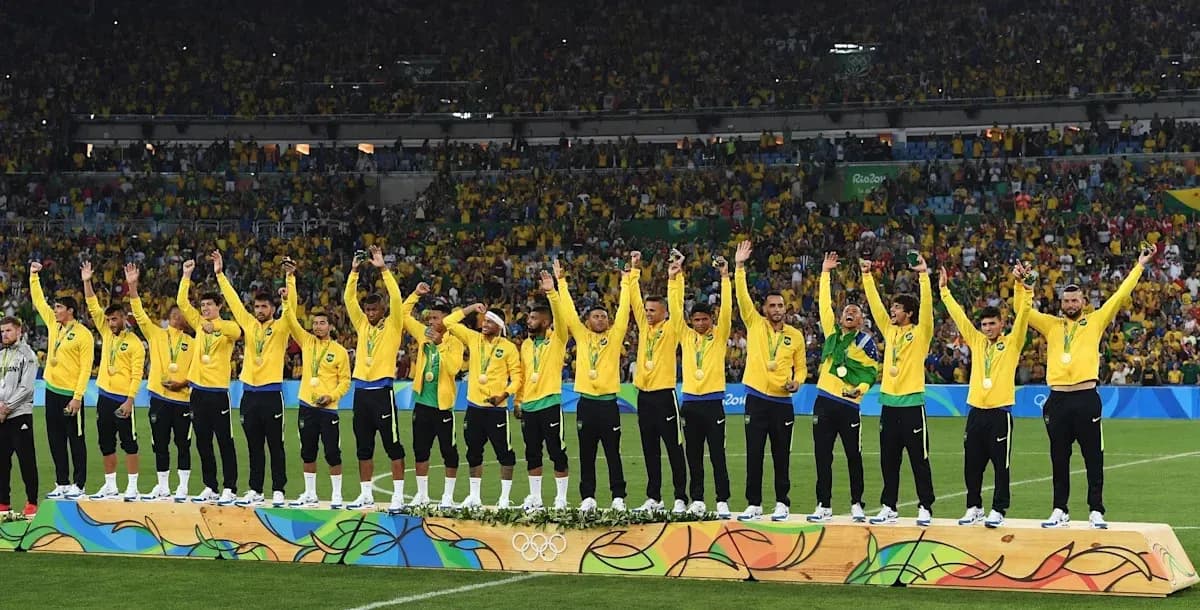
Brazil's Historic Olympic Gold: Neymar's Decisive Moment
Ten years on, the image is still razor sharp.
Neymar, standing over the ball at the Maracanã penalty spot. A nation holding its breath. Germany beaten not by a sweeping move or a late header, but by one left-footed strike that finally delivered the only title Brazil had never owned.
On August 20, 2016, the Brazilian Olympic team climbed onto the top step of the podium for the first time. More than 63,000 people packed into the Maracanã, carrying the weight of decades of expectation and the scars of 7-1. Across from them, Germany again. Different competition, different stakes, same ghost.
A final that gripped a nation
The match itself never allowed anyone to relax.
Brazil struck first. In the 26th minute of the first half, Neymar bent a free kick over the wall and under the bar, a shot as precise as it was symbolic. The stadium exploded. For a moment, gold felt close.
Germany refused to fold. They grew into the game, pushed higher, and in the 15th minute of the second half, Max Meyer found the equaliser. 1-1. The Maracanã tightened. The script, suddenly, looked dangerous again.
Extra time came and went with no breakthrough. Legs tired, minds sharpened. Every touch felt like it carried history with it. The gold medal, the last missing line in Brazilian football’s honours list, would be decided from the spot.
Up to the fourth penalty, nobody blinked. Renato Augusto, Marquinhos, Rafinha and Luan converted for Brazil. Ginter, Gnabry, Brandt and Süle answered for Germany. Then came Nils Petersen, one of the tournament’s leading scorers.
Weverton guessed right.
He dived, saved, and in that instant turned the shootout on its head. The roar that followed his stop sounded like a dam breaking. It handed Neymar the chance every Brazilian kid dreams of: the decisive kick, at home, for gold.
He walked up. Struck cleanly. Scored.
Brazil, at last, were Olympic champions.
A rocky start, a ruthless response
The road to that night was anything but smooth.
Rogério Micale’s side opened Group A in Brasília under heavy scrutiny and left the capital with only frustration. A 0-0 draw against South Africa, then another goalless stalemate against Iraq. Two games, no goals, and a storm of doubt.
Qualification hung on the final group match in Salvador. At Arena Fonte Nova, Brazil needed not just a win over Denmark, but a performance that reasserted their authority. They delivered both.
Gabriel Barbosa scored twice, Gabriel Jesus added another, and Luan completed a 4-0 rout that flipped the mood of the entire campaign. The attack finally clicked. The pressure, at least for a night, eased.
With first place in the group secured, Brazil moved to São Paulo for the quarterfinals and a bruising meeting with Colombia at Arena Corinthians. Colombia had drawn with Sweden and Japan and beaten Nigeria in their group; they arrived with belief.
Brazil cut through it. Neymar opened the scoring, Luan added the second, and a 2-0 win secured at least a shot at the podium. The team looked sharper, more confident, more in tune with what the occasion demanded.
Then came Honduras in the semifinal at the Maracanã, a side that had already knocked out Argentina and South Korea and advanced from a group with Portugal. Any nerves about a tight contest vanished almost immediately.
Brazil ran riot.
Neymar and Gabriel Jesus both scored twice, Marquinhos and Luan also found the net, and the 6-0 demolition sent the hosts surging into the final with momentum and swagger. The stage was set. Germany awaited. History waited with them.
The 18 names behind the gold
Behind Neymar’s iconic celebration and Weverton’s decisive save stood a tight group of 18 medalists who carried Brazil to that long-awaited title.
In goal, Weverton of Athletico-PR became the hero of the shootout, backed up through the tournament by Uilson of Atlético Mineiro.
The full-back positions were shared by William (Internacional), Douglas Santos (Atlético Mineiro) and Zeca (Santos), while the centre of defence rotated between Rodrigo Caio (São Paulo), Luan Garcia (Vasco da Gama) and Marquinhos, then at Paris Saint Germain.
Midfield control and balance came from Thiago Maia (Santos), Rodrigo Dourado (Internacional), Rafinha Alcântara (Barcelona), Renato Augusto (Beijing Guoan), Felipe Anderson (Lazio) and Walace (Grêmio). They stitched together the transitions that freed the forwards to decide games.
Up front, the firepower was unmistakable: Neymar, then of Barcelona, Luan of Grêmio, Gabriel Barbosa of Santos and Gabriel Jesus of Palmeiras formed an attack built for a home Olympics and the weight that came with it.
One more name deserves mention. Veteran goalkeeper Fernando Prass was called up for the Games and part of the group’s journey, but an elbow injury in the warm-up for a friendly against Japan at Serra Dourada in Goiânia ruled him out before the tournament began. He did not step onto the Olympic pitch, but his place in that story remains.
A decade later, that night at the Maracanã still stands apart in Brazilian football’s crowded trophy room. Not the biggest title, perhaps. But the one that finally closed a gap that had lingered for generations—and raised the question that still hangs over every new crop of talent: who will write the next chapter as boldly as they did in 2016?
Related News
PSG's Senny Mayulu Injured During France U21 Match
Italy’s Giacomo Raspadori Withdraws from Nations League Ahead of France Clash
Holger Rune's First ATP Tour Match Since Achilles Injury Set at Japan Open
Liverpool Faces New Setback as Cody Gakpo Leaves Netherlands Match Early
Denmark's Brian Riemer Confirms Patrick Dorgu Injury Withdrawal from National Squad
Real Madrid Concerned as Konaté Exits France Camp with Knee Injury