
Borussia Dortmund's New Dimension: The Rise and Fall of Konstantelias
Borussia Dortmund had been crying out for this. For something – for someone – to jolt Signal Iduna Park back to life with the kind of football that makes 80,000 people lean forward at once.
On Saturday night, they found it. And then lost it almost immediately.
A New Dimension – Then Disaster
“They are two lads who can bring us a different dimension here,” Niko Kovac said on Sky after the 2-0 win over Hamburger SV, and he was right. Painfully right, as it turned out.
Giannis Konstantelias and Konstantinos Karetsas walked into the Bundesliga as if they owned the stage. On their league debuts, the two Greek playmakers gave Dortmund something that has often gone missing in recent seasons: not just flair, but flair that hurts opponents, that breaks games open, that actually wins points.
Kovac had hinted at it before kick-off. The squad, he said, now had players who could deliver the “spectacular things” people demand, without drifting into showboating. This was supposed to be the year Dortmund upgraded their creativity between the lines. Within 45 minutes, it looked like they had.
Konstantelias and Karetsas, both signed from smaller European leagues, offered everything Julian Brandt once did in that role – but with a sharper edge. They didn’t just float into pockets; they detonated them. From a standing start, they could explode past markers, turn tight spaces into launchpads, and constantly ignite new attacking situations.
Against HSV, that difference was glaring.
Konstantelias Electrifies Signal Iduna Park
The first half was a showcase. Karetsas and Konstantelias kept dropping into half-spaces, turning, and driving at a Hamburg side that simply couldn’t get set. Every time Dortmund switched from right to left and punched the ball into the gaps, HSV were chasing shadows.
Konstantelias, who had already impressed in the Super Cup defeat to Bayern, looked like he had been playing in the Bundesliga for years. His close control at full tilt stood out immediately. The way he twisted out of pressure, the agility, the fluidity of his movement – it all felt like the kind of talent Dortmund fans fall for very quickly.
He brought bite as well. Around the half-hour mark he snapped into a challenge in midfield, won the ball, and Signal Iduna Park roared as if he had scored. It was the sort of aggression off the ball that endears a gifted technician to a hard-nosed crowd.
Then came the finish. The moment that should have been the start of a story, not the cruel twist in it.
Shortly before the break, Konstantelias made it 2-0. A no-look effort, aimed at the near corner, took a deflection off a Hamburg defender and wrong-footed the keeper. There was luck in the final touch, but not in the move. It was all invention, all confidence. His first Bundesliga goal, his first in black and yellow, and it felt like the beginning of something big.
“First half, top – that was perfect. We implemented everything we wanted to implement,” defensive leader Waldemar Anton said on Sky, purring over Dortmund’s display. He later summed up the Greeks’ performance in one word: “Brutal.”
After barely 100 minutes in a Dortmund shirt, Konstantelias already looked like a future cult hero. You could see the season taking shape around him.
By Sunday afternoon, that vision had been ripped up.
Cruciate Tear – Season Shattered
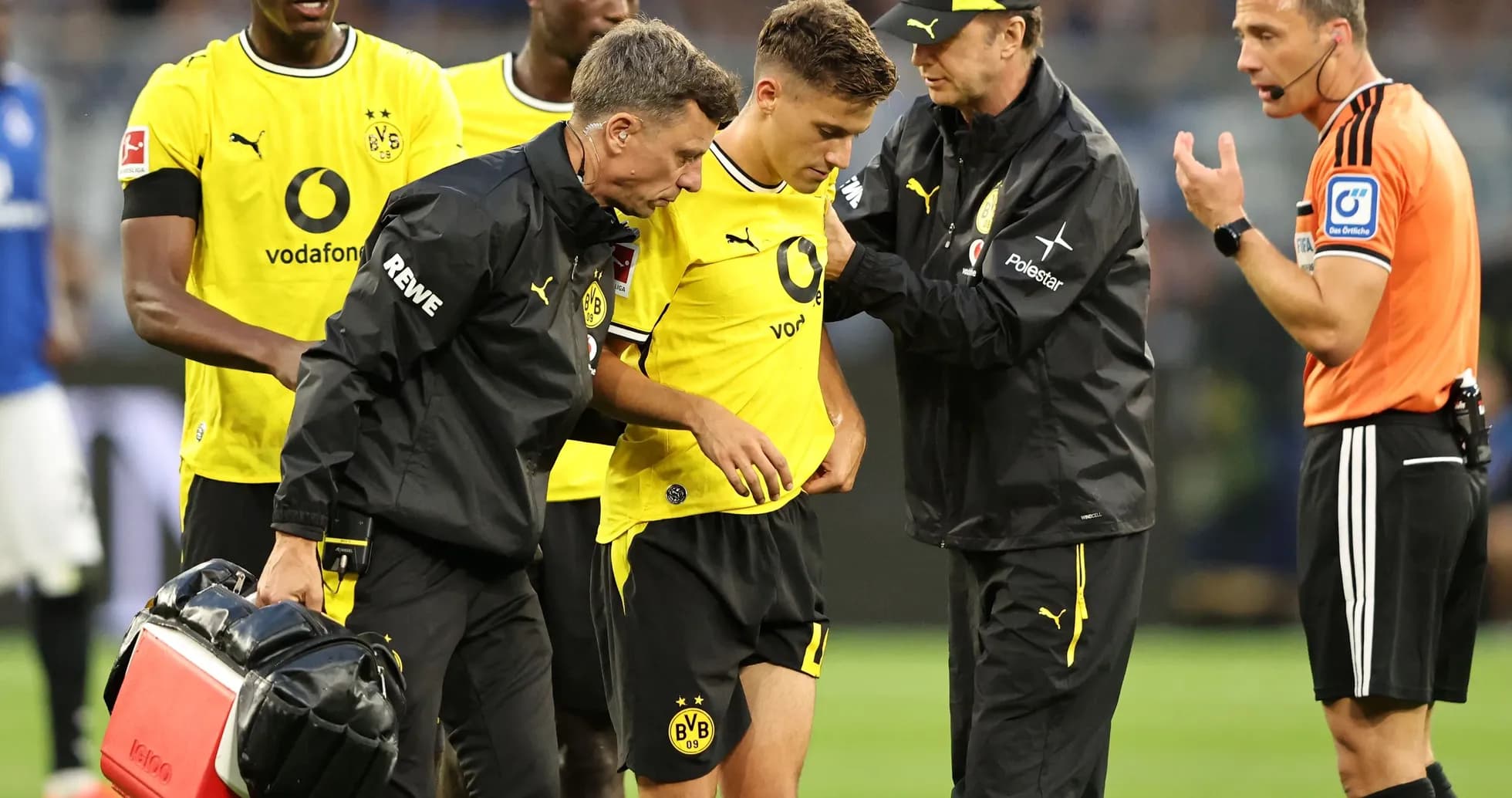
A day after the opener, Dortmund confirmed the diagnosis everyone had feared since he went down early in the second half: cruciate ligament tear. League debut, goal, win – and then months on the sidelines.
“This news hits us very hard because Giannis has already shown in a very short time why we see him as a great player for Borussia Dortmund,” sporting managing director Lars Ricken said. “For now, however, his focus and ours is on his recovery. Giannis has our full support in that.”
Kovac had already sounded worried on Saturday night. “We have to talk about something more serious there. We will have the examination on Sunday. But at least it doesn't sound good, from what the doctor told me,” he admitted.
The injury came just after Konstantelias had narrowly missed his second goal of the evening. In an innocuous-looking movement during a challenge, his knee gave way. He crumpled to the turf, immediately distressed, and left the pitch in the 54th minute. The mood inside the stadium shifted in an instant.
For him, it is a brutal personal setback. For Dortmund, it is a sporting problem of the highest order.
The €26 million signing had already made it obvious: with him, Borussia’s attacking play was sharper, more mobile, more unpredictable. Without him, the second half sagged. HSV improved, yes, but the drop in Dortmund’s dynamism after his substitution was impossible to ignore.
“When Dortmund play from right to left, play into the spaces in between, then first of all you do a lot of chasing and don't really manage to get into the press. That was our problem,” HSV captain Nicolai Remberg admitted on Sky. That problem eased once Konstantelias left the pitch.
Karetsas Loses His Perfect Partner
Together with Karetsas, Konstantelias had caused most of Hamburg’s headaches. The two rotated constantly, never standing still, always asking questions between the lines. Their first touch and ball control meant Dortmund could play fast and precise at the same time, without losing structure.
“The mobility they have, how dangerous they are – that is a huge quality at that age and it is something we need for the future as well. I'm glad we have them with us,” Anton said.
Now Karetsas has lost his ideal foil just as the partnership was beginning to spark.
From the club’s point of view, the question is obvious: how do you replace a player who seemed to upgrade the entire attacking structure overnight?
“I felt incredibly sorry for the lad. From day one here he has had a terrific presence, also in the dressing room. We all already like him very much,” sporting director Ole Book said, clearly shaken after watching the player he had pushed so hard to sign leave the field injured.
Kovac turned to Marcel Sabitzer on Saturday, opting for more defensive stability in midfield. The Austrian did his job, but he cannot replicate Konstantelias’ creativity or his ability to unpick a block from a standing start.
On paper, Samuele Inacio is the closest profile in the squad. The 18-year-old is highly rated and was meant to be eased in. Instead, his cameo against HSV ended in chaos with a lightning red card. Throwing him straight into the Konstantelias role would be a huge ask.
Maximilian Beier offers another solution, but that would force a rethink. Kovac had planned to use the Germany international on the flank. Moving him centrally would open up a hole on the wings and shift several pieces at once.
Transfer Window Tension – Sancho Back in Play?
Time is not on Dortmund’s side. The summer window closes on Tuesday, 1 September, at 8pm. Three days to decide whether this is a problem they solve internally or in the market.
“Depending on how serious the injury actually is, we will shape our further steps accordingly. But one thing is certain: over the next three days we are not planning anything,” Ricken had said before the full extent of the damage became public. That stance may now be tested.
The obvious internal candidates are limited. The obvious external target from earlier in the summer, Said El Mala, is gone. He has extended his contract at 1. FC Cologne and is no longer an option.
So the conversation circles back to a familiar name.
Jadon Sancho.
Before Konstantelias and Karetsas arrived, the idea of a third Sancho spell in Dortmund had dominated the rumour mill. Once the Greeks signed, that noise faded. Now, with one of them out long term, it returns.
Sancho fits the profile. Like Konstantelias, he can create dynamism from a standing start, operate between the lines, and unlock deep defences. His best football came in a Dortmund shirt. He knows the club, the stadium, the expectations.
He is also a free agent after his contract at Manchester United expired. Financially, the risk would be manageable, though he would need to accept a significant pay cut to make a comeback. The real question is sporting: does the 26-year-old still have the level that once made him one of Europe’s most feared young attackers?
His recent loans at Chelsea and Aston Villa suggest otherwise. Those spells were, by general consensus, disappointing. The explosiveness, the end product, the swagger – they all flickered, but rarely burned.
Dortmund now stand at a crossroads. Do they trust Karetsas, Inacio, Beier and the rest of the squad to absorb the loss of Konstantelias? Or do they roll the dice on a familiar face whose career has stalled, but who once lit up this stadium just as brightly as their new No. 10 did on his cruelly short league debut?
For a club that had finally found its “different dimension,” the next move will say a lot about how bold Borussia Dortmund really want to be.
Related News
PSG's Senny Mayulu Injured During France U21 Match
Italy’s Giacomo Raspadori Withdraws from Nations League Ahead of France Clash
Holger Rune's First ATP Tour Match Since Achilles Injury Set at Japan Open
Liverpool Faces New Setback as Cody Gakpo Leaves Netherlands Match Early
Denmark's Brian Riemer Confirms Patrick Dorgu Injury Withdrawal from National Squad
Real Madrid Concerned as Konaté Exits France Camp with Knee Injury