
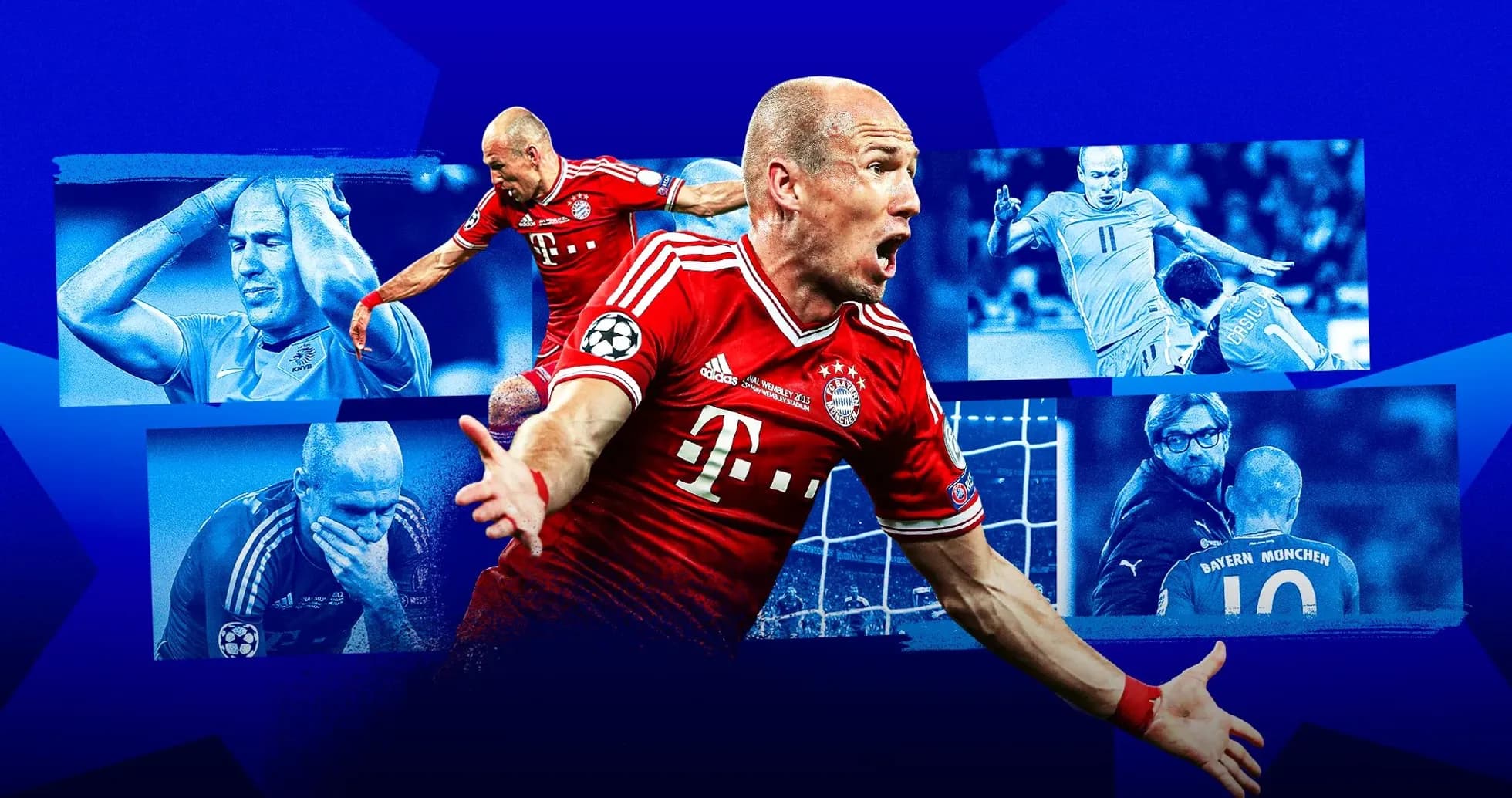
Arjen Robben: Mastering the Biggest Stage
For a long time, defenders knew exactly what was coming. It didn’t help them. Arjen Robben would pick up the ball on the right, drive at full tilt, feint, cut inside, open his body and whip that left foot through the ball. Everyone in the stadium saw it unfolding. Full-backs still ended up twisted, goalkeepers still ended up beaten.
Before the tags of “bottler” and “nearly man” clung to him, Robben was one of the most ruthless attackers in world football. He torched elite sides on Champions League nights – Manchester United, Barcelona, Borussia Dortmund – and stacked domestic titles at PSV, Chelsea, Real Madrid and Bayern Munich.
By 2010, it felt like his moment.
The first push for Europe
Louis van Gaal had Bayern humming. Mario Gomez, Thomas Müller, Franck Ribéry, Bastian Schweinsteiger – a spine built to bully Germany and chase Europe. They won the Bundesliga and DFB-Pokal in 2009-10, but the Champions League run almost died before it began.
Fiorentina had them on the brink. Bayern carried a 2-1 lead from Munich, Robben on the scoresheet from the spot. In Florence, they collapsed, trailing 3-1 on the night. Then, in the 65th minute, Robben took the ball in the middle of Fiorentina’s half, glided infield and uncorked one of the purest strikes of his career. Aggregate 4-4. Bayern through on away goals. Robben, again, the difference.
The pattern repeated against Manchester United. Injury kept him out of the first leg in Munich, a 2-1 Bayern win. At Old Trafford, they sank 3-1 behind. Another mountain, another Robben moment. He met a corner from Ribéry with a laser-guided volley, a finish so precise he almost looked stunned as he celebrated. Away goals. Bayern survived.
In the semi-final against Lyon, he did it again. A long-range hit, struck with that familiar violence and curve, left Hugo Lloris helpless in a 1-0 win. Robben was dragging Bayern through Europe almost on his own.
Then came the final in Madrid. At the Santiago Bernabéu, against José Mourinho’s Inter, he finally looked mortal. Bayern started with Ivica Olić and Thomas Müller up front, Ribéry suspended, and never really sparked. Robben was subdued in a tame 2-0 defeat. The chance to conquer Europe slipped away.
The summer would be even crueller.
Johannesburg and ‘The toe of Casillas’
Robben arrived at the 2010 World Cup battered, late to the party after more hamstring trouble, the “Man of Glass” nickname following him to South Africa. Once he got on the pitch, he transformed the Netherlands.
He opened the scoring in a nervy last-16 win over Slovakia. Against Brazil, he teed up a crucial goal in a 2-1 quarter-final victory. In the semi-final, he headed in what proved to be the winner against Uruguay. Oranje were in the final. Robben was central to everything.
The decider in Johannesburg against Vicente del Bosque’s Spain turned ugly. Nine Dutch players booked, Nigel de Jong’s kung-fu kick into Xabi Alonso’s chest burned into football’s collective memory. But the defining image came just after the hour mark.
Wesley Sneijder slipped a pass straight down the middle. Robben burst clear, alone, the World Cup at his mercy. He measured his steps, weighed his options, perhaps overthought it. As he tried to slide the ball left, Iker Casillas thrust out a leg and diverted it wide with the faintest of touches.
Dutch media called it “The toe of Casillas”. That was all it took to shatter a nation’s dream and plant the seed of a narrative that would stalk Robben for years.
Casillas later admitted his mind was racing: “Stay on your feet, stay on your feet, stay on your feet…” He finally dived, assuming Robben would go past him. Of all the possibilities, Robben picked the one route the goalkeeper could reach. Casillas was blunt: if that goes in, the final probably ends very differently.
The Netherlands never recovered. Andrés Iniesta settled it in extra-time.
“It hurts to miss such a chance,” Robben said four years later. “It’s part of sport, just a moment, a snapshot. But it will be part of me and part of my career for all of my life.”
That snapshot was only the beginning.
Penalties, pain and the Allianz silence
Injury again clipped his wings in 2010-11, but even half-fit he was devastating: 12 goals and eight assists in just 14 Bundesliga games. The following season, he stayed on the pitch long enough to power Bayern back to another Champions League final.
The semi-final second leg in Madrid brought him face to face with his past. Real went 2-0 up inside 14 minutes, 3-2 ahead on aggregate. The Bernabéu roared. Bayern looked doomed. Then, in the 27th minute, a penalty.
Robben against Casillas again, two years on from Johannesburg. This time, from 12 yards, he buried it. Casillas got a fingertip to the ball, but not enough. Aggregate level. Bayern survived the storm and won on penalties. Robben had stared down his World Cup ghost and scored.
It felt like a dress rehearsal. The real test came in Munich.
Chelsea stood between Bayern and the trophy in the 2012 final at the Allianz Arena. Bayern dominated but found themselves locked at 1-1 in extra-time when Didier Drogba fouled Ribéry in the box. Another penalty. Another Robben moment.
He struck low to the corner. Petr Čech guessed right, dropped, and smothered it. The stadium froze. The noise died. Chelsea would go on to win on penalties. Robben’s miss came just weeks after a failed, title-deciding spot kick against Borussia Dortmund in the Bundesliga. The narrative hardened: brilliant, but broken when it mattered most.
“I can't describe how I feel with words, but it's been a terrible night,” he said afterwards. “Two or three times, you feel you have the cup in your hands but at the end you stand with nothing.
“It wasn't a good penalty. I wanted to shoot the ball hard and high in the goal, but the ball didn't go high enough. It was a terrible penalty kick. After that, I still played well but you have to change your mindset at that point.”
The scars were obvious. So were the doubts around him.
One last chance
By 2012-13, the fear was simple: the season might pass him by. Injuries again restricted him to 16 Bundesliga matches. Bayern were so strong they barely needed him domestically, tearing the league apart while he watched stretches from the sidelines.
They did need him in Europe. He somehow stayed fit for the Champions League knockout rounds, and the old, ruthless Robben reappeared.
Barcelona felt it first. In Munich, he tortured Jordi Alba and scored a sumptuous third in a 4-0 demolition. At the Camp Nou, the world saw the purest version of his trademark move. Early in the second half, he took a long pass on the right, one razor-sharp touch, cut inside Adriano and bent a glorious shot into the top corner. Barcelona were shredded 7-0 on aggregate. Robben was the conductor.
“That 4-0 was my best game at the Allianz Arena,” he later told Sport Bild. “Against such a great team. With an uncharacteristic Robben goal. I broke through on the right wing with a stepover and had time to curl the ball into the far corner from a tight angle.”
He still had one more act left that season. The biggest one.
Wembley: the weight of two cities
The 2013 Champions League final at Wembley was a German civil war. Jürgen Klopp’s wild, relentless Borussia Dortmund against a Bayern side scarred by previous finals.
Dortmund dominated the first half, swarming in yellow. Bayern held. Then Robben tilted the game. In the second half, he slipped a pass across goal for Mario Mandžukić to open the scoring. Eight minutes later, Dortmund levelled from the spot. The tension cranked up again.
Soon after, Robben looked certain to score, only for Neven Subotić to appear from nowhere and hook the ball away almost on the line. Old fears resurfaced. Was this going to be another night of almost?
The answer dropped out of the London sky. A long, looping pass drifted towards the edge of the Dortmund box. Ribéry fought for it and, with one instinctive touch, flicked a delicate backheel through a thicket of yellow shirts. Robben saw the gap and burst into it.
Roman Weidenfeller stood in front of him. Mats Hummels and Subotić closed in from either side. Johannesburg. Munich. Penalties. Misses. All of it hovered over the moment.
Robben didn’t lash at it. He glided. He slipped between defenders, nudged the ball past the goalkeeper with a feather-light touch and watched it trickle across the turf, agonisingly slow, until it kissed the net.
“When I got the ball, I was free,” he told reporters. “I anticipated Franck’s movement. The only thought was: ‘I hope he puts the ball there’ because I saw the space. I took it well. My first choice was actually to go past [Weidenfeller] on the left side but then he made a move and I could put it to the other side. He was on the wrong leg.”
Bayern were champions of Europe again. Robben had written a new ending.
“To finally win this Champions League, that's a dream come true,” he said. “You can't describe it – so many emotions go through your head, especially because you know what it is like to lose. I think you can enjoy it even more when you win the title.
“After the disappointment of last year, and to a [lesser extent] 2010, and the World Cup for me – that's three finals and you don't want the stamp of a loser. At last we did it today, and we can forget about the other things a bit. It was a sense of ‘finally’.”
In 2025, Bayern fans voted that goal – that slow, rolling, redemptive finish at Wembley – the greatest in the club’s 125-year history. Second place? Robben’s volley at Old Trafford.
The “loser” label had been ripped up.
Brazil and the final rewrite
Freed from the weight, Robben only grew more dangerous. At 30, he arrived at the 2014 World Cup in Brazil playing like a man unshackled.
The opening match brought a rematch of the 2010 final: Spain versus the Netherlands. This time, there was no heartbreak. There was humiliation – for Spain.
Robben produced one of the performances of his life in a 5-1 demolition. His first goal came from a long pass he killed with a sublime touch before leaving Sergio Ramos flailing and finishing clinically. His second was outrageous. He sprinted away from Ramos, collected another long ball, sat Casillas down on the grass, then waited, waited, and lashed the ball home while the goalkeeper scrambled on his knees.
He terrorised defences throughout the tournament. Under Louis van Gaal, a Netherlands side that looked short on star power still battled their way to the third-place play-off. Robben was their spear.
By then, the story around him had changed completely. He was no longer the man who froze in finals. He was the man who kept showing up in them.
The legacy in Bavaria
The numbers in Munich tell their own tale. Eight Bundesliga titles. Five DFB-Pokals. A Champions League.
Across 307 appearances for Bayern, Robben produced 144 goals and 101 assists. After the 2013 triumph, Bayern reached four more Champions League semi-finals under Pep Guardiola, but never lifted the trophy again. Robben’s Wembley winner remained the club’s modern European peak.
When he finally said goodbye in 2019, tears in his eyes and another league title in his hands, the Allianz Arena rose as one. The same fans who once whistled him off the pitch now sang his name as that of a club legend.
He did not leave as the tragic figure who crumbled under pressure. He left as something far more compelling: a ferocious, flawed, relentlessly driven forward who had felt the full crush of failure on the grandest stages and still found a way to bend those stages to his will.
In the end, the snapshot that defined Arjen Robben wasn’t Casillas’ toe or a missed penalty. It was the ball rolling, almost in slow motion, over the Wembley goal line – the moment a career, and a reputation, finally turned.
Related News
Juventus Faces NEC in Europa League: Anxiety and Opportunity
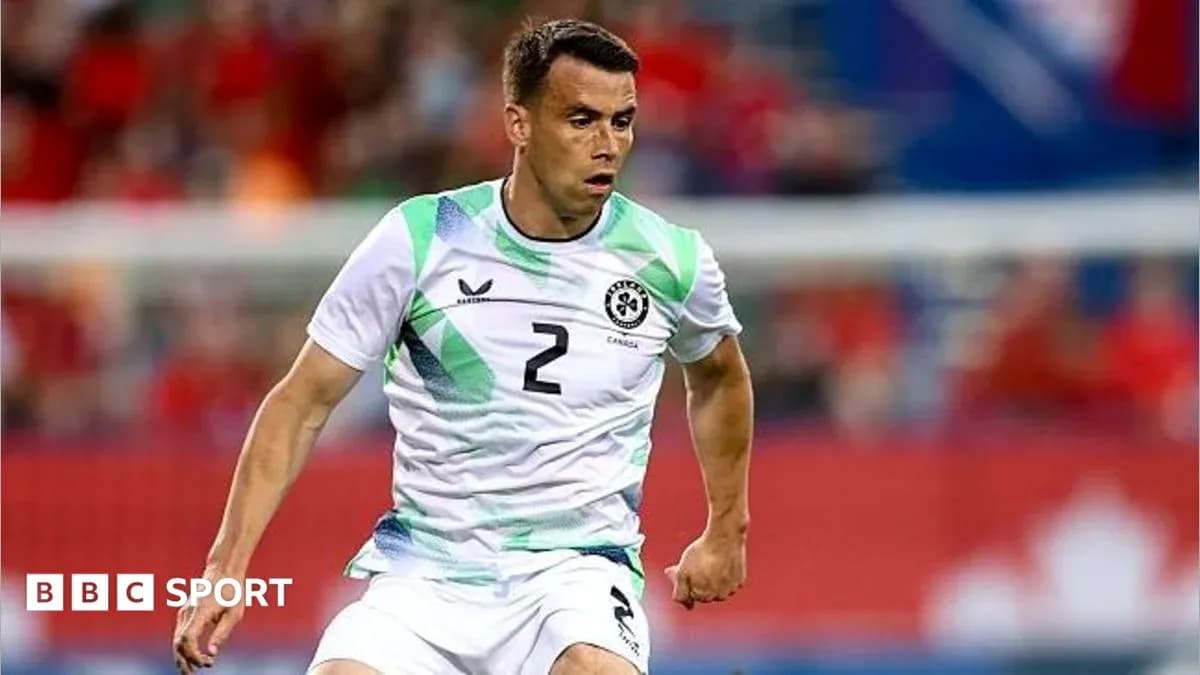
Seamus Coleman Omitted from Republic of Ireland Squad for Nations League
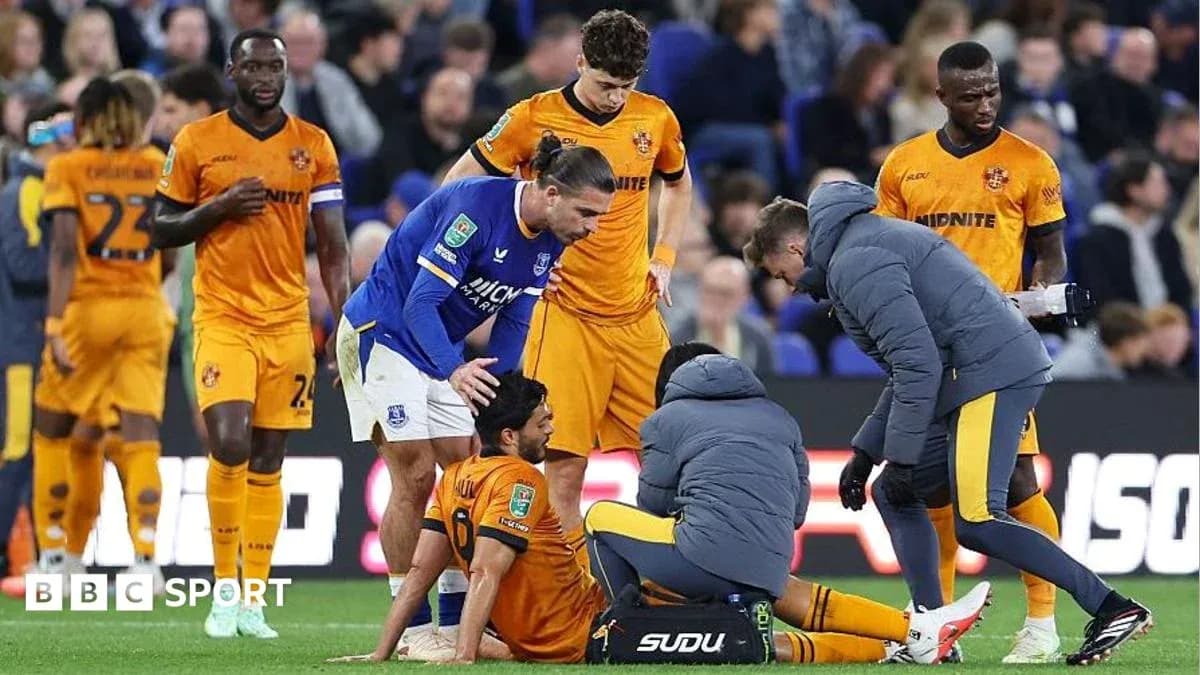
Wolves' Raul Jimenez Ruled Out for Black Country Derby

Dylan Lawlor Returns to Boost Cardiff City Ahead of Charlton Clash
Tuchel Reflects on England's World Cup Collapse

Millwall vs West Ham: A 100th Dockers Derby Showdown