
AI's Impact on Soccer: From Scouting to Injury Prevention
The machines are here. Not to pick the team, not yet, but to whisper in the ears of the people who do.
Across soccer, AI has stopped being a buzzword and quietly become part of the daily grind: scouting, rehab, academy planning, even the odd tactical tweak. The technology isn’t replacing humans. It’s trying to clean up their mess.
From Arsenal blog to global data fixer
For Guy Bracha, it started in a bedroom, not a boardroom.
A diehard Arsenal fan with a blog and a tech day job, he used to spend nights poring over games, mixing the “eye test” with numbers to flag players he thought the big clubs were missing. The posts hit a nerve. Scouts started reading. His inbox began to fill.
Then work got busy.
So Bracha built himself an AI helper to spit out the bare-bones structure of his articles. He would feed it ideas, it would give him a draft. That’s when things got strange.
“I started to get inbox requests from professional scouts and at clubs asking me, 'How do I know about that on a player?’” he recalled. His answer? It was just ChatGPT doing the heavy lifting. If that was impressing people inside the game, he wondered, what exactly were they using?
The answer: everything and nothing.
Clubs were drowning in numbers. Wyscout had exploded in the early 2010s, then a wave of rivals arrived. Every provider had its own metrics, its own language, its own dashboards. Scarcity had flipped into chaos.
“In the past 10 years, this industry has moved from complete scarcity to data overload,” Bracha said. “There are so many different data providers.”
So he built Marquee, a company that now works with clubs around the world to strip away the noise.
“If we automate a lot of these, so to speak, glorified spreadsheet processes, and the different platforms that are scattered and cannot be consolidated into one place. We do it for them,” he said. “In a sense, Marquee is an analytical department that works for the club.”
Marquee isn’t Football Manager with a nicer interface. It’s a paid service that builds tailored player profiles and lists of potential signings, not just based on quality, but on system fit and role. Clubs can ignore the recommendations if they want. Some don’t.
A handful of Premier League sides use it. Barcelona and MLS club Chicago Fire have publicly backed it. Whether Marquee will be credited with unearthing the next superstar is still unknown. But it is already part of the recruitment ecosystem – and, crucially, part of the internal politics.
Bracha knows his tech brushes up against people’s jobs.
“From an ROI perspective, it will always be faster, quicker, righter to go to us because we've already built something, and we're investing a lot to improve it,” he said. Salaries are among a club’s biggest expenses. “Do they want to hire more to build such a thing or just buy externally? It's like the AI’s most common question nowadays: build or buy? In this case, I think buy.”
He also knows he has to tread carefully.
“It's more about them, to be fair, to kind of feel comfortable with everything that we do together. And then once we create some successful stories together, we will definitely publish it,” he said.
The tech is ready. The humans need convincing.
When the machine spots the limp first
In MLS, FC Cincinnati had a very different problem: a tired center back.
During a league game against Nashville SC last year, the club’s system flagged “an irregular movement pattern” from defender Matt Miazga. Five minutes later, he asked to come off.
The tech hadn’t warned them in real time. It didn’t force him to play through anything. But on review, the data showed something had gone wrong. The machine knew he was in trouble before anyone on the touchline did.
That’s where Springbok Analytics comes in. Not to prevent the injury, but to answer the question every club hates: when is a player really back?
Springbok asks new clients for their worst-case scenario: “send us your most complicated injury.” Most of the time, that means the hamstring.
Football still hasn’t cracked it. A 2020 NIH study found hamstrings make up 12 percent of all professional soccer injuries, with re-injury rates swinging wildly between four and 68 percent. Coaches call it a fatigue injury, most common late in halves. Clubs throw money and time at rehab protocols. The numbers keep going the wrong way.
“We’ve got all the new technology that exists every which way, all the new ways of testing people… how much force can you produce? What does running look like? Hamstring injuries have not gone down. They've gone up,” said Matt Brown, Analytics Director at Springbok.
He thinks the sport has been looking in the wrong place. The problem isn’t just the leg. It’s the data.
Quantifying muscle strength, balance, and atrophy is slow, fiddly work. Traditional MRIs are, as Brown puts it, “thousands and thousands of slices of [two-dimensional gray images].” Doctors stack them, interpret them, and build their own 3D picture. It takes time.
Springbok’s roots lie far from soccer. At the University of Virginia, scientists developed hyper-specific MRI tech for children with cerebral palsy, creating 3D graphics that allowed surgeons to calculate tendon lengthening with precision. When that worked, Springbok took the idea into sport.
The NBA signed on in 2023. MLS selected Springbok for its Innovation Lab this year.
Now, using AI, Springbok pre-processes those MRI slices.
“We can now pre-process those images using AI… we can get all the crazy MRI images and the 3D space and time and all the stuff that exists there. We process through them, create the muscle boundaries, and we can give a very finalized, beautiful 3D digital twin,” Brown said.
The pitch is simple: Springbok doesn’t treat the injury, doesn’t promise miracles, doesn’t stop the hamstring from pinging in the first place. What it does is turn a week’s worth of manual analysis into a few hours of automated, hyper-detailed measurement.
“You want to scan a player at the time of injury, two months later, six months later, to track atrophy and see if you're getting the stimulus and the changes that you're going after with muscle,” Brown explained.
“We are the support system in that we can make imaging from an MRI way more impactful and actionable. We are not the ones that actually actualize it for you. We are providing you the measurements. But you're trained in this. You've done 10 years of this. You have your own thesis,” he added.
The doctor still makes the call. The machine just hands them a sharper picture.
Four photos, 10 seconds, a digital twin
If Springbok is about getting injured players back, Fit:Match is about making sure the next generation doesn’t get lost before they’re ready.
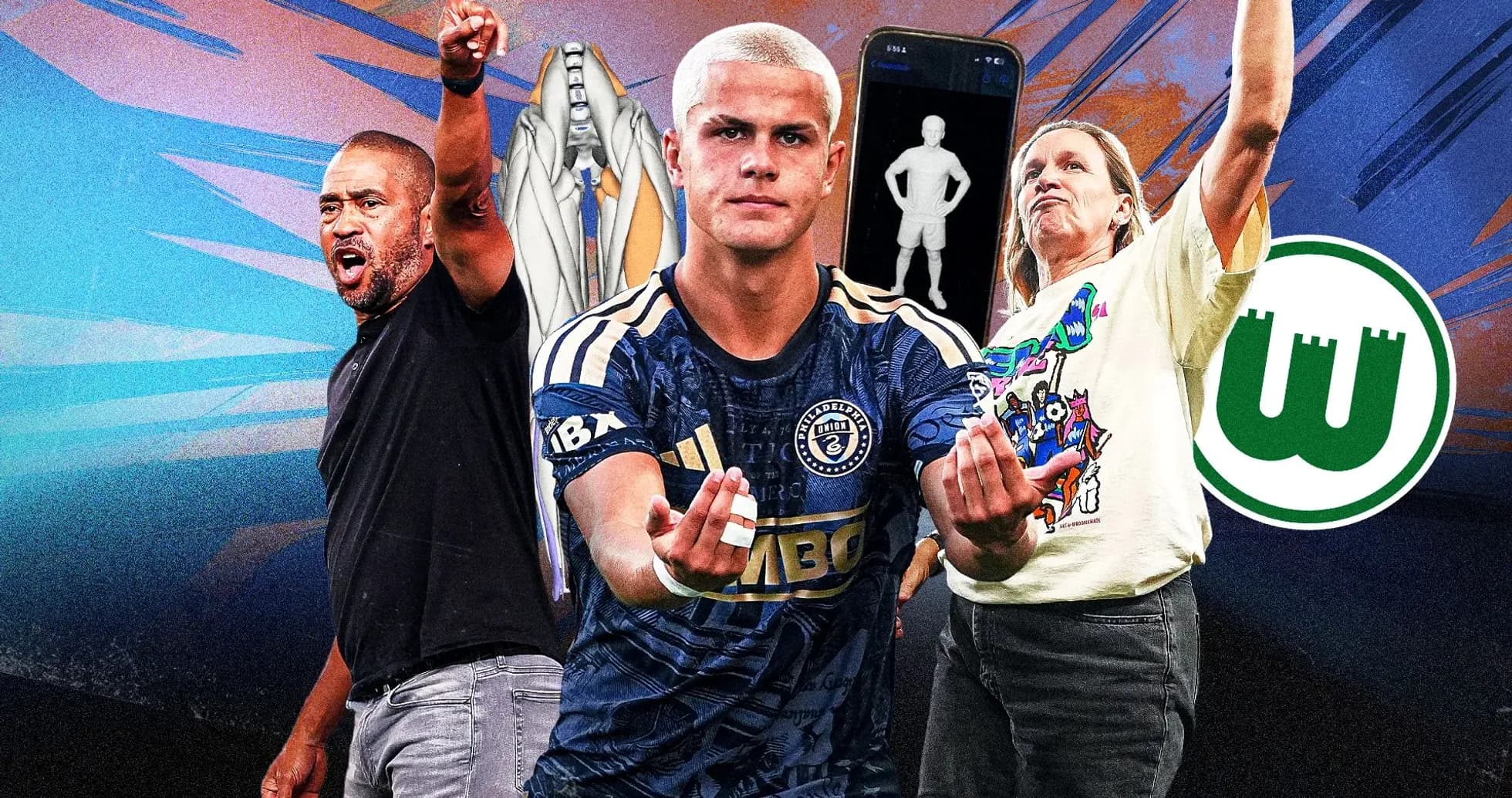
At the Philadelphia Union academy, staff live in the grey area between talent and body. How much first-team football can a teenager like Cavan Sullivan handle? How quickly will he grow? Will his frame cope with the workload?
There has never been a single, clean answer. Clubs test for strength, size, projected height, peak performance. It’s time-consuming, subjective and often inconsistent.
Fit:Match wants to cut that down to a phone and 10 seconds.
The process is bluntly simple. A user takes four pictures of a player from different angles. The phone calculates height, body mass, wingspan and a full set of body measurements. Then it goes further, projecting likely height, growth maturation and a basic snapshot of what full physical development might look like. Within 30 seconds, a digital profile lands in the coach’s hands.
Founder Haniff Brown calls it “ChatGPT for soccer” with a half-smile. Underneath the line is a serious point: this is a standard process at pro clubs, stripped down, sped up and standardized.
Brown didn’t come from sport. He came from fashion, trying to solve a very different problem.
“How can we allow [a user] to upload a body profile of himself so that he doesn't have to buy four shirts and return the three that don't fit? You'll just buy one and boom,” he said.
Retail noticed. So did hospitals and healthcare companies. Then, in 2024, an unnamed European club asked Fit:Match to scan its academy players. Brown saw a new lane.
“I was very clear from the start that it had to take no more than 15 seconds, and the reason I was clear on that is that I realized that coaches don't like assessments that take too long. They want the kids going back, doing their drills,” he said. “The longer and more complicated the assessment is, the less likely they are to use it.”
The club bought in. Others followed. The roadblock wasn’t the tech. It was the humans again.
“What we saw was one coach would, for the same player, measure and get one result, and from the same team, another coach would measure that same player and come up with a different result,” Brown said.
So Fit:Match removed the tape measure from the equation. Four photos, 30 seconds, and the system spits out a detailed profile. Now, clubs and even kids themselves use it.
“When parents register their children to go into an academy, they can actually upload their photos. It generates their digital twin, and then on the back end, we tell MLS all these stats on that player,” Brown said.
That data helps clubs place players in the right age groups, or at least make a more educated guess. Youth soccer is still heavily skewed by physical size. Early developers dominate. Late developers drift away.
“A player who is a 14-year-old but an early developer is far different from a player who's 14 and a late developer, and now MLS can scientifically tell that, and then make better pathways for those late developers so that they don't drop out of the ecosystem,” Brown said.
The promise is seductive: fewer kids lost, fewer bad guesses, a fairer pathway. It also opens up a can of ethical questions.
Projecting the body – and, by extension, the future – of a teenager is not a neutral act. Nor is giving a machine a say in who gets fast-tracked.
“The first step was getting people comfortable,” Brown admitted.
The uneasy ethics of an AI touchline
That theme runs through every corner of AI’s arrival in soccer. The tech is often ready. The culture drags behind.
Marquee understood quickly that it couldn’t just dump outputs on clubs and walk away. It had to sit alongside existing staff, not over them. Fit:Match had to prove it wasn’t a gimmick or a shortcut, but a way of standardizing what coaches were already trying to do. Springbok had to convince doctors that it was there to help, not to second-guess.
And even when the numbers look good, the football doesn’t always follow.
Wolfsburg were one of Europe’s early AI cheerleaders, trumpeting savings of €1 million per year through automated admin and injury-prevention tools. On the pitch, they struggled. The PR campaign backfired as results dipped and the narrative turned: robots in the office, points dropped on the weekend.
They have doubled down anyway. Sevilla have gone down a similar road, using IBM WatsonX to manage and make sense of their data.
Others have taken a more personal, almost playful approach. Some coaches admit to tinkering with ChatGPT in their own time, feeding it matchup scenarios and formations just to see what comes back. Most of those experiments never leave the laptop.
One did.
Seattle Reign head coach Laura Harvey revealed on the Soccerish podcast with Lori Lindsey and Christina Unkel that she asked ChatGPT a blunt question: “What formation should you play to beat NWSL teams?”
For two of the then-14 clubs, the answer came back: use a back five.
Harvey didn’t blindly obey. She took the idea to her staff, wrestled with it, and eventually the Reign rolled out a five-defender system. They finished fifth – eight places higher than the previous season.
Did ChatGPT transform Seattle Reign? Of course not. Coaches still coached, players still played. But a line of code had nudged its way into the tactical conversation and stayed there.
For AI advocates, that’s enough. The win isn’t the league table. It’s the fact that the machine had a seat at the table at all.
There are plenty of misses too, models binned, outputs ignored, recommendations quietly shelved. That might be the real point. AI is becoming another tool, another voice in a sport already full of them – analysts, agents, scouts, sports scientists, doctors, data firms.
In a game decided by inches and milliseconds, the ethics and optics of that extra voice can feel like a luxury argument.
“We’re all looking for any advantage we can get,” said Fraser, speaking for a growing majority inside the sport.
The question now isn’t whether AI belongs in soccer. It’s how far clubs are willing to let it in before it stops being a whisper and starts calling the shots.
Related News

PSG's Senny Mayulu Injured During France U21 Match

Italy’s Giacomo Raspadori Withdraws from Nations League Ahead of France Clash
Holger Rune's First ATP Tour Match Since Achilles Injury Set at Japan Open

Liverpool Faces New Setback as Cody Gakpo Leaves Netherlands Match Early
Denmark's Brian Riemer Confirms Patrick Dorgu Injury Withdrawal from National Squad

Real Madrid Concerned as Konaté Exits France Camp with Knee Injury