
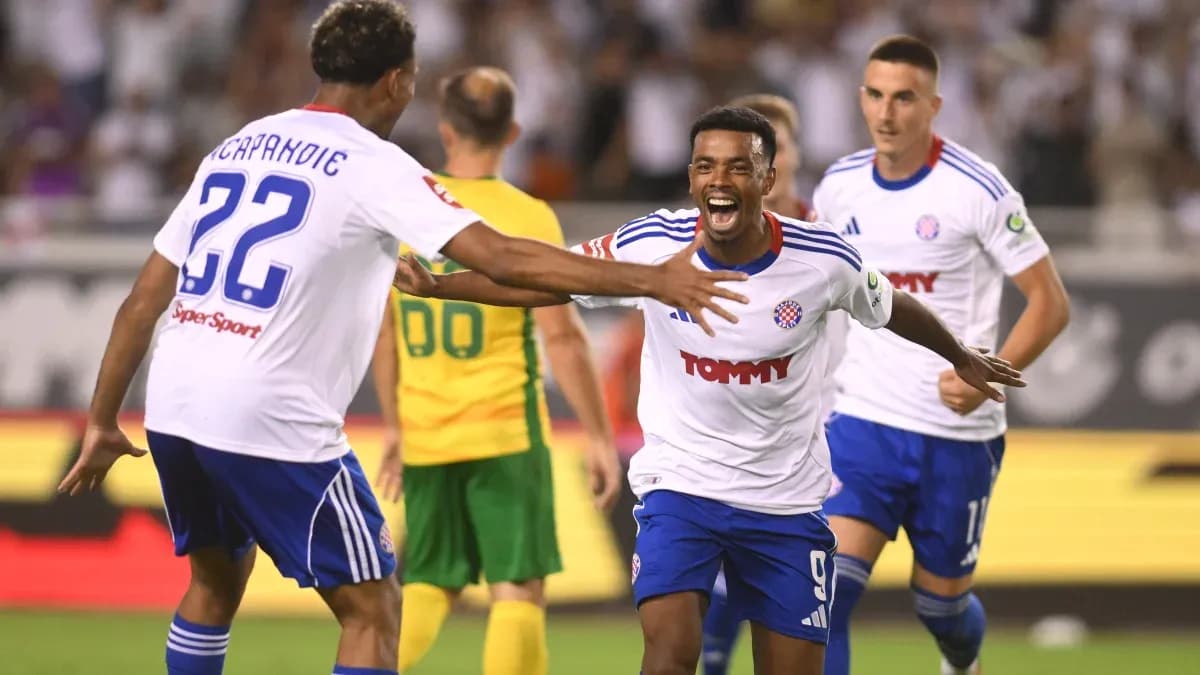
Žilina's Tactical Shift Leads to 2-1 Victory Against Hajduk Split
Žilina’s 2-1 turnaround against HNK Hajduk Split at Štadión pod Dubňom was built on clear structural contrasts between the teams and a decisive use of substitutions, rather than on any measurable statistical dominance in classic metrics like possession or shots, which are not available from the data. The tactical story is therefore read almost entirely through lineups, event timing, and the pattern of changes.
Hajduk opened in a 4-2-3-1 that looked designed for control and width. The back four of M. Acapandie, M. Skelin, Alec Van Hoorenbeeck and Šimun Hrgović sat behind a double pivot of Roko Pukstas and A. Pajaziti, with a narrow, technically-oriented band of three – R. Brajkovic, N. Skoko and D. Melnjak – supporting lone forward M. Sego. On paper, this offered good rest defence (two holding midfielders and four defenders) against Žilina’s transition threat.
Žilina, by contrast, lined up in a 3-4-3 under Pavol Stano, signalling an aggressive, front-foot approach at home. The back three of J. Minarik, A. Narimanidze and T. Paliscak were protected by a busy central pair, Xavier Adang and M. Kacer, with T. Hranica and K. Bari expected to provide width and vertical runs from the flanks. Up front, the trio of F. Kosa, M. Roginic and P. Ilko gave Žilina three high reference points against Hajduk’s back line.
First Half
The first half largely validated Hajduk’s structure. Their 4-2-3-1 gave them clear lanes to press Žilina’s first line of build-up: Sego could screen the central centre-back, while the wingers jumped to the wide centre-backs, and the double pivot stayed close enough to Adang and Kacer to prevent easy progression through the middle. The two early yellow cards for Hajduk – Šimun Hrgović at 21' and Alec Van Hoorenbeeck at 30', both for “Foul” – underline an aggressive, sometimes overzealous, engagement in duels rather than a passive mid-block.
The breakthrough just before the interval encapsulated their main attacking idea. At 45', A. Van Hoorenbeeck scored for Hajduk, assisted by Šimun Hrgović, before the goal was confirmed by VAR at 45+3'. The involvement of both full-backs – Hrgović as provider, Van Hoorenbeeck as scorer – reflects how Hajduk looked to overload the flanks and attack the far post from wide deliveries. With Žilina’s wing-backs often high, the spaces behind them were natural targets for late-arriving defenders.
At half-time, Žilina were 0-1 down but did not change system; instead, they adjusted personnel to sharpen their wing-back play. Immediately after the restart at 46', T. Paliscak (OUT) was replaced by M. Okal (IN). Given Paliscak’s role in the back three, this was a like-for-like defensive adjustment, likely aimed at improving 1v1 defending and distribution on that side, while maintaining the 3-4-3 structure.
Second Half
The turning point came in the early second half. At 52', M. Roginic equalised for Žilina, assisted by F. Kosa, with VAR confirming the goal at 54'. This sequence illustrates the core logic of Stano’s 3-4-3: wide forward (Kosa) pulling Hajduk’s full-back out and then supplying a central forward (Roginic) attacking the space between centre-backs. The fact that VAR had to confirm both teams’ first goals suggests fine margins in the timing and positioning of runs, but tactically it shows Žilina successfully exploiting the half-spaces behind Hajduk’s double pivot.
Stano then doubled down on energy and verticality in midfield and attack. At 66', he made a double change: M. Kacer (OUT) for F. Bzdyl (IN) and F. Kosa (OUT) for M. Fasko (IN), followed by P. Ilko (OUT) for S. Datko (IN) at 72'. Finally, at 82', Xavier Adang (OUT) made way for A. Florea (IN). Across these four substitutions, Žilina refreshed both central and wide zones, keeping intensity high against a Hajduk side that increasingly had to defend deeper.
The disciplinary pattern around this phase is telling. At 67', Xavier Adang received a yellow card for “Persistent fouling”, highlighting how Žilina’s central midfielder was repeatedly stepping in to break up transitions – a byproduct of committing numbers forward. Later, at 90+2', Andrei Florea was booked for “Foul”, again reflecting an aggressive, front-foot mentality in the middle third and late-game attempts to kill counters.
Hajduk’s response from the bench was more conservative and arguably less coherent offensively. At 64', N. Skoko (OUT) was replaced by D. de Almeida (IN), a like-for-like switch in the attacking midfield line, perhaps to add fresh legs between the lines. But the double substitution at 75' – Šimun Hrgović (OUT) for A. Sanyang (IN) and R. Brajkovic (OUT) for A. Guram (IN) – altered the balance on the flanks. Removing Hrgović, who had been both an assist provider and a booked, combative full-back, reduced one of Hajduk’s key outlets down the side. The 84' change, with M. Sego (OUT) and M. Livaja (IN), introduced a different profile at centre-forward, likely more of a link player, but it came relatively late, with Hajduk already under pressure.
Without concrete data on shots or possession, the decisive tactical moment is the 90' own goal by D. Melnjak, which turned the game to 2-1 in Žilina’s favour. From a structural viewpoint, an own goal in that phase often stems from cumulative territorial pressure: repeated deliveries into the box, tired defensive legs, and slight mis-timings in clearances. Žilina’s persistence with three forwards and constant refreshing of their midfield and wide players suggests they maintained attacking volume until the end, forcing Hajduk’s back line – including Melnjak – into increasingly stressed defensive actions in their own area.
Card distribution ended perfectly balanced – Žilina 2 yellows, Hajduk 2 yellows, total 4 – but the reasons and timing show different tactical profiles. Hajduk’s cautions (both “Foul” in the first half) came from assertive pressing and duels while they were in control; Žilina’s (one for “Persistent fouling”, one for “Foul” in added time) came from a high-risk, high-intensity chase and then game management once they had turned the scoreline around.
In statistical terms, the only hard numbers available are these disciplinary figures and the 2-1 final scoreline (0-1 at half-time). With no possession, shot, passing or goalkeeper data, the verdict rests on structure and substitutions: Hajduk’s initial 4-2-3-1 gave them the platform to lead, but Stano’s 3-4-3, aggressively managed from the bench, tilted the dynamic after the break. Žilina’s continual injection of fresh legs in midfield and attack, combined with persistent pressure on Hajduk’s back four, ultimately produced the decisive late error from Melnjak and a first-leg advantage that reflects tactical bravery more than statistical dominance.
Related News

Celje vs Red Bull Salzburg Predicted Lineups and Team News

Anderlecht vs Red Bull Salzburg Predicted Lineups and Team News
NEC Nijmegen vs Benfica Predicted Lineups: Team News for UEFA Europa League
Plzen vs Benfica Predicted Lineups: Team News Ahead of UEFA Europa League
Benfica vs Lech Poznan Predicted Lineups and Team News

Benfica vs OFI: Predicted Lineups and Team News for UEFA Europa League