
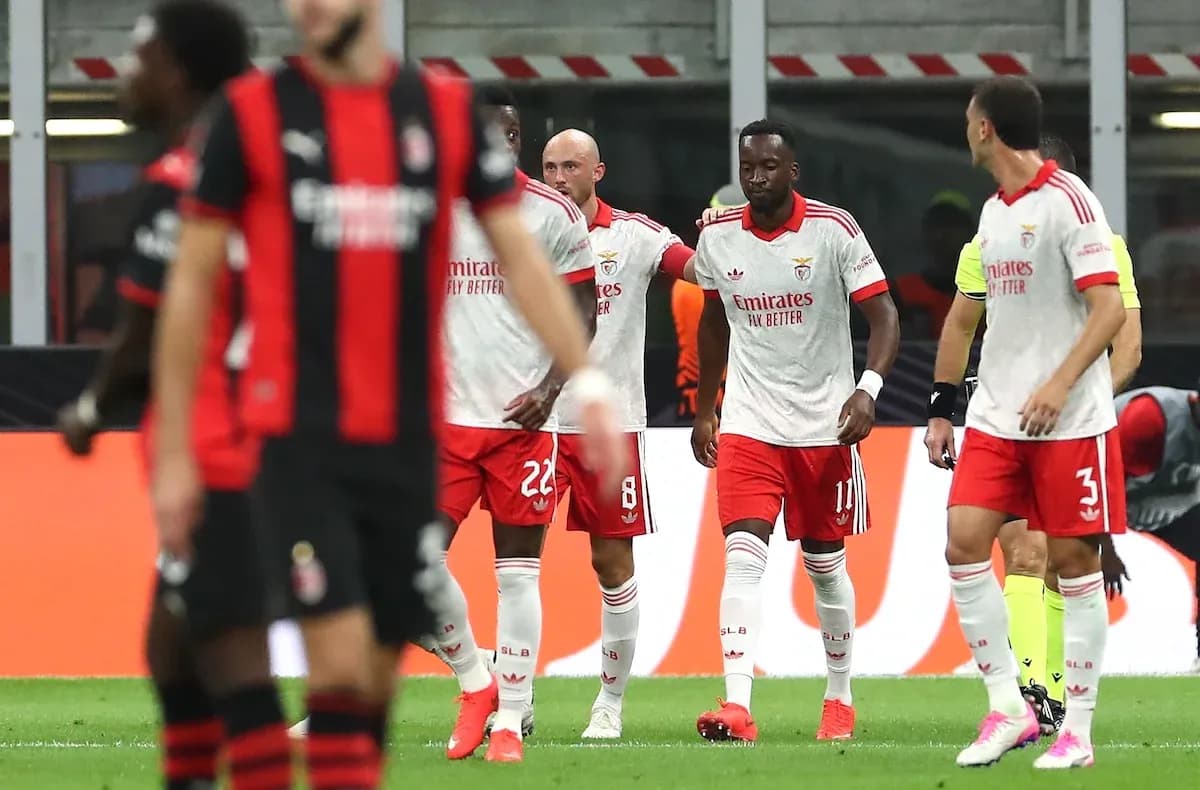
Benfica Dominates AC Milan in UEFA Europa League Opener
Under the San Siro lights, the opening League Stage night in the UEFA Europa League turned into a lesson in European control. Benfica walked out of Milano with a 2–0 away win, leaving AC Milan bottom of the early table and already chasing the pack.
I. The Big Picture – contrasting European identities
Following this result, the standings tell a stark story. AC Milan sit 31st in the league table with 0 points from 1 match, a goal difference of -2 from 0 goals scored and 2 conceded overall. At home they have played 1, lost 1, with 0 goals for and 2 against. Benfica, by contrast, occupy 7th place with 3 points from their opening league-stage outing, a goal difference of 2 built on 2 goals scored and none conceded overall. On their travels they have played 1, won 1, scoring 2 and conceding 0.
The numbers echo wider seasonal patterns. Heading into this game, Milan’s Europa campaign was a blank slate statistically, but their profile is already harsh: overall they have played 1, lost 1, failed to score, and conceded 2. Their average goals for overall stand at 0.0, with 2.0 goals against overall. Benfica arrived with a much deeper European rhythm: overall they have played 7 matches in this competition, winning 5, drawing 1 and losing 1. They average 3.0 goals for overall and just 0.9 against, with a clean sheet in 2 of those 7 games.
This fixture therefore pitted a side still trying to imprint a continental identity under Ruben Amorim against a Benfica team already hardened by qualifying rounds and early-season European battles under Marco Silva.
II. Tactical Voids – absences and discipline
Both coaches had almost full squads, but Benfica’s right flank carried a quiet void. A. Bah was listed as missing this fixture through injury, a notable absentee given his place among the competition’s leading assist providers. His 1 assist in earlier matches and his previous yellow card in the tournament underline both his attacking thrust and combative edge; without him, Silva turned to D. Banjaqui at right-back and leaned more heavily on the creative line of D. Lukebakio and J. Kaminski ahead.
For Milan, there were no formal absentees listed, but the statistical picture hints at a different kind of void: cutting edge. They have already failed to score in their only Europa League match overall, and at home that “failed to score” count stands at 1. Discipline-wise, Milan’s card profile in this competition is narrow but telling: 1 yellow card overall, and it came in the opening 0–15 minutes – a 100.00% share of their cautions concentrated in the very start of games. It suggests early nerves and potentially reckless pressure as they try to impose themselves.
Benfica’s disciplinary pattern is more distributed and reflects a side comfortable suffering without losing control. Overall they have spread their yellow cards across the match, but there is a clear late-game spike: 30.00% of their cautions arrive between 76–90 minutes, another 10.00% between 91–105. This is a team that pushes intensity to the end, even at the risk of bookings.
Individually, the warning signs are clear. V. Pavlidis, who came off the bench at San Siro, sits among the competition’s leading yellow-card collectors with 2 cautions overall, as does L. Barreiro with 2. Both are impact options from the bench, and both bring a level of edge that can tilt tight games – or tip them into danger.
III. Key Matchups – hunter vs shield, engine vs enforcer
Hunter vs shield
Milan’s “hunter” role in this match was diffuse rather than centred on a single talisman. G. Ramos led the line in a 3-4-2-1, flanked by A. Cisse and O. Hutchinson, with S. Chukwueze pushing high from the right side of midfield. Yet the team’s Europa numbers are brutal: 0 goals for overall, 1 match failed to score, and no evidence yet of a reliable scoring pattern. At home, the same: 0 goals for, 2 against.
Against that, Benfica’s defensive “shield” was not just A. Trubin in goal but a structure. Across their 7 Europa matches overall, they have conceded only 6 goals, with an average of 1.0 goals against on their travels. They have already kept 1 away clean sheet, and the back four of Banjaqui, A. Circati, T. Araujo and S. El Karouani at San Siro reflected a unit that is comfortable defending space as much as the box.
Engine Room – playmaker vs enforcer
The real tactical intersection in this fixture lay between Benfica’s advanced creators and Milan’s central screen. J. Kaminski arrived as one of the Europa League’s top performers: overall he has 1 goal and 1 assist, with 3 key passes and 10 total duels. His 76% passing accuracy and 7.9 average rating underline a player who thrives between the lines, exactly the zone Milan’s 3-4-2-1 must protect.
He operated with D. Lukebakio, another standout in this competition. Lukebakio’s Europa numbers – 1 goal, 3 shots all on target, 3 successful tackles, 10 duels with 7 won – paint him as a two-way winger, capable of tracking back yet ruthless when breaking. Together with G. Sudakov in the central pocket, they formed a triangle designed to drag Milan’s midfield out of shape.
Amorim’s shield against this was the trio of A. Jashari, Y. Musah and the wider work of D. Bartesaghi. Musah’s role as a carrier from deep was essential to breaking Benfica’s press, but Milan’s inability to turn those carries into final-third presence left Ramos isolated. With S. Pavlovic, K. De Winter and F. Terracciano forming the back three in front of M. Maignan, Milan had numerical stability but lacked the vertical bite to disrupt Benfica’s 4-2-3-1.
On Benfica’s side of the engine room, J. Palhinha anchored the midfield with F. Aursnes. Palhinha’s profile as an enforcer – physically dominant, happy to foul when needed – allowed Kaminski and Lukebakio to stay higher. Aursnes, tidier in possession, gave Benfica the ability to recycle the ball and force Milan’s block to shuffle from side to side, gradually opening seams.
IV. Statistical Prognosis – what this result really says
Following this result, the statistical prognosis for both squads in the league stage is sharply divergent.
Milan’s overall line now reads: 1 match played, 0 wins, 0 draws, 1 defeat, 0 goals scored, 2 conceded, 0 clean sheets, and 1 match failed to score. Their home averages – 0.0 goals for, 2.0 against – mark them as a side that has not yet found a reliable attacking structure in Europe under this shape. The early yellow-card concentration between 0–15 minutes suggests emotional starts that could be exploited by more experienced opponents.
Benfica, on the other hand, extend a broader Europa narrative. Overall they have 21 goals scored and only 6 conceded across 7 matches, with 5 wins and just 1 defeat. On their travels, they average 1.8 goals for and 1.0 against, with 1 away clean sheet already in the bank. Their penalty record – 4 taken, 4 scored, 0 missed – underlines a ruthless streak in high-pressure moments.
The creative core of Kaminski and Lukebakio, supported by Sudakov and underpinned by Palhinha, looks well-calibrated for this format. With depth options like Rafa Silva, V. Pavlidis, G. Prestianni and L. Barreiro on the bench, Marco Silva has the luxury of changing the game’s rhythm without sacrificing intensity – even if that comes with a disciplinary edge from players already on 2 yellows overall.
For Milan, the path forward is clear but demanding. Amorim’s 3-4-2-1 has a coherent defensive skeleton, yet the numbers insist on a shift in risk: more runners beyond Ramos, greater licence for Chukwueze and Hutchinson to attack the box, and perhaps earlier use of creative substitutes such as L. Modric or C. Pulisic to unlock packed defences.
As the League Stage unfolds, this night at San Siro may be remembered as the moment Benfica announced themselves as serious contenders – and the evening when Milan realised that in Europe, structure without incision is not enough.
Related News
Levski Sofia vs Red Bull Salzburg: Europa League Defeat Analysis
Five Europa League Players to Watch in the 2026/27 Season

Celje vs Red Bull Salzburg Predicted Lineups and Team News

Anderlecht vs Red Bull Salzburg Predicted Lineups and Team News
NEC Nijmegen vs Benfica Predicted Lineups: Team News for UEFA Europa League
Plzen vs Benfica Predicted Lineups: Team News Ahead of UEFA Europa League