
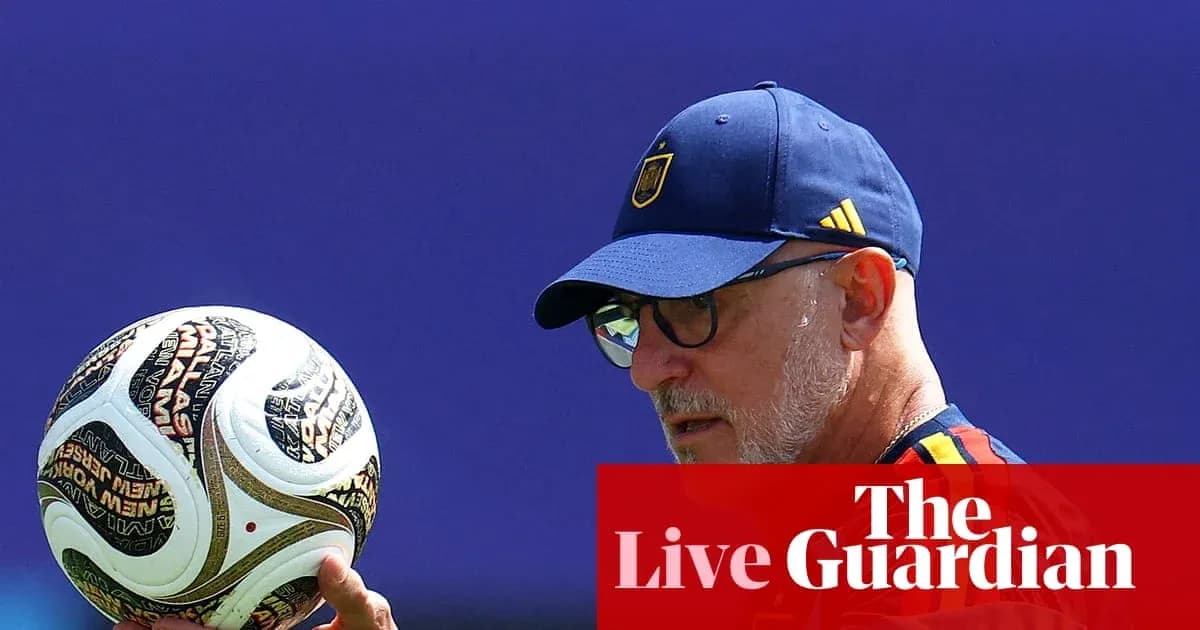
World Cup Questions and Future of Football
The World Cup has hit one of those barren stretches. Sixty-three hours without a ball being kicked, yet the sport refuses to sit still. Arguments about formats, managers, legends and even pub takings are filling the silence.
This is the final week of the tournament. The football will return. The noise around it has never really stopped.
Fans chasing moments before they disappear
For some, this World Cup is not just another tournament; it’s a race against time.
One England supporter, Al Daw, took his 70-year-old mother to the Panama match in New Jersey. It poured down, the MetLife felt, in his words, “like a prison”, but the pull of England and the World Cup dragged him back in. A couple of weeks later, with five children at home and another on the way, he gambled again.
He booked semi-final tickets for himself and his eight-year-old son before England had even secured their place, then added flights from Manchester to Atlanta via Paris and a hotel by the stadium. “Crackers pricing,” he admitted, but he went for it. He watched England’s quarter-final through his fingers, lost his voice, and now his son Digby is heading to see England – and possibly Lionel Messi’s last game for his country. A lifetime memory, if England can just find a way to snatch the win.
That is the World Cup at its most raw: risk, cost, anxiety, and the hope that one night will justify it all.
Pubs packed, tills quiet
The tournament is supposed to be a bonanza for pubs. For some, it still is. For others, this World Cup has exposed a new reality.
In Stourbridge, at the Shovel Inn where Jude Bellingham was born, owner Steve Hopkins is walking away from the trade after the tournament. He has worked in pubs for six World Cups and says most of them were “fantastic for trade”. This time, turnout has been poor. People are staying home or drifting in at the last minute. Where once a pub would be full by mid-afternoon for an 8pm kick-off, that early swell has disappeared.
A good night’s takings for the Shovel Inn used to be about £3,000. Hopkins says if he makes £1,000 on Wednesday’s semi-final, he will “be doing well”. For him, this World Cup will be the last stand in a business reshaped by Covid and changing habits. The atmosphere is still there when people come, he insists. The problem is getting them through the door.
France, Spain, England, Argentina – who can stop the machine?
With the semi-finals looming, the conversation inevitably turns to the only thing that truly matters on the pitch: who can stop France?
Spain look the most likely candidates. With Rodri edging back towards his pre-injury level, they have the control and rhythm to disrupt the French midfield. They still need more from Lamine Yamal, who does not yet look fully fit, but their structure and technical level give them a real shot.
England have a different route. They can out-run France in midfield, overwhelm them with legs and energy, but their defence feels brittle. Over 90 or 120 minutes, that vulnerability may tell.
Argentina, for all the romance around Messi, lack depth in midfield. Against a French team that can rotate gears and press from all angles, that looks a fatal flaw.
The fixture list may be on hold, but the arguments are not.
Portugal’s great waste – and the Mourinho what-if
Away from the semi-finalists, Portugal remain the great underachievers of this World Cup cycle. Roberto Martínez has at his disposal a double Champions League-winning midfield, Bruno Fernandes in front, and still his team have looked dour and blunt. The contrast between the quality on the pitch and the football produced has been stark.
The treatment of Bruno has jarred most. He is a player who needs time on the pitch, someone who keeps trying things until one comes off. Cut his minutes and you cut the odds of him making something happen. Ask him to collect the ball off the back four and you blunt him further.
Against that backdrop, the idea of José Mourinho taking this Portugal squad has hovered over the tournament. Many expected him to move into international management by now. Instead, he is heading back to Real Madrid, the latest club to bet they can rediscover his old magic. It will be box office at the Bernabéu, but no guarantee of success.
The thought lingers: could he really have done any worse than Martínez with this group?
Tuchel, Bellingham and a flash of heat
Not all tension at this World Cup has come in the stands or between nations. Thomas Tuchel and Jude Bellingham briefly found themselves at the centre of a storm, words exchanged in a moment of high emotion and release.
Yet both are serious professionals, both obsessed with winning, and both know they need each other. The sense is that this will blow over quickly, if it hasn’t already. This is the modern game: flashpoints replayed and dissected, then quietly resolved while the cameras look elsewhere.
Stones, Messi and the problem of genius
The looming possibility of England facing Argentina has sparked another old debate: how do you stop Messi?
John Stones divides opinion. As a footballer, he is admired. As a pure defender, doubts remain. His lack of pace could be exposed by Julián Álvarez and Lautaro Martínez. His ability to track Messi’s movement is an open question. The tactical puzzle is obvious; the solution less so.
That puzzle feeds into a wider argument about greatness. For some, Messi is the greatest of all time, his consistency and longevity unmatched. Others still point to Diego Maradona’s peak, especially at Mexico 86 and the season that followed when he carried Napoli to their first scudetto, as a level no one has surpassed.
For those who grew up on Mexico 86, that tournament still feels like football’s wildest dream. Maradona’s second goal against England, Barry Davies’s line – “you’ve got to say that’s magnificent” – and the sense, for a generation of children, that one man could simply run past everyone whenever he chose.
It turned out almost no one could. Only Diego. No player has done more to challenge the idea that football is strictly a team game.
The World Cup that keeps growing
While the semi-finals simmer in the background, FIFA president Gianni Infantino has floated his latest expansion vision: a World Cup with 64 teams.
On instinct, it feels wrong. On paper, it might not be. One argument goes that the quality gap between the 48th and 64th-ranked teams is not that significant, so the overall standard would not collapse. A larger field would also allow a return to a cleaner format: only the top two from each group go through. No more third-placed teams sneaking into the knockouts after beating only the weakest side. No more 72 group matches just to eliminate 16 teams.
An expanded tournament could open doors for nations who rarely, if ever, make it. The Euros have already shown how new faces can enrich a competition.
The catch is everything around the football. Infrastructure, travel, hotels, training bases, media facilities – all would need to scale up. The risk is obvious: only a handful of countries might be able to host, and qualification, already bloated, would grow even more tedious.
The World Cup is becoming bigger, cleaner on paper, messier in practice.
The game behind the game
While the world waits for the semi-finals, the conversations keep circling back to the same themes: who can stop France, how to judge Messi against Maradona, what to do with bloated formats, and why a World Cup semi-final might no longer guarantee a packed pub.
Somewhere between Atlanta, Stourbridge, North Maluku and the Bernabéu, football is stretching, arguing with itself, trying to work out what it wants to be.
The next ball hasn’t even been kicked. The next era is already on the line.
Related News
Ilia Topuria Accuses Justin Gaethje After UFC Defeat

Tyson Fury vs Anthony Joshua Fight Date and Venue Confirmed
Switzerland Calls Up In-Form Sion Striker Winsley Boteli for Nations League
Bournemouth Secures Historic 2-1 Win Over Real Sociedad in Spain
Portugal Announces Squad for 2026 UEFA Nations League; Cristiano Ronaldo Expected to Play
Raphinha Channels Ronaldo Nazario as Barcelona's Leading Striker After Position Change