
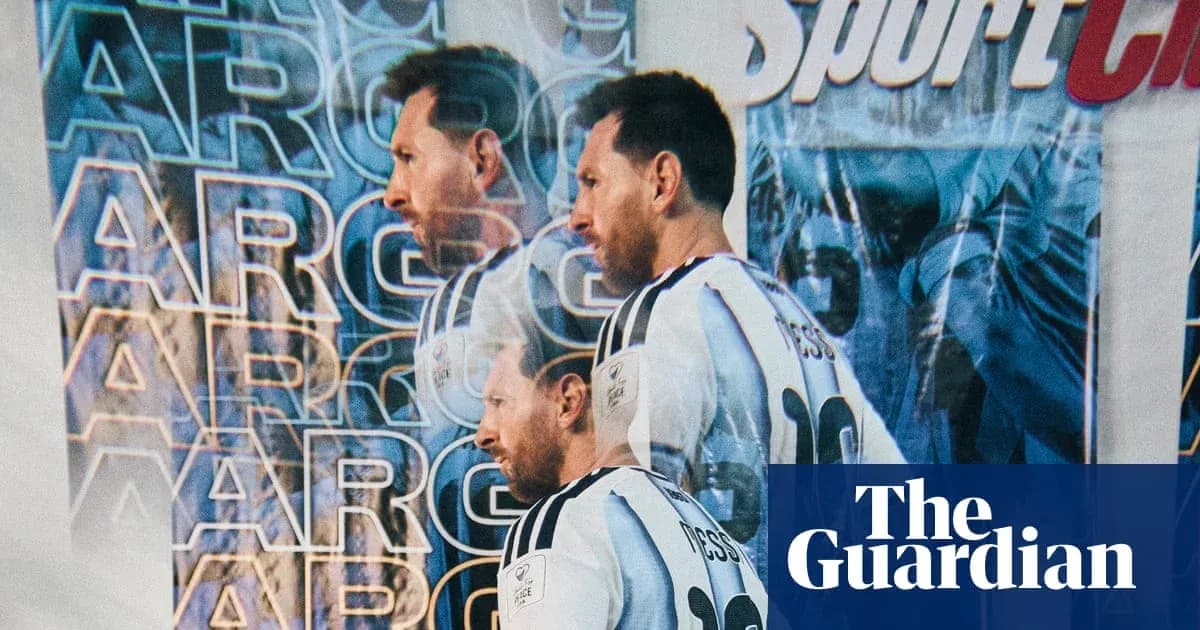
Inside the World Cup’s Portrait Factory: Capturing Icons
Lionel Messi freezes, almost statuesque, staring straight down the lens. A rigid frame, a calm face, the tiniest flicker of light in his eyes. A global icon reduced, for a heartbeat, to a still life.
Marc Cucurella does the opposite. Hair flying, shoulders loose, he looks like he’s about to break into a dance. Diego Moreira hides his eyes behind a forearm, an eerie tattoo doing the talking instead. Harry Kane drops on to one knee, caught between awkward and earnest.
Welcome to the World Cup’s most unavoidable fixture: the official portrait.
There are 1,248 players and 48 managers at this tournament, and not one of them has escaped the ritual. No one gets a pass from Fifa’s lens. Whether they arrive armed with a rehearsed celebration or shuffle in with the enthusiasm of a tax return, they all leave with a headshot that will follow them for weeks.
Inside the World Cup’s portrait factory
Getty Images, commissioned by Fifa, has spent recent weeks turning training bases into makeshift studios. Two photographers are assigned to each squad. One builds a plain set, the other something more distinctive. Players and coaches shuttle between the two like travellers at a busy airport gate, ushered in, posed, and sent back out again.
The lighting is deceptively simple. A big studio strobe with a softbox aimed squarely at the body. A couple of rim lights at the back to carve out shoulders and jawlines. No elaborate rigs, no sprawling crews. Just a tight, efficient set-up designed to survive the onrush of a full squad on a tight schedule.
The backdrops this year are more muted than the bold, graphic look of 2022. The colour has shifted from the walls to the glass. Special lens filters – the kind that smear light and fracture colour – do the heavy lifting, throwing up unpredictable blur and kaleidoscopic flares. Messi’s portrait, with its dreamlike halo and smeared edges, comes out of that controlled chaos.
Behind the scenes, Getty’s own pictures tell a second story: players laughing between frames, staff adjusting collars, photographers hunched over laptops while a superstar studies their own reflection on screen.
“Like a production line”
Tom Jenkins, the Guardian’s veteran sports photographer, knows the drill. Photographing elite footballers can be awkward at the best of times. Turn it into a conveyor belt and the pressure ramps up.
“With these kinds of shoots, you only get a few minutes with each player and you have to bash out various pictures and think incredibly quickly,” he says. It’s speed dating with global celebrities, except the only thing that matters is the frame.
You still need the basics. The school-photo shot. Shoulders square, eyes forward, clean background. The kind of image that used to define media guides and sticker albums. But that’s no longer enough. The modern game demands something else: personality, theatre, a hint of brand.
“You want some shots that are dead plain like a school photo – that’s how player portraits always used to be done – but these days you also want pictures that are more emotive and fun,” Jenkins explains. Some players arrive with a pose already loaded, a goal celebration ready to deploy. Others wait for direction. The photographer has to carry a mental list of options and fire them out on instinct.
The power dynamic flips for a moment. On the pitch, these players control stadiums. Under the lights, the photographer calls the shots. “The interesting thing is that you’re in control of these superstars and every aspect of the shoot,” Jenkins says. “There’s a lot of pressure that comes with that.”
So everything must be ready before the first boot steps on set. Lights tested. Filters checked. Backdrops smoothed. Once the door opens, there’s no time for tinkering. “You have to make sure you’ve set things up and tested everything before they arrive, so that when the shoot starts you can just focus on them.”
Image-obsessed players, ruthless audiences
Every player gets a name card. Even Messi. Not because anyone might forget who he is, but because somewhere, deep in the editing chain, a file will need to be tagged correctly. The world’s most famous footballer reduced to a label on a white board for a few seconds.
Most players insist on seeing the shots straight away. A quick glance at the monitor. A nod. Sometimes a request for another take. They know what plays well.
“Most football players are very aware of their own image these days and they know how powerful it can be, especially through Instagram,” Jenkins says. This is a generation raised on brand campaigns and social media metrics. Eberechi Eze has fronted Burberry. Declan Rice has stood in front of the lights for L’Oreal. The studio is no longer a foreign land; it’s another part of the job.
Some thrive on it. They lean into the character, exaggerate the swagger, sell the myth. Others remain stiff, giving little away. That’s where the filters, the angles, the split-second timing come in. When the subject is flat, the camera has to provide the spark.
Not that the court of public opinion shows any mercy. England’s portraits sparked the usual online inquest. Rice was ribbed for a clear case of sunburn. Anthony Gordon drew comparisons to Princess Diana. Dean Henderson’s sideways glare became instant meme material, his expression hovering somewhere between suspicion and horror.
Yet the more creative frames – the warped reflections, the fractured colours, the dramatic shadows around Jude Bellingham and his teammates – reveal what can be done in-camera when the photographer pushes the limits of a simple set-up. Even a flat pose can turn into something striking with the right lens and a fraction of risk.
The reluctant star: Marcelo Bielsa
And then there is the portrait that has cut through more than any player’s: Marcelo Bielsa’s.
Shot by Michael Regan at Uruguay’s base in Cancún, the image has travelled the world precisely because the subject refused to play along. While others faced up, Bielsa looked down. Hands in pockets, gaze fixed on his feet, he simply declined the unspoken contract of the portrait session.
The result is pure Bielsa. Awkward. Stubborn. Honest. An anti-portrait that tells you more about the man than any carefully curated pose could.
“I’m not a model,” he protested afterwards. Of course he did. The line fits the frame. A coach who has built a career on obsession and principle was never going to perform for the camera on command.
For Jenkins, that’s exactly the point. “Ultimately I think the best portrait is one that displays the individual’s personality, and that’s why the Bielsa picture is so brilliant,” he says. “It’s perfectly him.”
In a World Cup saturated with images, the most revealing shot might be the one where the subject refuses to look up.
Related News
Raphinha’s Hat-Trick Powers Barcelona to 7-2 Victory Over Racing Santander
Carabao Cup Fourth Round Draw: Liverpool Set to Clash with Chelsea, Arsenal to Face Fleetwood Town
Key Football Matches to Watch in Azerbaijan This Autumn
Raphinha's Hat-Trick Drives Barcelona to 7-2 Triumph Over Racing Santander
Hansi Flick Leads Barcelona to Record-Breaking Seven Wins in a Row
Gavi Reflects on Injury Return as Barcelona Dominate Racing Santander 7-2