
World Cup Last 16: Giants Wobble as Altitude Questions Grow
Six days, 16 matches, and half the World Cup has been stripped away. From 32 hopefuls, only 16 remain – and the route here has been anything but smooth for some of the favourites.
Germany’s exit was the thunderclap. A side with roughly a 63% chance of progressing, sent home by Paraguay on penalties. Not a plucky scare, not a narrow escape. Gone. If Senegal had held on against Belgium, that would have landed in the same weight class of shock. They didn’t, but the warning flares are everywhere for the established powers.
Morocco’s victory over the Netherlands carried the feel of an upset, yet the numbers tell a cooler story. The Dutch were only around 55% favourites in the Elo model – barely more than a coin flip. It was one of the round’s most finely poised ties, and it played out like it.
At the other end of the spectrum, some of the supposedly straightforward contests produced the fiercest drama. Cape Verde, given only a 10% chance of knocking out holders Argentina, dragged them into extra time and had them sweating for survival. Congo, with just a 17% probability of progress, led England with 15 minutes to go. These were not meant to be epic struggles. They were.
Old powers dominate, but the outsiders linger
The last 16 has a familiar look. Asia’s challenge is over. Africa is down to two survivors. The bracket is once again weighted heavily towards Europe and South America.
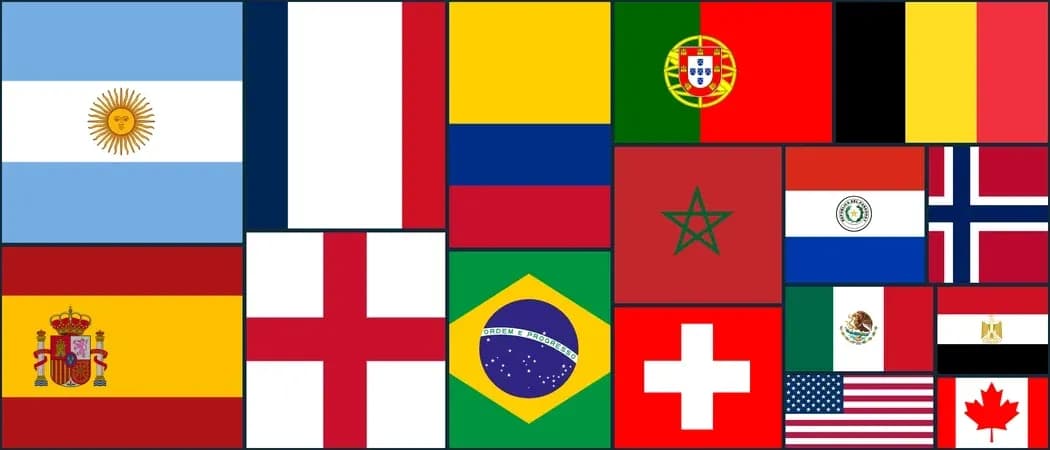
From outside those traditional power bases, only Canada, Egypt, Mexico, Morocco and the United States remain. Collectively, their chances of winning the whole thing amount to about 3.5%. They are the long shots, the awkward questions for the favourites, not yet the likely champions.
At the top of the tree, Argentina are still there, but not unscathed. Their extra-time escape against Cape Verde has trimmed their overall title probability to 28%. Part of that shift comes from elsewhere: France have quietly profited from Germany’s collapse at the hands of Paraguay.
France’s chance of lifting the trophy has jumped to 14%. Spain’s has climbed to 16%. Both cruised through their last-16 ties – Spain making light work of Austria, France dispatching Sweden with similar authority. One more step taken, one more obstacle cleared.
England, Mexico City and the thin air
England’s own prospects have nudged upwards to 12%. That rise owes as much to simple arithmetic – fewer teams left – as it does to performance. The path in front of them remains brutal. Brazil and Argentina still lurk on their side of the draw, assuming they first deal with Mexico in Mexico City.
On paper, England hold a clear edge. Even after accounting for home advantage, the expected goals model gives Mexico just 0.6 xG to England’s 1.6. That gap translates into a 62% probability of an England win inside 90 minutes, 13% for Mexico, and a 25% chance of a draw that drags the tie to penalties.
Yet no one is talking only about tactics or talent. The conversation keeps coming back to altitude.
Mexico City sits a little above 2,000 metres. The myths around playing at that height are well-worn: gasping lungs, heavy legs, the ball flying differently through the air. But when you dig into thousands of past international matches played at different altitudes, the story becomes far more nuanced.
Rounded to the nearest 500 metres, the raw data shows almost no simple, linear impact of altitude on the likelihood of a home win. At sea level – and around a third of all internationals are played within 250 metres of it – home teams win about 55% of the time. Between 2,000 and 2,250 metres, where Mexico City sits, the home win rate actually drops slightly, to 52%.
That sounds like altitude is a red herring. It isn’t that simple.
When the mountains help – and how much
To get a clearer view, you have to strip out team strength. The model uses Economic Observatory Elo ratings, which line up closely with FIFA rankings and have a strong record predicting international results. These ratings give an implied probability of a home win, from 1 (home win certain) to 0 (away win certain).
By coding the actual result as 1 for a home win and 0 otherwise, then subtracting the Elo prediction and taking the average, you get a measure of how often home teams outperform expectations at different altitudes.
The pattern is revealing. Below about 1,750 metres, home sides win roughly as often as the Elo model suggests they should. No clear altitude effect. Above that threshold, the numbers begin to tilt. Home teams at higher altitudes – places like Bolivia above 3,000 metres, or Ecuador, Ethiopia and Mexico above 2,000 – start to outperform their Elo-based expectations.
Even then, the effect is modest. At the very highest altitudes in the sample, the over-performance gap reaches about 20 percentage points. That sounds sizeable, but statistically it still sits within the margin of error. It hints at an advantage rather than proving an overwhelming one.
For Mexico against England, that’s the crux. The data does not point to a huge, decisive edge for the hosts. It also doesn’t dismiss the possibility that Mexico gain something from the thin air, especially against opponents with little time to acclimatise.
A leveller, not a coin flip
Run a simple thought experiment. If altitude knocks 0.25 expected goals off England’s tally and adds 0.25 to Mexico’s, the picture changes. England’s win probability drops from 62% to 48%. Mexico’s rises from 13% to 24%. The chance of penalties grows with it.
Even then, England remain the stronger side in every major model – whether based on past results or on squad valuation measures such as Transfermarkt. Altitude acts as a leveller, shaving away at the gap, but it does not quite drag the tie into pure toss-up territory.
What it does promise is jeopardy. A favourite made just vulnerable enough, in a stadium where the air is thin and the noise is thick.
The rest of the bracket: favourites with frailties
Across the remaining last-16 ties, the simulations paint a bracket that still leans heavily towards the big names, but with clear pressure points.
- Argentina over Egypt (77% likely)
- England over Mexico (74%)
- Morocco over Canada (70%)
- Spain over Portugal (72%)
- Colombia over Switzerland (70%)
- Brazil over Norway (69%)
- Belgium over the United States (64%)
- France over Paraguay (62%)
France’s figure jumps off the page. Only a 62% chance of progressing against Paraguay, despite their attacking firepower. The numbers echo what the group-stage preview of Group D already suggested: Paraguay are stubborn, drilled, and defensively hard to move.
Strip away the reputations and look again at the expected goals. France are projected at just 1.1 xG in that tie, Paraguay at 0.6. It is still a game France should win, but it also looks like their sternest examination so far – a grind rather than a showcase.
The pattern is clear. The giants are still in control of the tournament’s destiny, but they are not cruising untouched. Germany have already paid the price. Argentina have flirted with the edge. France and England now walk into traps of their own – one built on defensive resilience, the other on altitude and atmosphere.
The last 16 is set. The numbers favour the usual suspects. The question now is who has already used up their escape.
Related News

Raphinha’s Hat-Trick Powers Barcelona to 7-2 Victory Over Racing Santander

Carabao Cup Fourth Round Draw: Liverpool Set to Clash with Chelsea, Arsenal to Face Fleetwood Town
Key Football Matches to Watch in Azerbaijan This Autumn

Raphinha's Hat-Trick Drives Barcelona to 7-2 Triumph Over Racing Santander

Hansi Flick Leads Barcelona to Record-Breaking Seven Wins in a Row

Gavi Reflects on Injury Return as Barcelona Dominate Racing Santander 7-2