
World Cup 2026: Seven Nations Vie for Glory
Seven nations remain. One World Cup to win. And as the 2026 tournament narrows to its sharpest edge, the story is increasingly European blue — with one stubborn streak of South American sky.
Argentina stand alone as the last non-European side left in the United States–Mexico–Canada showpiece. Around them, six European heavyweights and hopefuls jostle for position, history and survival. One bad night and it’s over. One moment of genius and the entire narrative tilts.
This is where reputations harden, myths are born, and careers are defined.
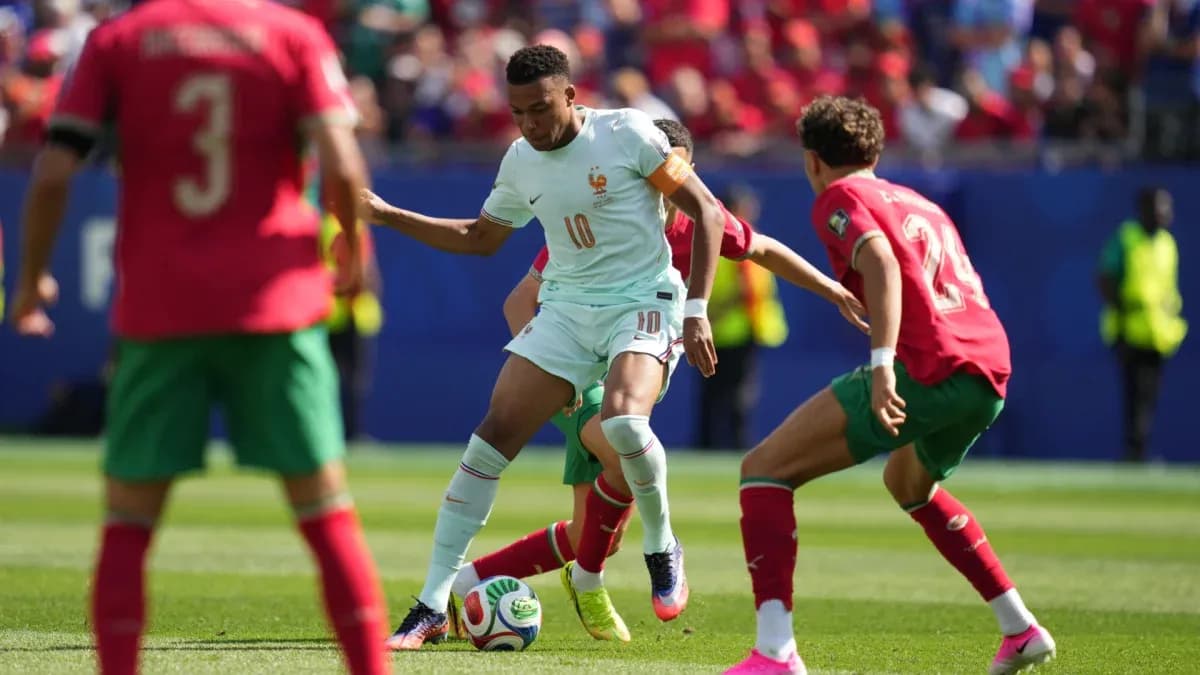
France: Mbappé chasing history
France are already there, waiting in the semi-finals, looking ominously comfortable.
Les Bleus brushed aside Morocco 2-0 on Thursday to book their place in Dallas next Tuesday, July 14, at AT&T Stadium. They are two-time world champions and now one step from a shot at a historic hat-trick. The only question left for them in the short term is simple: Spain or Belgium?
France have not just progressed; they’ve imposed themselves. Group I was a procession: Senegal beaten 3-1, Iraq dismantled 3-0, Norway put away 4-1. The knockout phase brought sterner tests, yet the results barely flickered — Sweden 3-0, Paraguay 1-0, Morocco 2-0. Six wins, no defeats, barely a wobble.
At the heart of it all, inevitably, is Kylian Mbappé.
The captain has turned this World Cup into another personal exhibition. France’s all-time leading scorer is already the tournament’s top marksman this year and has climbed alongside Lionel Messi on 17 non-penalty World Cup goals across all editions. For a player who openly places Messi and Cristiano Ronaldo ahead of himself, his numbers argue back on his behalf.
He did scare a nation with an ankle injury against Morocco, but Mbappé has insisted he is “completely fine”. France will expect him not just to play, but to dominate. He is no longer the prodigy chasing legends. He is right on their shoulders.
Spain: La Roja’s new conductor
Spain arrive at their quarter-final with Belgium on Friday at SoFi Stadium in Los Angeles with a familiar feeling building around them. When they last lifted the World Cup in 2010, they did it with control, patience and a cold, technical ruthlessness. This version has some of that steel, but there’s a fresh streak of electricity on the right flank.
Lamine Yamal is only 18. He already looks like the kind of player tournaments bend around.
Spain eased through Group H after a cagey 0-0 with Cabo Verde, then a 4-0 dismantling of Saudi Arabia and a narrow 1-0 win over Uruguay. Once the knockouts arrived, they shifted up a gear: Austria swept aside 3-0, Portugal edged 1-0 in a heavyweight Iberian clash.
Yamal came into the World Cup still working back from a hamstring injury, warning he was not yet ready for full 90-minute shifts. It hasn’t mattered. His talent has flashed through anyway — the touch, the daring, the sense that defenders are never quite sure which way he’ll go.
Spain are officially ranked just behind Argentina. On form, they look every inch a champion-in-waiting. If they get past Belgium, a semi-final with France would pit Mbappé’s established stardom against Yamal’s rising light. That’s not just a match; it’s a generational crossroads.
Belgium: Lukaku against the noise
Belgium were supposed to be fading from the golden-generation glow. Instead, they just walked into the United States and hammered the hosts 4-1.
De Rode Duivels didn’t just eliminate Team USA; they silenced a stadium and shredded a narrative. FIFA’s decision to suspend Folarin Balogun’s red card so he could play — and Donald Trump’s claim of involvement in that call — had tilted the build-up toward an American resurgence. The betting markets followed. Belgium ignored all of it.
They had already navigated a tricky Group G with draws against Egypt (1-1) and Iran (0-0), then a ruthless 5-1 demolition of New Zealand. In the knockouts, Senegal fell 3-2 before the U.S. were blown away.
Rudi Garcia, even after that statement win, remarked that “everyone thinks [they] are going home.” The perception of Belgium as yesterday’s story lingers. Romelu Lukaku is doing everything he can to tear it up.
Belgium’s all-time top scorer has been a weapon off the bench, scoring in each of their last three World Cup games as a substitute. In doing so, he became the first player in World Cup history to score as a substitute in four separate matches. That is not a footnote. That is a striker redefining the idea of impact.
Spain will not underestimate him. Nor should they. Lukaku smells records, and he smells disrespect. Few combinations are more dangerous.
Norway: Haaland and the dream that no longer feels impossible
Norway are in uncharted territory. A quarter-final. A date with England on Saturday, July 11, at Hard Rock Stadium in Miami. Their best-ever World Cup already secured — but absolutely not enough for them.
Placed with France in Group I, Landslaget took an early 4-1 beating from the reigning champions. Many sides would have shrunk from that. Norway did the opposite. They thrashed Iraq 4-1, then edged Senegal 3-2 to reach the knockouts, where they proceeded to eject Côte d'Ivoire and Brazil, both by 2-1 scorelines.
Beating Brazil in a World Cup knockout game is not something that happens by accident. It changes how a team sees itself.
At the center of this transformation is Erling Haaland, the striker whose name now sits comfortably in conversations alongside Messi and Ronaldo. He brushes off the comparisons, but his numbers shout over his modesty: 60 goals in 53 senior internationals, the 60th coming against Côte d'Ivoire in this tournament. Messi and Ronaldo needed more than twice as many games to reach that mark.
Norway are no longer tourists. With Haaland leading the line, they walk into Miami believing they can drag England into a fight they might not like.
England: Kane’s relentless pursuit
England’s relationship with the World Cup has always been a tangle of hope, history and heartbreak. This time, they are three wins from ending a wait that stretches back to 1966, and they have a striker in the form of his life carrying their ambitions.
The Three Lions fought their way out of Group L with a 4-2 win over Croatia, a frustrating 0-0 with Ghana, and a composed 2-0 victory over Panama. In the knockouts, they edged the Democratic Republic of Congo 2-1 and then came through a breathless 3-2 against Mexico.
Harry Kane, their captain and all-time top scorer, is again the spearhead. Six goals so far in this World Cup put him fourth on the scoring charts behind Mbappé, Messi and Haaland — elite company that suits him. He already owns a Golden Boot from 2018, and his 2025-26 season has been monstrous: 73 goals in all competitions, second only to Messi’s legendary 2011-12 tally.
Kane is not a forward riding a hot streak. He is a machine of repetition, angles and nerve. Against Norway, he meets Haaland in a duel that could define the entire quarter-final slate. One chases his nation’s first World Cup in six decades. The other chases their first semi-final ever.
Something will give.
Argentina: Messi’s last great stand?
Argentina arrive at Arrowhead Stadium in Kansas on Saturday as the world’s No. 1-ranked side and the last South American flag-bearer in a European-dominated endgame. It suits them. La Albiceleste have always thrived with a little edge, a little sense of defiance.
They have been ruthless so far. Group J saw Algeria beaten 3-0, Austria 2-0, Jordan 3-1. The knockout stage tightened the margins but not the outcome: Cabo Verde sent home 3-2, Egypt dispatched by the same scoreline. No drama in the results, only in the manner.
At the center of everything, again, is Lionel Messi.
Head coach and captain, Argentina’s all-time top scorer, and still the gravitational force of the tournament. He became the first player ever to win the World Cup’s Golden Ball twice; now he is busy rewriting the record book again. He has already set the mark for most goals in World Cup history, taking that tally to 21, and he stands alone as the first player to score in eight consecutive World Cup matches.
These are not just records; they are milestones in a farewell tour that may never be officially called one, but feels like it. Every touch carries weight. Every free-kick, every dribble, every pause before a penalty feels like a moment you might never see again.
Switzerland will not care about the sentiment. They cannot afford to. But they will have to find a way to stop the most decorated player in the sport’s history with the world watching.
Switzerland: Xhaka and the art of resistance
Switzerland have never been this close to something seismic in the modern era. Ranked 19th in the world, Nati now stand in front of the ultimate test: Argentina, Messi, and the full weight of football history pressing down on them.
Their path here has been quietly impressive. Group B began with a 1-1 draw against Qatar, then a 4-1 win over Bosnia and Herzegovina and a 2-1 victory over Canada. In the knockouts, they handled Algeria 2-0 before surviving Colombia in a goalless battle decided 4-3 on penalties.
This is a team that knows how to suffer, how to hang on, how to bend without breaking.
Granit Xhaka is the embodiment of that mentality. The captain and defensive midfielder has already led Switzerland to their first World Cup quarter-final since 1954. He does not rely on goals — his position rarely allows it — but on control, passing lanes, and the ability to fracture an opponent’s structure with one smart ball.
He will need the game of his life against Argentina. Not just to track Messi, but to organize the press, to break out under pressure, to give his side a foothold in a match that could otherwise become a blue-and-white wave.
Switzerland have spoken openly of their excitement at facing Messi. Beneath that admiration sits something sharper: the desire to be remembered as the team that stopped him.
Seven nations remain. France already wait in the last four, with Mbappé stalking more history. Spain and Belgium will collide in Los Angeles to decide who joins them. England and Norway head to Miami with Kane and Haaland braced for a shootout. Argentina and Switzerland travel to Kansas, one side carrying the greatest of all time, the other chasing the greatest upset of this World Cup.
The bracket is set, the margins are thin, and the stars have all reported for duty.
Now the question is simple: whose story survives the week?
Related News
Ilia Topuria Accuses Justin Gaethje After UFC Defeat
Tyson Fury vs Anthony Joshua Fight Date and Venue Confirmed
Switzerland Calls Up In-Form Sion Striker Winsley Boteli for Nations League
Bournemouth Secures Historic 2-1 Win Over Real Sociedad in Spain
Portugal Announces Squad for 2026 UEFA Nations League; Cristiano Ronaldo Expected to Play
Raphinha Channels Ronaldo Nazario as Barcelona's Leading Striker After Position Change