
World Cup 2026: Iran Faces Protests and Political Tension in LA
By the time Iran walk out to face New Zealand in Los Angeles tonight, the football will already be fighting for space. Noise, anger and symbolism are coming for this game from every side.
This is the World Cup where the host nation is at war with one of the participants. A first in the tournament’s 96-year history. Iran’s opening match at SoFi Stadium is not just a fixture; it is a collision point – between a regime and its opponents, between Fifa’s sanitised image and a conflict it cannot airbrush away.
Taremi’s tension and a World Cup on edge
Mehdi Taremi has felt it from the start.
“I have felt the tension from the first moment we arrived at this World Cup,” the Iran captain said. “This kind of tension, it undermines that joy and it undermines the message of Fifa and our people, which is that football brings about peace. I feel like this World Cup could have provided a better atmosphere than it has.”
Iran have already been forced to uproot their base to Mexico. Visa problems have dogged members of the delegation. Travelling fans have seen tickets stripped away. All of it wrapped in the wider reality of a country at war with the United States, playing in the US.
The usual pre-tournament rhythm – training, media duties, tactical tweaks – has been replaced by logistics, security briefings and political calculation. Taremi’s words cut through the usual platitudes. The tension is not abstract. It is lived, daily.
Protesters promise “hell” in LA
Outside the camp, another battle line has been drawn.
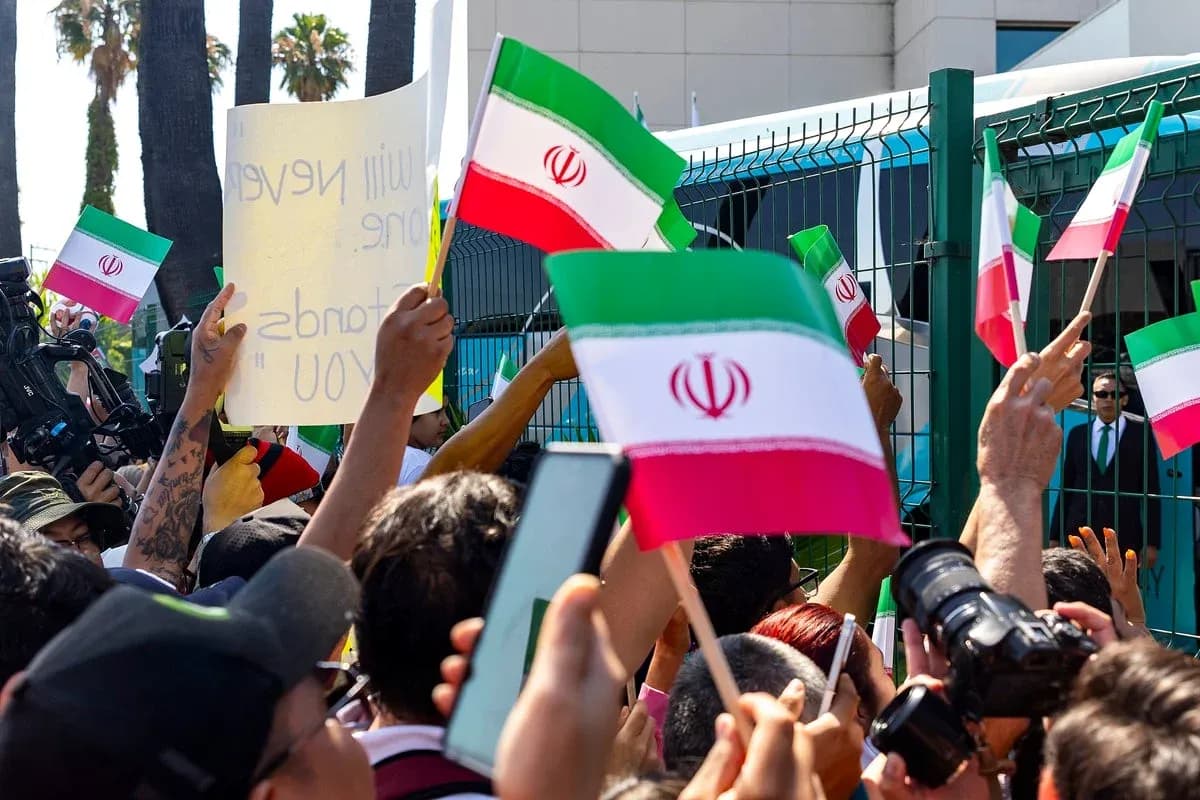
Iranian protesters, many long settled in the US, have vowed to turn this opening match into a public reckoning with the regime they fled. SoFi Stadium will not just be a venue; it will be a stage.
“We’re going to make it hell,” one woman told the Daily Mail, explaining how activists had bought tickets in numbers and organised buses from San Diego, Orange County and across Los Angeles. The plan is simple and confrontational: boo the anthem, turn backs to the pitch, and raise pre-revolutionary Iranian flags that Fifa currently prohibits inside stadiums.
“I know Fifa banned it [the flag] but we will make a way to get it in. So we're going to see this flag, not the terrorist regime’s flag,” she said.
That is the image they want beamed around the world: a national team playing under one flag, a section of its people defiantly holding up another.
A coach under orders
In the middle of this stands Amir Ghalenoei, a head coach with instructions no manager should ever receive.
He has been told by the Iranian government to stop the match if pre-revolutionary flags are brandished or if negative chanting against the regime is audible. The prospect is surreal: a World Cup game, in a host city thousands of miles from Tehran, potentially halted at the demand of a government locked in war with the country staging the tournament.
Publicly, Ghalenoei tried to draw a line.
“We don’t pay attention to any of the hype and anything that goes on around us,” he said on Friday. “We are here to represent the respectful people of Iran, be it the Iranians inside Iran or the Iranian diaspora.
“We are not political people... football is separate from politics.”
That separation is already shattered. The very fact he has been briefed to intervene if dissent breaks out shows how tightly politics has wrapped itself around this team. Every chant, every banner, every camera pan to the stands could become a trigger point.
Fifa’s tightrope
Fifa, as ever, sits in the background, trying to control the picture.
The governing body has banned the pre-revolutionary flag from stadiums. It insists on neutral stadium names, to the point of covering the giant Levi’s logo at Levi’s Stadium in San Francisco and rebranding it as San Francisco Bay Area Stadium. It preaches that football “brings about peace,” as Taremi referenced.
Yet here it is, overseeing a World Cup where a VAR official is under scrutiny for an alleged white supremacist hand gesture, where a Mexican fan has lost his job after a racist act towards a Korean influencer, and where one of the tournament’s most politically charged fixtures could be paused mid-game on government orders.
The contradiction is stark. Fifa wants a controlled show. The world, and this World Cup, refuse to stay on script.
A perilous campaign with no easy exits
For Iran’s players, the stakes are personal as well as sporting. They know what happened in Qatar, when silence or small acts of defiance were read as political statements and carried consequences at home. They know that tonight, every look during the anthem, every non-celebration, every interaction with protesting fans will be dissected.
Their opponents, New Zealand, arrive simply wanting to play a World Cup match. They walk into a cauldron not of their making.
The surreal possibility hangs over everything: that in Los Angeles, under the glare of a global audience, a World Cup match could be stopped because a government thousands of miles away cannot tolerate the sound of its own people booing.
If that moment comes, the question will not be whether football and politics can be separated. It will be what this tournament really stands for when the whistle blows and the noise from the stands refuses to be silenced.
Related News
Raphinha’s Hat-Trick Powers Barcelona to 7-2 Victory Over Racing Santander
Carabao Cup Fourth Round Draw: Liverpool Set to Clash with Chelsea, Arsenal to Face Fleetwood Town
Key Football Matches to Watch in Azerbaijan This Autumn
Raphinha's Hat-Trick Drives Barcelona to 7-2 Triumph Over Racing Santander
Hansi Flick Leads Barcelona to Record-Breaking Seven Wins in a Row
Gavi Reflects on Injury Return as Barcelona Dominate Racing Santander 7-2