
The Part-Time Team That Won Three Consecutive Wembley Finals
You might know that Pep Guardiola's Manchester City clinched four League Cups in a row from 2018 to 2021, but another team managed a similar feat earlier. Whitley Bay, a ninth-tier Northern Football League club, won three consecutive FA Vase finals between 2009 and 2011, an unmatched record in non-league football.
The FA Vase is a nationwide tournament for amateur teams, created in 1974. Over its long history, The Seahorses are the only team to have won it four times, including those three back-to-back victories. Their success came under the guidance of Ian Chandler, an unassuming IT manager from Sunderland who quietly planned their historic run during breaks at work.
A Manager with Dual Roles
Ian Chandler, who had played for Whitley Bay during three separate periods, took over as manager in 2004 and remained in charge for ten years. Balancing his day job with managing wasn't easy. Instead of attending meetings, Chandler found himself arranging travel and scouting reports. The team was motivated by a tough semi-final loss in 2007-08, where they fell short against Lowestoft Town despite a strong comeback attempt.
"It's the hardest thing to keep a team together - as soon as players get noticed, they move on," Chandler told BBC Sport. "But after we reached the Vase semis, players wanted to stay and prove themselves. Then the lads wanted to do it again. And again."
Although a lifelong Sunderland supporter, Chandler modeled his team after Kevin Keegan's Newcastle sides, focusing on entertaining football rather than just winning.
"There was a standing joke in the team, two or three at the back? One time we chased a game with two at the back," he said. "The Premier League can be so boring; fans want to be entertained, that's what we promised."
Building a Strong Team and Community
Chandler was already a club hero before his managerial role, having scored the winning goal in the 2002 FA Vase final. Though inexperienced at first, he gradually assembled a skilled squad that became a powerhouse in non-league circles. Chairman Paul McIlduff praised their style.
"We played good football. We had pace on the wing, fantastic midfielders, and deadly strikers," McIlduff recalled. "When we recruited players, it was about fitting the dressing room's psychology. No one thought they were better than anyone else, they played for each other."
One standout player was Paul Robinson, nicknamed the Whitley Bay Maradona. He progressed through Newcastle United's academy before spending much of his career in northeast non-league football, including time at Whitley Bay from 2007 to 2013. Robinson also worked with Chandler at software company Sage.
"He was my manager both at work and in football, I was sick of him," Robinson joked. "But it helped getting time off for matches, and he understood when my mind drifted, picturing scoring and hoping for an easy game."
Robinson's most memorable moment came in the 2010 FA Vase semi-final, where his last-minute diving header secured a thrilling 6-5 aggregate win, sparking a pitch invasion.
"Everyone goes to the finals, but the earlier rounds were bigger games," Robinson said. "At home, we'd get 2,000 or 3,000 fans. It felt real, like the '90s FA Cup. You don't expect that in non-league."
Legacy Beyond Football
Whitley Bay's success turned them into a feared side across England's non-league scene, ready for big matches unlike many amateur clubs. For example, during a 2009 quarter-final against Biggleswade, the opposition arrived in suits and ties, treating it like their cup final, yet Whitley Bay won 5-2 comfortably.
Their achievements boosted pride in Whitley Bay, a working-class town near Newcastle with Victorian holiday roots. Local volunteers rallied, selling tickets door to door and decorating shops in blue and white stripes. One volunteer, Jenn Robinson, shared how the community embraced the team.
"Every shop had things in the windows, the blue and white stripes," she said. "We got many local sponsors, and I still help with buffets for players and fans."
Newcastle United helped with ticket sales, and North Tyneside Council provided security for large crowds at Hillheads Park. Despite logistical hiccups, such as train delays to Wembley, supporters made it to all three finals, some even enjoying royal treatment in the stands.
"It was surreal and a delight," Jenn remembered. "At our first Wembley final, we sat in the royal box. One security guard showed me Prince William's seat, which he hadn’t yet occupied."
The Wembley Triumphs
Chandler's son Benjamin was a mascot at all three finals. Chandler recalled the overwhelming atmosphere.
"The first year was crazy, everything was brand new," he said. "The bus driver even scraped the side driving into the ground. The second year we tried to take it all in. The third year, it was just about winning three in a row."
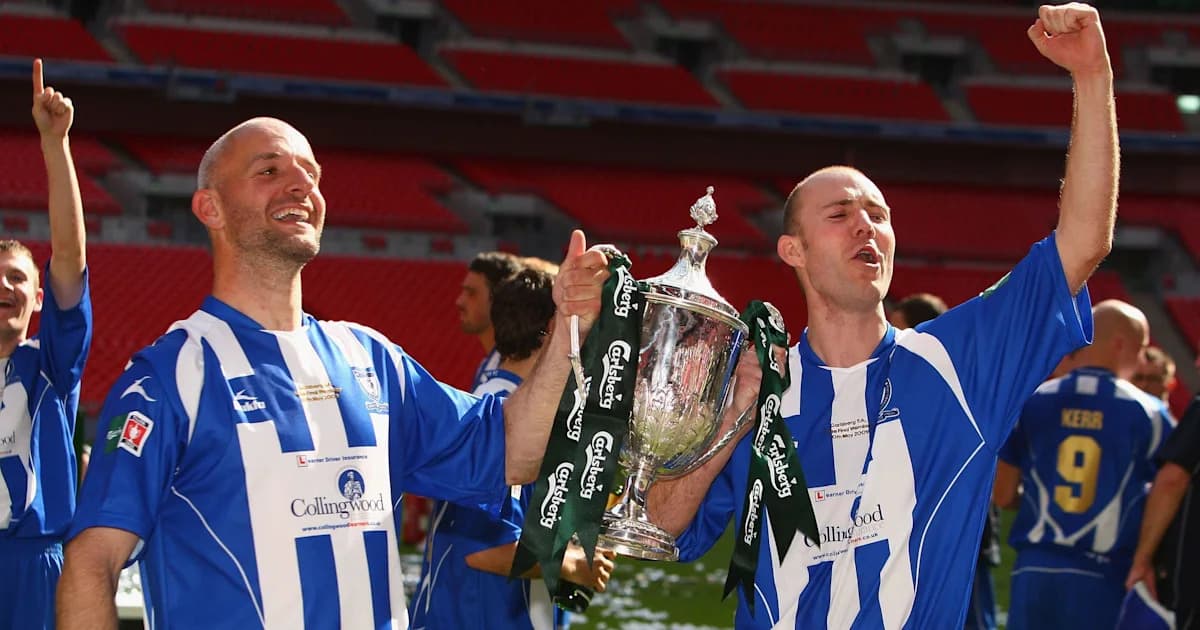
The three Wembley wins included a 2-0 victory over Glossop North End in 2009 before 12,200 fans, a dominant 6-1 win against Wroxham in 2010, and a close 3-2 triumph over Coalville Town in 2011. In the 2010 final, striker Paul Chow scored after just 21 seconds — then the fastest goal in a Wembley final until Ilkay Gundogan beat it 13 years later with a 13-second strike.
Across the three finals, nearly 30,000 supporters filled the stands. Post-match celebrations moved from simple pub visits to rented rooms hosting families, friends, and fans. The 2010 celebrations included a squad trip to Marbella for five nights, described by Robinson as the best ten days of his life.
The 2010 trophy ceremony held special meaning as former teammate Mark Taylor, diagnosed with motor neurone disease, joined the squad. Taylor had played the previous year's final and remained a core presence despite his illness.
"Mark used to come on away trips after his diagnosis, just wanting to be Mark," Chandler said. "He’s still around, giving me grief on Facebook. He was the heart of our second and third years."
A Lasting Impact
The team's success brought media attention, with reporters visiting Chandler’s workplace and family members interviewed. Chandler even rubbed shoulders with coaching legends at sports awards, recalling Sven Goran Eriksson greeting his wife.
For Robinson, returning to the IT office after Wembley glory was a stark contrast.
"One year I got a standing ovation walking in, but then it was back to normal," he admitted. "People would tease me: ‘Are you talking about Wembley again? Give it a rest, Robbo!’"
Whitley Bay's golden era ended after Chandler left in 2014 following a dip in form. The club hasn’t added major trophies since 2011 and still plays in the ninth tier. Yet, memories endure in the football-loving northeast.
"My wife and I were at a pub in Durham recently, and a guy asked, ‘Are you Ian Chandler?’" he laughed. "Then he started talking about that team. In the northeast, everyone follows football. It was lovely."
Related News
UFC 332: Full Fight Card, Odds, Start Time, and What to Expect
Andy Roddick Responds to Andre Agassi's Comments on Alexander Zverev at the 2026 Laver Cup
Knicks Prepare for Versatile Title Defense with Possible Role Shifts
Rui Hachimura Swaps Lakers Loyalty for Clippers in Memorable Jersey Exchange
2026 Brasileirão Home Standings: Which Teams Dominate on Their Turf?
The Part-Time Team That Won Three Consecutive Wembley Finals