
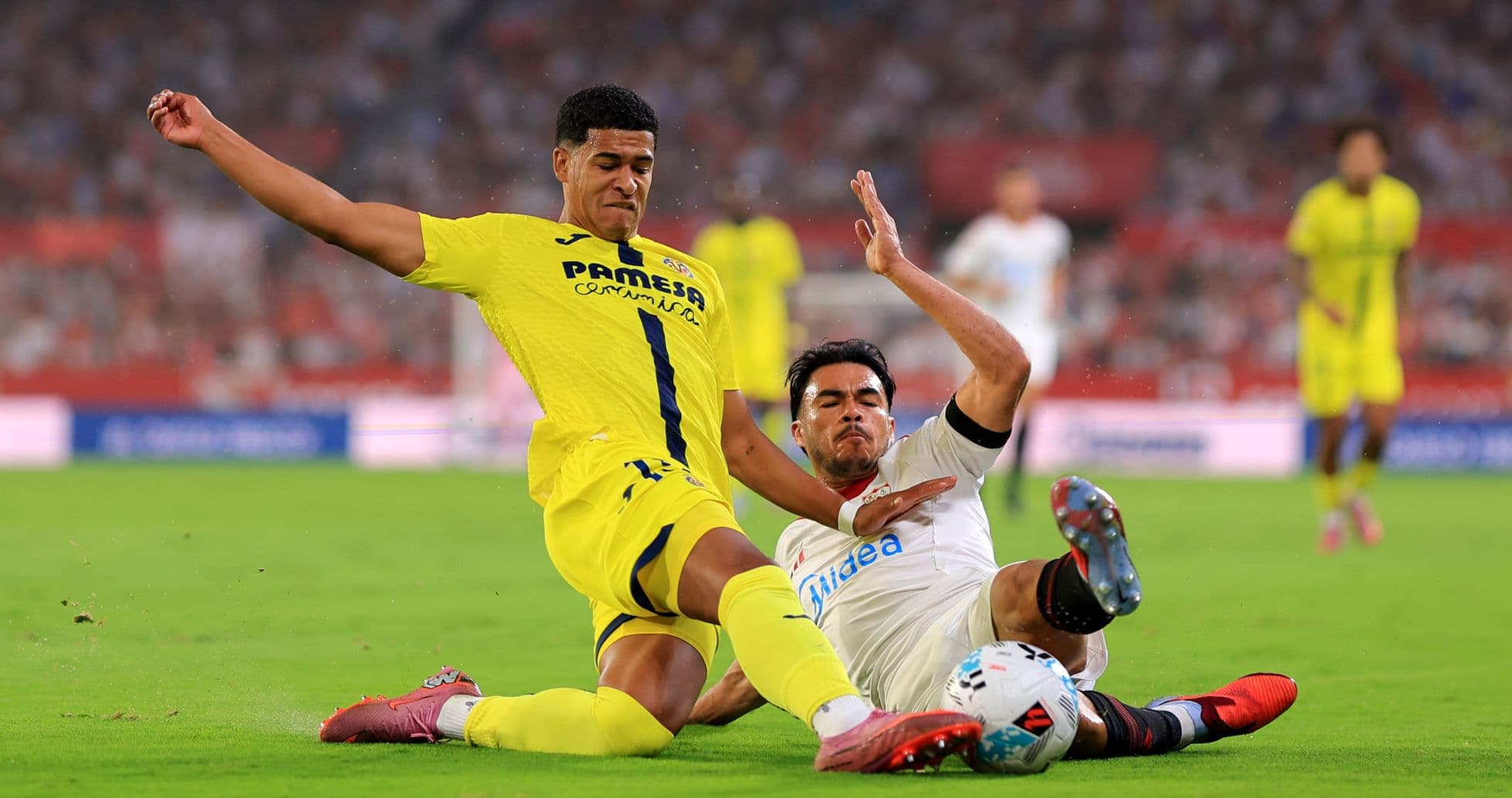
Villarreal vs Sevilla: Tactical Battle in 2-3 Defeat
Villarreal’s 2-3 defeat to Sevilla at Estadio de la Ceramica was a study in contrasting game models: the home side’s territorial, possession-heavy 4-4-2 against a compact, counter-punching 5-3-2 that grew more efficient as the match wore on. Despite leading 2-0 and finishing with 63% of the ball and 554 passes, Villarreal were gradually dismantled by Sevilla’s structural discipline and superior penalty-box management.
Villarreal’s first-half control was clear in both shape and tempo. Marcelino’s 4-4-2 used Alberto Moleiro and Nicolas Pepe as high, narrow wide midfielders coming inside to overload the half-spaces, with Dani Parejo and Pape Gueye orchestrating from central zones. Full-backs Alfonso Pedraza and A. Freeman provided the width, often pinning back Sevilla’s wing-backs and forcing the away side into a deep 5-3-2 block.
The opening goal on 13 minutes encapsulated this plan. Villarreal circulated through midfield, drawing Sevilla’s central trio narrow, before Moleiro and Georges Mikautadze combined between the lines. Mikautadze’s movement off the front line dragged a centre-back out, and his assist released Gerard Moreno into the right channel, finishing for 1-0. Seven minutes later, the second goal further exposed Sevilla’s early difficulties in tracking runners from midfield. Moleiro again operated between Sevilla’s midfield and defence, feeding Mikautadze, whose timing and finish for 2-0 underlined how Villarreal’s twin strikers exploited gaps either side of Kike Salas.
At 2-0, Sevilla adjusted without changing their nominal 5-3-2. Luis Garcia Plaza pushed D. Sow slightly higher to press Parejo, while L. Agoume dropped closer to the back line to screen direct passes into Moreno and Mikautadze. The wing-backs, G. Suazo and Oso, became more aggressive stepping out on Villarreal’s full-backs, and this shift turned the game.
Sevilla’s first goal on 36 minutes came from exactly that wing-back dynamic. With Villarreal stretched in possession, a transition saw L. Agoume find Oso arriving from deep on the left. Villarreal’s back four, which had been comfortable when defending set positions, struggled to pick up late arrivals; Oso’s finish for 2-1 punished a defensive line that had become too narrow and reactive to the ball.
The equaliser at 45 minutes was a set-piece and structure moment. Sevilla, now more confident, loaded the box, and R. Vargas’ delivery found K. Salas, who attacked the space between centre-backs to make it 2-2. Villarreal’s zonal organisation faltered, with Renato Veiga and P. Navarro neither attacking the ball nor blocking Salas’ run. The halftime score of 2-2, despite Villarreal’s territorial dominance, already hinted at the underlying problem: Sevilla were getting higher-quality final actions from fewer attacks.
After the break, the tactical battle turned around substitutions and control of central spaces. Villarreal’s double change on 60 minutes — T. Partey (IN) for Pape Gueye (OUT) and Tajon Buchanan (IN) for Nicolas Pepe (OUT) — aimed to add vertical thrust and more aggressive ball-winning in midfield. Partey’s presence did stiffen central duels, but it also subtly altered Villarreal’s rhythm: more direct, slightly less patient, which suited Sevilla’s counter-attacking intentions.
Sevilla’s first change at 68 minutes — J. Sanchez (IN) for R. Vargas (OUT) — freshened their midfield legs and maintained the intensity around Parejo. Villarreal responded at 70 minutes with S. Comesana (IN) for Parejo (OUT) and Ayoze Perez (IN) for Mikautadze (OUT), moves that reduced their creative passing range in deep zones. Comesana is more of a runner and presser than a pure tempo-setter, and Villarreal lost some of the controlled circulation that had disorganised Sevilla early on.
The decisive phase arrived on 72 minutes in a double twist. Sevilla replaced N. Maupay (OUT) with A. Sanchez (IN), adding a more mobile forward profile alongside A. Adams. Immediately, Sevilla’s more dynamic front line exploited Villarreal’s reconfigured midfield. D. Sow, still on the pitch at that moment, broke a line and fed Adams, whose movement between Villarreal’s centre-backs and precise finish completed the comeback at 2-3. It was a classic example of Sevilla’s verticality: few passes, direct occupation of central channels, and clinical execution.
From that point, Sevilla managed the game with structural maturity. Villarreal, though still dominant in possession and finishing with 4 shots on goal from 6 total, were largely kept to lower-quality efforts, reflected in their xG of 0.81. Sevilla, with 13 total shots and 5 on target, generated a slightly higher xG of 0.88, showing that their attacks, while fewer in number, consistently reached more dangerous zones.
The late substitutions for Sevilla — N. Gudelj (IN) for D. Sow (OUT) and Castrin (IN) for A. Adams (OUT) at 86 minutes — were clearly aimed at consolidating the lead, adding defensive ballast in midfield and fresh legs in the back line. Villarreal’s attempts to break them down increasingly came from wide crosses and hopeful entries rather than the incisive combinations of the opening 30 minutes.
Defensively, Villarreal’s issues were less about volume of pressure and more about box management. They committed 11 Fouls to Sevilla’s 9, but crucially, their back line struggled with tracking and duels at key moments. The late Yellow Cards for Ayoze Perez (Foul, 81') and Renato Veiga (Foul, 90+2') reflected a side chasing the game and occasionally resorting to stopping transitions rather than controlling them with structure. Sevilla’s only booking, for Jose Angel Carmona (Time wasting, 90+3'), underlined their shift from reactive defending to game-state management once ahead.
In goal, A. Tenas for Villarreal made 2 saves, while O. Vlachodimos for Sevilla needed only 1 save. Both keepers posted a goals prevented figure of -0.22 for their respective teams, indicating that, if anything, each conceded slightly more than the shot quality might predict. That aligns with the sense that this match was decided more by defensive organisation and marking than by goalkeeping heroics.
Statistically, Villarreal’s 63% possession and 554 passes, with 499 accurate (90%), paint the picture of a side that controlled territory but not the scoreboard. Sevilla’s 37% possession and 325 passes, with 276 accurate (85%), fit a deliberate, lower-possession model that prioritised compactness and fast, vertical attacks. The corner count (6-4 to Villarreal) and Sevilla’s higher volume of shots (13 to 6) further illustrate the paradox: Villarreal built the platform, but Sevilla controlled the decisive zones.
In tactical terms, this 2-3 result will concern Villarreal from a defensive index perspective: conceding three times at home, despite limiting Sevilla’s xG to 0.88, suggests repeated failures in key micro-moments — late runners, set-piece marking, and central channel coverage after substitutions. For Sevilla, it reinforces a positive overall form narrative: a team comfortable without the ball, structurally robust in a 5-3-2, and increasingly ruthless when transitions and set plays present themselves.
Related News

LaLiga 2026-27 Season Schedule Released: Kickoff on August 15, Clásico on October 25
Atletico Madrid vs Real Madrid: Head-to-head Stats and Past Meetings
Real Madrid Dominates Rayo Vallecano in La Liga Clash
Atletico Madrid Dominates Real Sociedad 3-0 at Reale Arena
Barcelona Dominates Levante in High-Scoring Clash
Sevilla vs Barcelona Stats: Head-to-Head Record and Past Meetings