
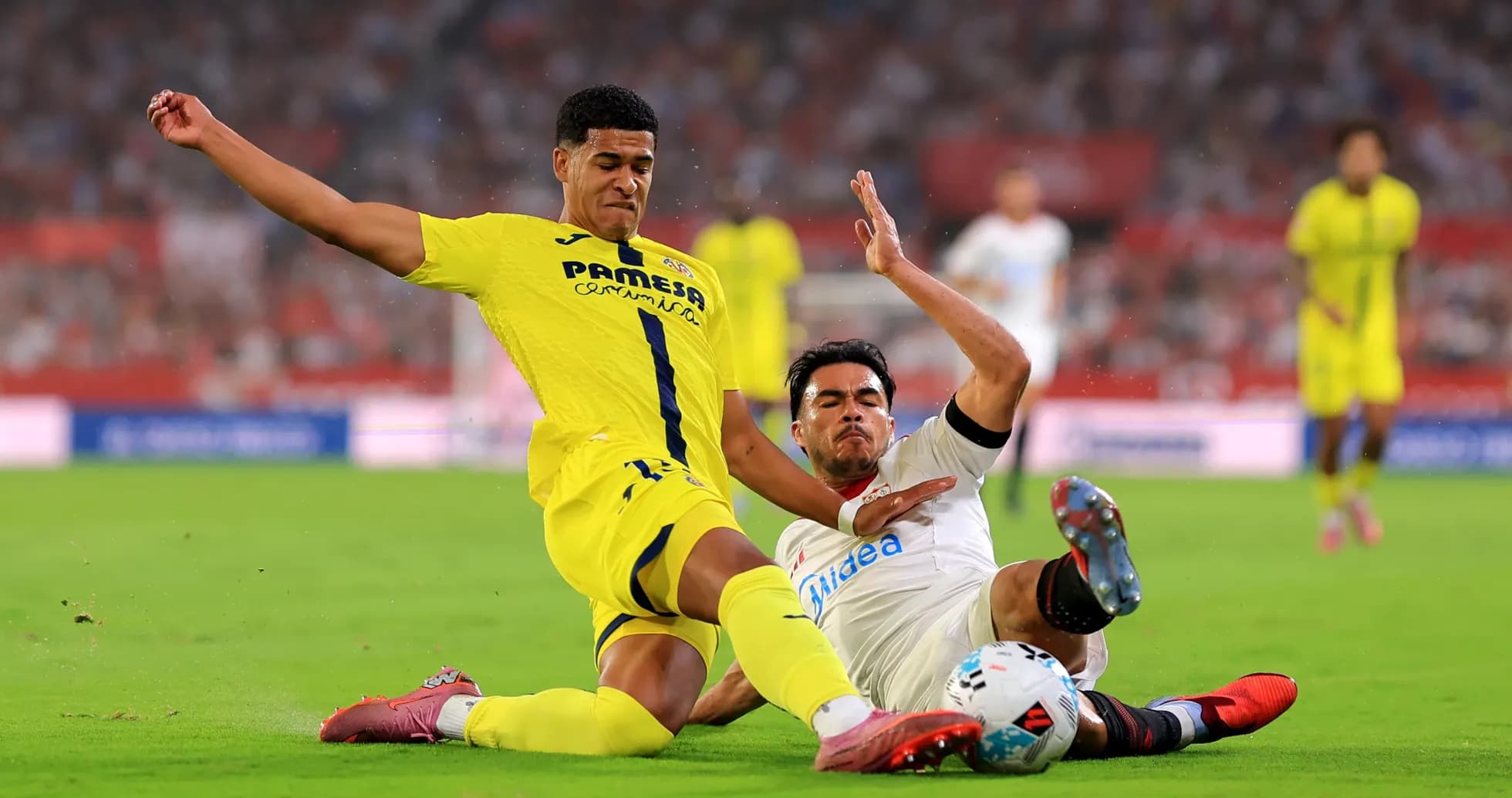
Villarreal vs Sevilla: High-Stakes La Liga Clash
Estadio de la Ceramica stages a high-stakes La Liga clash on 13 May 2026 as third-placed Villarreal host Sevilla in round 36 of the season. With Villarreal pushing to secure a Champions League league-phase berth and Sevilla still trying to lock in mid-table safety, the meeting carries very different but equally sharp incentives.
Context and stakes
In the league, Villarreal sit 3rd with 69 points, a +25 goal difference and a clear description line of “Promotion – Champions League (League phase)”. Their form column reads “DWWDW”, underlining how consistently they have collected points down the stretch. Across all phases, they have 21 wins, 6 draws and 8 defeats from 35 matches, scoring 65 and conceding 40.
Sevilla arrive in Villarreal in 13th place on 40 points with a -13 goal difference. Their form of “WWLLW” is volatile but recently positive, and their overall league record (11 wins, 7 draws, 17 losses, 43-56 goals) speaks to a season of instability rather than outright crisis. With a 9-point buffer to the 40-point mark and only three rounds left, they are close to mathematical safety but not yet fully out of danger.
For Villarreal, this fixture is about consolidating a top-four finish and potentially climbing further. For Sevilla, it is about avoiding being dragged back into late-season nerves and proving they can compete away from home against one of La Liga’s most dynamic attacks.
Villarreal: home fortress and attacking structure
In the league, Villarreal’s home record is elite: 14 wins, 1 draw and just 2 defeats from 17 at Estadio de la Ceramica, with 41 goals scored and only 15 conceded. Across all phases, they average 2.4 goals for and 0.9 against per home game, a profile of a side that not only dominates but usually controls the scoreline.
Their season statistics show a team built on attacking fluency and a stable base:
- Fixtures across all phases: 34 played, 21 wins, 5 draws, 8 losses.
- Goals for: 64 (41 home, 23 away), averaging 1.9 per match.
- Goals against: 39 (15 home, 24 away), averaging 1.1 per match.
- Clean sheets: 8 (5 at home).
- Failed to score: just 5 times all season.
Tactically, Villarreal are remarkably consistent. They have lined up in a 4-4-2 in 33 of 34 league matches, with only a single outing in 4-3-3. That suggests a clear, rehearsed pattern: two strikers, wide players who can tuck inside, and a midfield pairing tasked with both progression and protection.
Key to their attacking edge is the form of Georges Mikautadze and Alberto Moleiro. Mikautadze has 11 league goals and 5 assists in 30 appearances, with 50 shots (28 on target) and a solid duel output (92 duels won from 197). His dribbling volume (64 attempts, 31 successful) and 45 fouls drawn underline how he occupies defenders and wins territory.
Moleiro, from midfield, adds a second scoring and creative lane: 10 goals and 4 assists in 34 appearances, with 38 shots (19 on target) and 35 key passes. His 700 total passes at 78% accuracy and 60 dribble attempts (31 successful) show a player who both carries and distributes between the lines. Together, Mikautadze and Moleiro give Villarreal a dual threat: depth runs and penalty-box presence from the striker, and late arrivals plus combination play from midfield.
From set pieces, Villarreal are also efficient from the spot: across all phases they have 5 penalties, all scored, with a 100% conversion rate at team level. Combined with their biggest home win of 5-0 and a maximum home goals output of 5 in a single match, they are capable of blowing teams away when they find rhythm.
Defensively, the numbers are strong at home (15 conceded in 17), but the card profile warns of late intensity: 19 yellow cards between minutes 76-90 and 2 of their 3 red cards coming in that window. That may be relevant if this becomes a tense, physical contest.
Team news-wise, Villarreal will be without J. Foyth, ruled out with an Achilles tendon injury. A. Perez is listed as questionable with an injury. Foyth’s absence removes a versatile defensive option in the back line, potentially nudging Villarreal to keep their back four as settled as possible.
Sevilla: tactical flexibility and away fragility
Sevilla’s away record in the league is much less reassuring: 4 wins, 3 draws and 10 defeats from 17, with 19 goals scored and 32 conceded. Across all phases, they average 1.1 goals for and 1.9 against away from home. They have kept 3 away clean sheets but also failed to score 4 times on their travels.
Across all phases, their season profile is:
- 35 fixtures played, 11 wins, 7 draws, 17 losses.
- 43 goals for, 56 against.
- Clean sheets: 6 (3 home, 3 away).
- Failed to score: 8.
Where Villarreal are structurally stable, Sevilla are tactically flexible to the point of constant change. They have used nine different formations in the league:
- 4-2-3-1 (11 times)
- 3-4-2-1 (6)
- 5-3-2 (5)
- 4-4-2 (4)
- 3-4-3 (2)
- 5-4-1 (2)
- 3-5-2 (2)
- 4-1-4-1 (1)
- 3-4-1-2 (1)
That variety can be read two ways: adaptability, or a search for solutions. Away to a side as settled as Villarreal, the choice of structure will be crucial. A back five could protect against Villarreal’s wide overloads and the runs of Mikautadze, while 4-2-3-1 would offer more pressing height but risk leaving space between the lines for Moleiro.
Sevilla’s penalty record at team level is also perfect this season (5 taken, 5 scored), giving them a reliable route to goal if they can force mistakes in the box. However, their defensive record away – including a biggest away loss of 5-2 – underlines how quickly games can run away from them if they are stretched.
Discipline is another concern. Sevilla have accumulated a broad spread of yellow cards, with a particular spike late in games (19 yellows between 76-90 minutes and 20 between 91-105). They have also received red cards in multiple time windows, including 16-30, 31-45, 61-75 and 76-90, plus one in an unspecified range. In a high-tempo match against a side that draws fouls through dribblers like Mikautadze and Moleiro, this could be a decisive factor.
Injuries also complicate the picture. Marcao is ruled out with a wrist injury, depriving Sevilla of a central defensive option. M. Bueno (knee injury) and I. Romero (injury) are both listed as questionable. If one or both miss out, Sevilla’s options for rotating or reinforcing the back line and midfield will be further limited.
Head-to-head: Villarreal on top
The last five competitive meetings in La Liga underline Villarreal’s recent edge:
- On 23 September 2025 at Estadio Ramon Sanchez Pizjuan, Sevilla 1-2 Villarreal. Villarreal won.
- On 25 May 2025 at Estadio de la Ceramica, Villarreal 4-2 Sevilla. Villarreal won.
- On 23 August 2024 at Estadio Ramon Sanchez Pizjuan, Sevilla 1-2 Villarreal. Villarreal won.
- On 11 May 2024 at Estadio de la Ceramica, Villarreal 3-2 Sevilla. Villarreal won.
- On 3 December 2023 at Estadio Ramon Sanchez Pizjuan, Sevilla 1-1 Villarreal. Draw.
Across these five La Liga fixtures, Villarreal have 4 wins, Sevilla have 0, and there has been 1 draw. Notably, Villarreal have scored at least twice in each of their four victories, including two home wins by 4-2 and 3-2.
Tactical keys
- Villarreal’s 4-4-2 vs Sevilla’s shape: Expect Villarreal to stick to their tried-and-tested 4-4-2, using two forwards to pin Sevilla’s centre-backs and wide midfielders to attack the half-spaces. Sevilla’s response – likely a 4-2-3-1 or a back three/five – will determine whether they can compress the central channels without surrendering the flanks.
- Central creativity and second-line runs: Moleiro’s role between Sevilla’s lines is central. If Sevilla use a double pivot, they must track his late runs and deny him time to pick passes into Mikautadze. Failure to do so could see Villarreal replicate the multi-goal home outputs they have shown all season.
- Transitions and discipline: Sevilla’s best route may be in transition, exploiting any high positioning from Villarreal’s full-backs. However, with their card profile and the late-game yellow/red distribution, they must balance aggression with control to avoid playing with ten men at a hostile venue.
- Set pieces and penalties: Both sides have 100% team-level penalty records this season (5/5 each). In a tight match, whoever forces more box incidents – through dribbles, cutbacks or aerial duels – may gain a crucial edge.
The verdict
All available data points towards Villarreal as clear favourites. They combine an outstanding home record (14-1-2, 41-15 in goals) with a stable tactical identity and in-form attacking leaders in Mikautadze and Moleiro. Their recent head-to-head record – 4 wins and 1 draw in the last five La Liga meetings – reinforces that advantage, especially given their ability to repeatedly score multiple goals against Sevilla.
Sevilla’s recent form is not disastrous and their tactical flexibility offers some hope of tailoring a plan to frustrate Villarreal. Yet their away numbers (4-3-10, 19-32 in goals), defensive absences and disciplinary profile suggest they will be under sustained pressure.
Barring an unusually wasteful night from the hosts or an exceptional defensive display from Sevilla, the balance of evidence supports another Villarreal home win, likely in a match with goals at both ends given the visitors’ capacity to score and concede on their travels.
Related News

LaLiga 2026-27 Season Schedule Released: Kickoff on August 15, Clásico on October 25

Atletico Madrid vs Real Madrid: Head-to-head Stats and Past Meetings
Real Madrid Dominates Rayo Vallecano in La Liga Clash

Atletico Madrid Dominates Real Sociedad 3-0 at Reale Arena
Barcelona Dominates Levante in High-Scoring Clash

Sevilla vs Barcelona Stats: Head-to-Head Record and Past Meetings