
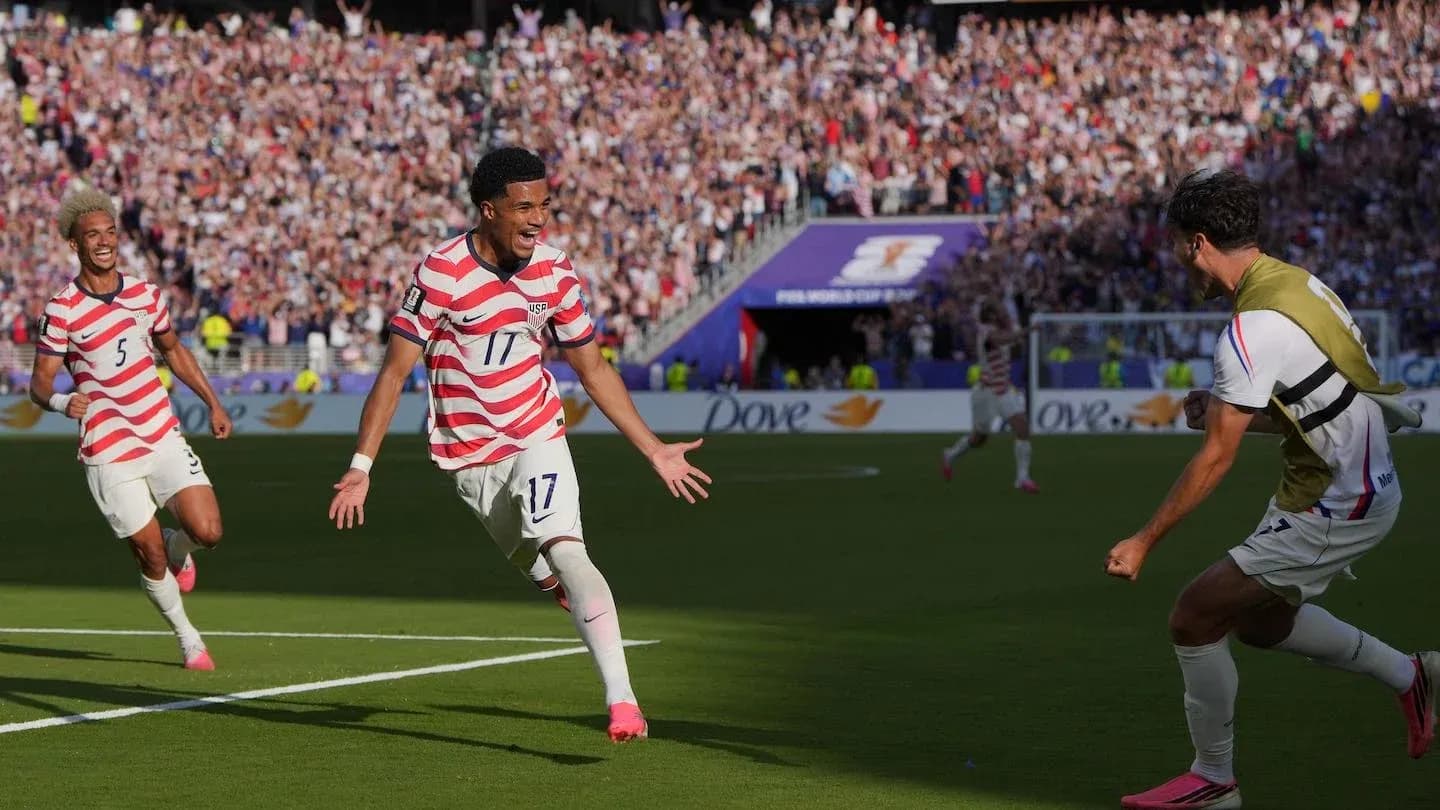
USA’s Tactical Mastery in 2-0 Win Over Bosnia & Herzegovina
USA’s 2-0 win over Bosnia & Herzegovina at Levi's Stadium in this World Cup Round of 32 tie was defined by structural clarity and superior penalty-box efficiency rather than territorial dominance. Despite trailing 52–48 in possession and facing a 10v11 scenario for the final half-hour, USA controlled the decisive spaces in both boxes, turning an xG of 0.92 into two cleanly executed goals while limiting Bosnia & Herzegovina to just 0.25 xG.
Mauricio Pochettino’s 4-3-3 was built on a clear positional framework. Matthew Freese (USA) behind a back four of Sergiño Dest, Chris Richards, Tim Ream and Antonee Robinson allowed the team to stretch the pitch horizontally, with Robinson and Dest stepping high to pin the Bosnian wing-backs. Tyler Adams anchored the midfield as the single pivot, with Weston McKennie and Malik Tillman operating as advanced number eights, connecting into a front three of Christian Pulišić, Folarin Balogun and Dest nominally starting as a wide forward on the right.
In contrast, Sergej Barbarez set Bosnia & Herzegovina up in a 5-3-2 that was clearly designed to compress central zones. Nikola Vasilj sat behind a line of five defenders, with Amar Dedić and Sead Kolašinac as wing-backs and a central trio of Nikola Katić, Tarik Muharemović and Stjepan Radeljić. Ahead of them, Armin Gigović, Ivan Šunjić and Kerim Alajbegović tried to screen vertical passes into the USA forwards, while Edin Džeko and Ermedin Demirović formed a traditional two-man strike partnership.
First Half
The first half pattern saw Bosnia & Herzegovina enjoy slightly more of the ball but with limited penetration. Their 446 total passes to USA’s 415 and a marginal edge in possession reflected circulation in deeper zones rather than sustained threat. USA’s block remained compact, with Adams protecting the space in front of Ream and Richards, forcing Bosnia & Herzegovina to shoot from distance; five of their ten attempts came from outside the box, and only three were on target, all handled by Freese (USA), who made three saves.
USA, by contrast, were far more direct and purposeful once they broke the first line of pressure. Six of their eight shots came from inside the box, and the front three repeatedly attacked the channels between Bosnia & Herzegovina’s wide centre-backs and wing-backs. The opening goal on 45 minutes from Folarin Balogun was the culmination of this approach: a central forward attacking the box at the end of a move that had drawn the Bosnian back five out of shape. Even without a recorded assist, the pattern was consistent with USA’s plan—quick, vertical access into the striker once the midfield line was bypassed.
Defensively, Bosnia & Herzegovina’s 5-3-2 was reactive rather than aggressive. They committed 13 fouls to USA’s 7, and the late yellow card for Stjepan Radeljić for “Holding” underlined how often their defenders were forced into recovery actions rather than proactive interceptions. Yet their low block did initially restrict USA’s volume of shots: only eight total attempts and just two on target. What made the difference was the quality of those chances relative to Bosnia & Herzegovina’s speculative efforts.
Second Half
The second half brought a dramatic shift in game state. Barbarez’s triple substitution at 51 minutes — Esmir Bajraktarević (IN) came on for Armin Gigović (OUT), Benjamin Tahirović (IN) came on for Ivan Šunjić (OUT), and Ermin Mahmić (IN) came on for Edin Džeko (OUT) — signalled a desire for more mobility and pressing in midfield and attack. However, the red card to Balogun for “Serious foul” on 64 minutes paradoxically clarified USA’s tactical identity. Reduced to ten men, Pochettino’s side dropped into a more compact 4-4-1, with the wide players tracking Bosnia & Herzegovina’s wing-backs more diligently and Adams sitting even closer to his centre-backs.
Bosnia & Herzegovina’s response was to push Kolašinac higher and later introduce Haris Tabaković (IN) for Sead Kolašinac (OUT) and Amar Memić (IN) for Nikola Katić (OUT) at 75 minutes, effectively reshaping their structure to add a penalty-box target. Yet their possession became sterile. USA’s mid-block forced them wide, and with only three blocked shots across the match, USA rarely allowed clear shooting lanes centrally. The Bosnian xG of 0.25 captures how little danger they created despite their territorial advantage.
The key tactical moment post-red card was USA’s second goal on 82 minutes from Malik Tillman. With Bosnia & Herzegovina committing more numbers forward, USA exploited the transitional spaces they had been waiting for all night. Tillman’s advanced role as a third man runner from midfield was decisive: instead of dropping to form a flat midfield line, he continued to attack the space between the lines, arriving in the box at the right moment to finish and effectively kill the tie.
Pochettino’s late substitutions were game-management tools rather than structural overhauls. Sebastian Berhalter (IN) came on for Sergiño Dest (OUT) at 87 minutes, Ricardo Pepi (IN) came on for Christian Pulisic (OUT) at 88 minutes, and Giovanni Reyna (IN) came on for Weston McKennie (OUT) at 90+5'. These moves injected fresh legs in midfield and attack, helped secure central zones, and provided outlets to relieve pressure without compromising the compact defensive shell.
From a statistical standpoint, the match underlined the contrast between possession and control. Bosnia & Herzegovina’s slight edge in the ball and passing volume (446 passes, 364 accurate at 82%) did not translate into high-quality chances or scoreboard impact. USA, with 415 passes and 346 accurate (83%), used the ball more vertically and efficiently, aligning closely with their 0.92 xG and two goals.
In the boxes, the differences were stark. Freese (USA) made three saves to protect a clean sheet, while Vasilj (Bosnia & Herzegovina) registered no saves and conceded twice, reflecting USA’s ability to convert their on-target efforts. Both teams’ “goals prevented” metrics at -1.73 suggest that each conceded more than the underlying shot quality might predict, but tactically, USA’s structure minimized danger far better.
Ultimately, this Round of 32 tie was decided by USA’s superior box management, clearer attacking patterns within a 4-3-3, and their adaptability after going down to ten men. Bosnia & Herzegovina’s 5-3-2 never found a way to turn possession into sustained, high-quality pressure, and once Tillman doubled the lead, the tactical contest was effectively over.
Related News
Thomas Tuchel Reflects on England's 10-Man World Cup Triumph and a Surprising Regret

Robert Moreno Takes Over as Interim South Korea Coach After World Cup Setback

Jude Bellingham Returns to Form with Real Madrid After World Cup Success

Chloe Kelly, Beth Mead & 13 Lionesses Who Must Shine in the Upcoming WSL Season for England’s 2027 World Cup Bid
Barcelona Cancels World Cup Tribute Amid Political Tensions
Messi Breaks Record for Most Penalties Taken and Missed in FIFA World Cup History