
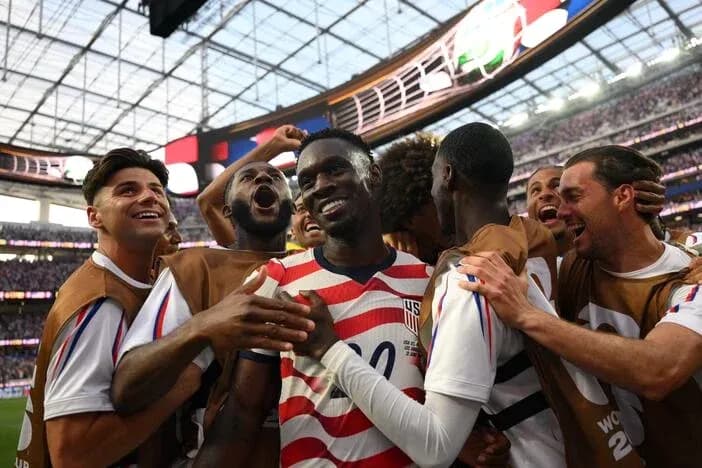
USA Dominates Paraguay in World Cup Opener
LOS ANGELES — For weeks, the World Cup felt like a tournament under siege. Politics, ticket prices, immigration snarls, transit chaos — the noise around Mexico, Canada and the United States as co-hosts was relentless.
Then the whistle blew.
Once the ball started rolling, the arguments outside the stadium walls faded into a low hum, replaced by something far more familiar: shocks, statements, and the kind of early drama that can bend a five-week tournament out of shape before anyone settles in.
And nowhere did that shift feel louder than in Los Angeles.
A U.S. opener with real bite
For a men’s national team still writing its World Cup identity, Friday night at Los Angeles Stadium against Paraguay will live long in the memory.
Scoreline first: USA 4, Paraguay 1. The most goals the U.S. men have ever scored in a World Cup match. Not a grind, not a scrape. A statement.
Folarin Balogun led the charge. Two goals, ruthless finishing, and a small slice of history: the first multi-goal World Cup game by a U.S. player since the inaugural tournament in 1930. Nearly a century between such performances says plenty about how rare this kind of attacking dominance has been on this stage.
Behind him, the platform was immaculate. Chris Richards, back in the XI after missing both pre-tournament friendlies with injury, turned in the kind of performance coaches dream about. Eighty-three passes attempted. Eighty-three completed. No player has hit that mark in a World Cup match since detailed records began in 1966. He didn’t just return; he dictated.
Not everything was perfect. Christian Pulisic, the team’s star forward and emotional barometer, came off at halftime with a calf issue. He walked gingerly to the team bus afterward, his status unclear. One brilliant night, one nagging question.
From top to bottom, the U.S. sparkled — sharp in transition, confident in possession, aggressive without the ball. It felt like a coming-of-age performance.
But it was still only Matchday 1.
Australia crash the party in Group D
If the U.S. needed a reminder that World Cups rarely follow the script, it arrived 24 hours later.
Turkey, stacked with talent from Europe’s elite leagues, entered as the glamour side of Group D. Names like Real Madrid’s Arda Güler and Juventus attacker Kenan Yildiz give any team a sheen of inevitability. On paper, at least.
Australia tore that paper up.
With discipline, belief, and a ruthless edge, the underdogs stunned Turkey 2-0, ripping open the group and turning Friday’s USA–Australia clash into something far more than a routine second game. If the Americans win, they don’t just stay on track; they seize control of the group and put one foot firmly into a favorable position for the knockout rounds.
One dominant win can light a spark. Backing it up against a fearless Australia will show whether this U.S. team can sustain the fire.
Scotland’s return, Brazil held, and a group turned upside down
Elsewhere, the tournament produced the kind of twist that only a World Cup can deliver.
Scotland, back on this stage for the first time in 28 years, opened with a win over Haiti and now sit — at least for the moment — on top of Group C. That alone would be a story. The context makes it bigger.
Sharing the group with Brazil, the five-time world champions, and Morocco, one of the most formidable sides in global football, Scotland were supposed to be chasing scraps. Instead, Brazil and Morocco cancelled each other out in a 1-1 draw, leaving the Scots looking down on two heavyweights.
It won’t last forever. But for now, the table says what generations of Scottish fans have dreamed of seeing again: their team leading a World Cup group.
Firsts for Qatar, and a heavyweight stalemate
The theme of small steps and big moments continued in Group play.
Qatar, in just its second World Cup, finally has something tangible to show for its efforts. A 1-1 draw with Switzerland on Saturday delivered the country’s first-ever World Cup point. In 2022, as hosts, Qatar lost all three matches. This time, they have a foothold.
On Sunday, the Netherlands and Japan produced one of the weekend’s standout contests, a 2-2 draw between two Group F contenders that felt like a knockout tie in disguise. Two ambitious sides trading blows, neither quite able to land the decisive punch. It was a reminder that not every early classic needs a winner.
Curaçao’s 17 minutes with the giants
Then came one of those fleeting, unforgettable World Cup passages that lodge in the memory long after the final score is forgotten.
Curaçao, population 158,000, the smallest country ever to play in a World Cup, made its debut against Germany on Sunday. On paper, a mismatch. On the pitch, for a brief, glorious spell, something else entirely.
Germany struck first, as expected. Curaçao answered. For 17 minutes, the scoreboard read 1-1 and an island nation dared to believe it could stand toe-to-toe with a four-time world champion.
Reality eventually bit. Germany did what Germany so often does at this level, pulling away to win 7-1 — a scoreline that carries its own famous echoes in World Cup history. Yet those 17 minutes will belong to Curaçao forever.
Iran arrive late, but they arrive
The politics that framed this World Cup haven’t vanished. They’ve just moved into the background of the football.
On Monday, Iran open their campaign against New Zealand at Los Angeles Stadium, a fixture wrapped in geopolitical tension. After the U.S. and Israel attacked Iran in February, questions swirled over whether the Iranian team would even take part.
They are here, but on strict terms. Iran had initially planned to base its training camp in Tucson, Arizona. Instead, citing ongoing hostilities and security concerns, the team shifted to Tijuana, Mexico. The U.S. government is allowing the squad into the country only on the day before each of its three group matches.
It’s an extraordinary logistical and emotional backdrop for a team trying to focus on 90 minutes of football at a time.
Mbappé, Messi, and the weight of history
The week ahead will see the spotlight swing to two of the game’s brightest stars.
On Tuesday, France and Kylian Mbappé begin their World Cup journey against Senegal in a marquee Group I clash. Every tournament he enters now feels like a referendum on his era-defining talent, and Senegal, with their power and pace, offer no gentle introduction.
Also on Tuesday, the defending champions step into the light. Argentina and Lionel Messi start their bid for back-to-back titles against Algeria in Group J. The scale of that task is immense. Only two nations have ever defended a World Cup crown: Italy in 1938 and Brazil in 1962.
Messi already has his trophy, his final, his iconic night. The question now is whether this Argentina side can push through the weight of history and do what even the greatest teams rarely manage — stay on top of the world.
The politics, the logistics, the noise will all rumble on. But as the second week begins, the tournament has made one thing clear: once the ball is in play, the story belongs to the footballers.
Related News
Raphinha’s Hat-Trick Powers Barcelona to 7-2 Victory Over Racing Santander
Carabao Cup Fourth Round Draw: Liverpool Set to Clash with Chelsea, Arsenal to Face Fleetwood Town
Key Football Matches to Watch in Azerbaijan This Autumn
Raphinha's Hat-Trick Drives Barcelona to 7-2 Triumph Over Racing Santander
Hansi Flick Leads Barcelona to Record-Breaking Seven Wins in a Row
Gavi Reflects on Injury Return as Barcelona Dominate Racing Santander 7-2