
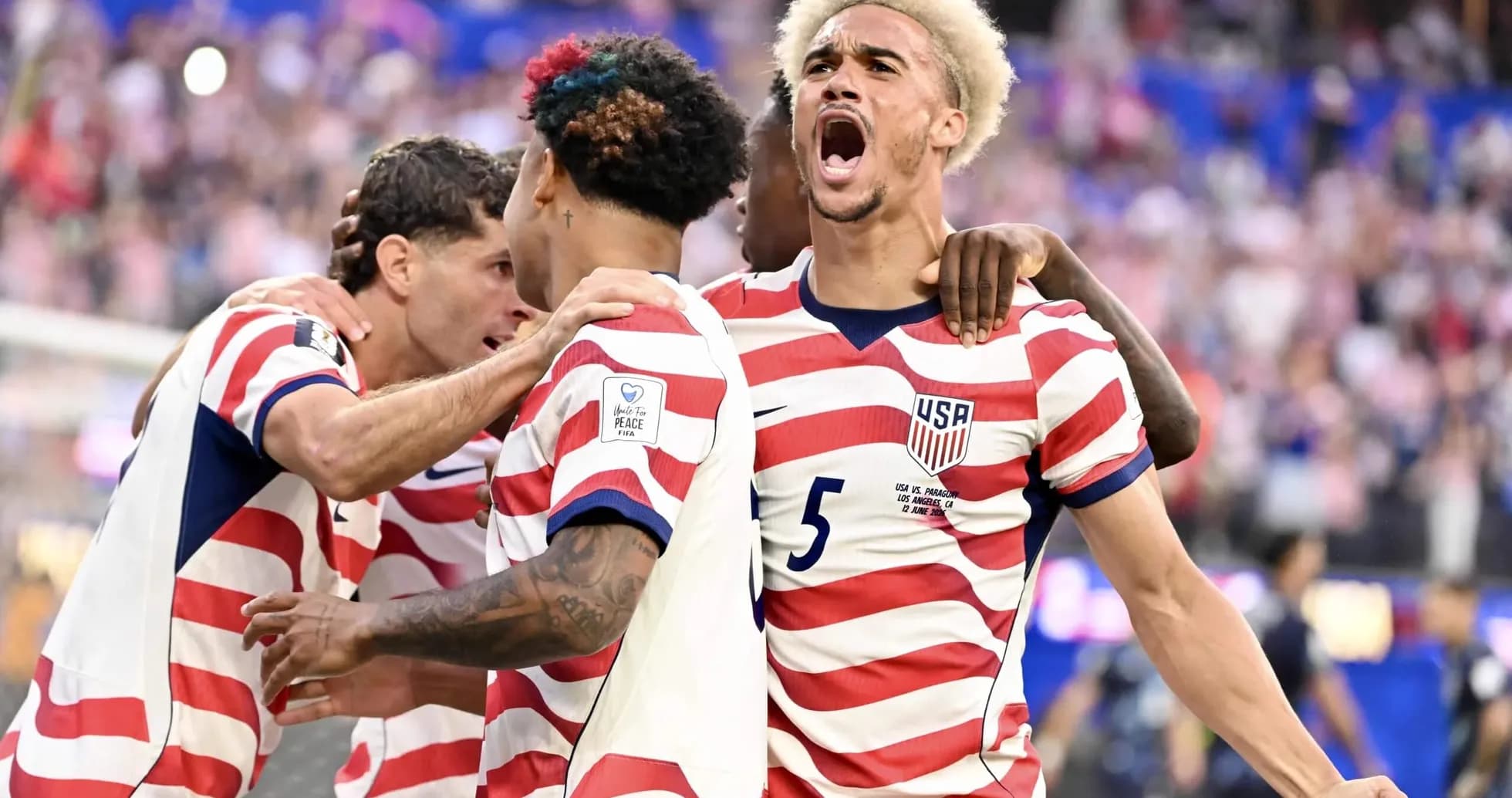
USA Dominates Paraguay in World Cup Opener
Under the roof of SoFi Stadium, the USA opened their home World Cup with the kind of statement performance that can reframe an entire group. Paraguay arrived with a reputation for stubbornness and counter-punching, but left on the wrong end of a 4-1 scoreline, outplayed across the pitch and outgunned in both penalty areas.
Following this result, the table tells a blunt story. USA sit 1st in Group D on 3 points with a goal difference of +3, having scored 4 and conceded 1 in total. Paraguay are 4th, pointless, with a total goal difference of -3 from 1 goal for and 4 against. The numbers are simple; the tactical story is anything but.
I. The Big Picture – A Host Finds Its Shape
Mauricio Pochettino’s USA lined up in a 4-2-3-1 that looked, from the first whistle, like a system built for this stage. With M. Freese in goal and a back four of A. Robinson, T. Ream, C. Richards and A. Freeman, the defensive line had balance: Robinson’s vertical thrust on the left mirrored by Freeman’s more controlled, pass-first profile on the right.
Ahead of them, T. Adams and M. Tillman formed the double pivot. Adams anchored, screening and recycling; Tillman roamed higher, knitting together the press and the possession game. The line of three – S. Dest, W. McKennie and C. Pulisic – blurred traditional roles. Dest stepped inside as a playmaking right-sided midfielder, McKennie arrived late into spaces vacated by Paraguay’s midfield, and Pulisic drifted infield from the left, dragging full-backs into no-man’s land.
At the tip, F. Balogun was the spearhead and reference point. His movement between the Paraguayan centre-backs forced G. Gomez and O. Alderete into constant decisions: step out and leave space behind, or hold the line and allow USA’s midfielders time to turn.
Gustavo Alfaro’s Paraguay went with a classic 4-4-2: O. Gill in goal, a back four of J. Alonso, Alderete, Gomez and J. Caceres; a midfield band of four with M. Almiron and D. Gomez wide, A. Cubas and D. Bobadilla central; and a front two of A. Sanabria and J. Enciso. On paper, it was compact and conservative. On the grass, it was repeatedly pulled apart by USA’s rotations between the lines.
II. Tactical Voids – Discipline and the Cost of Chasing
From a disciplinary standpoint, the contrast between the sides was stark. Heading into this game, USA’s season card profile showed control: just one yellow card, and that coming in the 46-60 minute window, representing 100.00% of their bookings so far. No reds, no chaos.
Paraguay, by contrast, already carried the scars of a side often forced into emergency defending. Their yellow-card distribution is scattered across the match: 20.00% in the opening 0-15 minutes, another 20.00% between 46-60, a late-game spike with 40.00% of cautions arriving in the 76-90 window, and 20.00% more in 91-105. It is the profile of a team that starts nervously, then grows increasingly desperate as matches slip away.
Those numbers have faces. J. Caceres, already in the spotlight for his yellow card and combative edge, and M. Almiron, also booked, embody Paraguay’s fine line between aggression and overreach. A. Arce, another caution in the book, adds to a disciplinary ledger that Alfaro must manage carefully as the group tightens.
For USA, the absence of any listed suspensions or injuries in the data meant Pochettino could roll out his strongest core. Paraguay, likewise, were at full complement, but their inability to control tempo without fouling became a structural weakness.
III. Key Matchups – Hunter vs Shield, Engine Room vs Enforcer
The “Hunter vs Shield” duel was brutally one-sided. F. Balogun, top of the scoring charts with 2 goals in his only appearance so far, operated as a complete forward. He took 4 shots, 3 on target, and converted his chances with ruthless economy. His 10 total duels, winning 5, show a striker willing to fight for every ball, not just wait for service.
Set against that, Paraguay’s total defensive record in this campaign – 4 goals conceded on their travels in 1 match, an away average of 4.0 goals against – exposes a fragile shield. G. Gomez and Alderete are strong individual defenders, but they were repeatedly isolated by USA’s vertical passing and wide overloads. Once USA’s full-backs and wingers pinned Paraguay’s back line, Balogun attacked the gaps with devastating timing.
In the “Engine Room” matchup, T. Adams and M. Tillman faced A. Cubas and D. Bobadilla. Tillman’s campaign numbers underline his importance: 38 passes with 3 key passes, 5 dribble attempts with 2 successes, and 18 total duels, winning 7. He is both connector and disruptor. Adams, while less flashy in the data, gives that platform.
Cubas and Bobadilla, under siege, were forced deeper and narrower. That, in turn, isolated M. Almiron, who despite 23 passes at 78% accuracy and 2 key passes, was often receiving the ball too deep and too wide to truly threaten. J. Enciso, one of Paraguay’s brightest lights, still managed 25 passes at 80% accuracy, 1 key pass, and 4 drawn fouls, but his influence was more about resistance than incision.
Further upfield, USA’s creative axis of Pulisic and G. Reyna adds another layer. Pulisic, already among the top assisters with 1 assist, completed 22 passes at 81% accuracy, with 2 key passes and 3 successful dribbles from 5 attempts. Reyna, off the bench, brought surgical efficiency: 8 passes at 100% accuracy, 1 goal from his only shot, and 2 duels won out of 3. As the tournament unfolds, that duo offers Pochettino flexibility between control and chaos.
Paraguay’s answer comes from Maurício and Enciso. Maurício, with 1 goal from 1 shot on target and 20 passes at 70% accuracy, showed he can break lines from midfield. Enciso, with 2 successful dribbles from 4 attempts and 8 duels won from 14, is the one player capable of dragging Paraguay up the pitch on his own.
IV. Statistical Prognosis – Where This Leaves Them
Overall, USA’s attacking numbers after one match are imposing: 4 goals for at home, a home average of 4.0 goals scored and 1.0 conceded, no clean sheets yet but an attacking ceiling that few in the group can match. Their penalty record is clean – 0 taken, 0 missed – so there is no psychological baggage from the spot.
Paraguay’s statistical profile is more troubling. On their travels, they have scored 1 goal and conceded 4, an away average of 1.0 for and 4.0 against. No clean sheets, and no failures to score yet, which hints at some offensive life – but the defensive leak is severe.
Without xG figures, we read the game through volume and efficiency. USA’s forwards and attacking midfielders are getting shots on target at a high clip (Balogun 3 of 4, Reyna 1 of 1), and their creative midfielders are producing key passes consistently (Pulisic, Tillman, Enciso, Almiron all on the creators’ ledger). Defensively, Paraguay’s reliance on last-ditch tackling – Caceres with 5 tackles, Almiron with 2, Enciso with 2 – suggests a block that is reacting rather than dictating.
Following this result, the prognosis is clear. USA look like a side whose 4-2-3-1 has immediate chemistry, with Balogun as the ruthless hunter and a midfield capable of both pressing and playmaking. Paraguay, already burdened by a negative goal difference and a scattered yellow-card profile, must tighten their defensive distances and channel their aggression more intelligently, or risk being overrun again as the group stage pressure intensifies.
Related News

Thomas Tuchel Reflects on England's 10-Man World Cup Triumph and a Surprising Regret

Robert Moreno Takes Over as Interim South Korea Coach After World Cup Setback

Jude Bellingham Returns to Form with Real Madrid After World Cup Success

Chloe Kelly, Beth Mead & 13 Lionesses Who Must Shine in the Upcoming WSL Season for England’s 2027 World Cup Bid
Barcelona Cancels World Cup Tribute Amid Political Tensions
Messi Breaks Record for Most Penalties Taken and Missed in FIFA World Cup History