
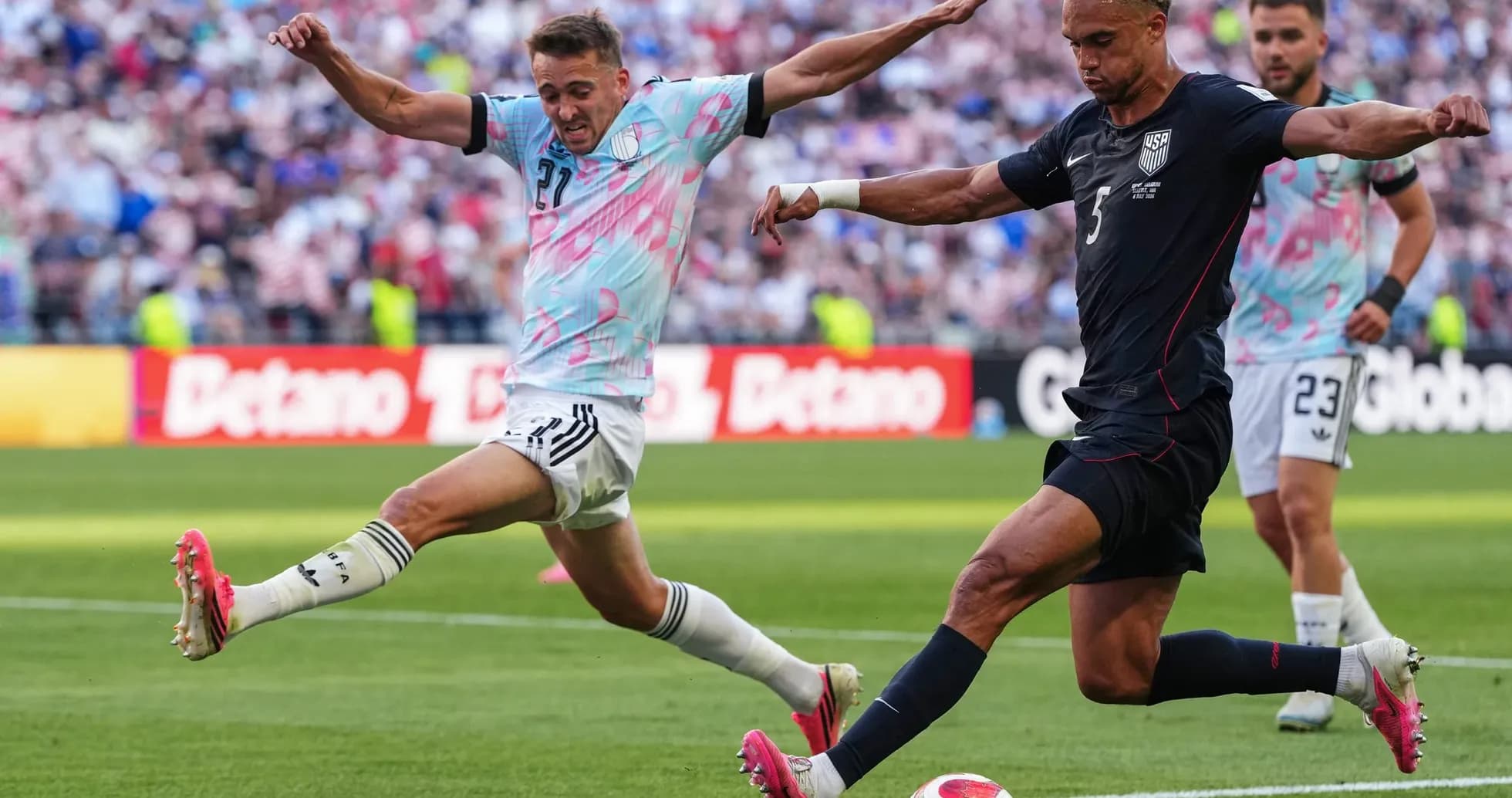
USA vs Belgium Tactical Analysis: Possession vs Efficiency
USA’s 4-3-3 at Lumen Field was designed to control the ball and tempo, and in pure volume it worked: 56% possession, 527 passes with 458 accurate (87%). Yet Belgium’s 4-2-3-1 under Rudi Garcia was far more incisive, translating 44% possession and 410 passes (333 accurate, 81%) into a 4-1 scoreline and a clear shot-quality edge, reflected in xG (2.15 to 0.67).
Structurally, Mauricio Pochettino’s USA built with a back four of Alexander Freeman, Chris Richards, Tim Ream and Antonee Robinson, screened by Tyler Adams at the base of midfield, with Weston McKennie and Malik Tillman as the two No.8s. Christian Pulišić and Sergiño Dest, nominally wide forwards, often dropped to receive, leaving Folarin Balogun as the central reference. The idea was to progress through short combinations and overload central lanes, which the passing numbers support, but the lack of penetration is stark: just 7 total shots, 2 on goal, and 5 from inside the box. Belgium were able to keep USA circulating in front of their block rather than breaking it.
Belgium’s 4-2-3-1 hinged on the double pivot of Amadou Onana and Nicolas Raskin, with Dodi Lukebakio and Leandro Trossard wide, Youri Tielemans as the central creator, and Charles De Ketelaere up top. Their attacking scheme was vertical and direct: win the ball, play early into De Ketelaere’s feet or into the channels, then flood the box with second-line runners. That approach produced 15 total shots, 7 on goal, and a heavy 10 attempts from inside the box. The shot profile matches the xG gap and explains why Belgium consistently looked more dangerous despite having less of the ball.
Out of possession, USA pressed selectively rather than relentlessly. The front three tried to steer Belgium’s build-up wide, but the visitors were comfortable playing through Thibaut Courtois, the centre-backs Nathan Ngoy and Brandon Mechele, and the full-backs Timothy Castagne and Maxim De Cuyper. Once Belgium cleared the first line, USA’s midfield line was repeatedly asked to turn and run towards their own goal, which exposed the back four to direct runs and cut-backs. The two yellow cards for USA, both for “Tripping” (Weston McKennie and Malik Tillman), underline a reactive defensive phase, with midfielders forced into recovery fouls rather than proactive interceptions.
Belgium’s defensive approach was more compact and calculated. The double pivot shielded central zones, forcing USA’s possession into wide areas where 1v1 defending by Castagne and De Cuyper, backed by the near-side centre-back, limited clean entries into the box. With only 0 blocked shots recorded against USA, Belgium did not need to throw bodies desperately in front of efforts; instead, they controlled shot volume and quality earlier in the phase. USA’s 3 corner kicks versus Belgium’s 5 also show that Belgium were better at sustaining pressure and pinning USA back.
In goal, Matthew Freese (USA) had a difficult night. He made 3 saves but conceded 4, with a goals prevented value of -0.69, pointing to underperformance relative to the quality of chances faced. Belgium’s finishing and shot locations were strong, but the data suggests Freese did not add value beyond the baseline expectation. At the other end, Thibaut Courtois (Belgium) faced only 2 shots on goal and made 1 save, with the same goals prevented figure of -0.69, indicating that the single goal conceded came from a relatively low-probability action and that Belgium’s defensive structure did most of the work in front of him.
The substitutions subtly shifted the tactical picture. For Belgium, Hans Vanaken’s early introduction for Amadou Onana moved the balance of the double pivot towards a more creative, possession-friendly profile, which helped them connect midfield to attack and maintain their threat between USA’s lines. Later, Romelu Lukaku replacing Charles De Ketelaere gave Belgium a more direct, penalty-box focal point to attack crosses and cut-backs, which aligned with their high volume of shots inside the area. Jérémy Doku and Alexis Saelemaekers added fresh pace and dribbling on the flanks to exploit tired USA full-backs.
USA’s changes were more like-for-like and did not radically alter the structure. Giovanni Reyna for Sergiño Dest shifted some creative responsibility in the right half-space, while Sebastian Berhalter, Ricardo Pepi, Haji Wright, and Maximilian Arfsten gave Pochettino fresh legs but could not tilt the underlying dynamics: USA still struggled to convert possession into clear chances. The late substitutions of Folarin Balogun and Antonee Robinson removed two of their more advanced outlets just as they were chasing the game, further limiting their ability to threaten Belgium’s back line.
Statistically and tactically, the verdict is consistent: USA controlled the ball but not the game. Their 56% possession and high passing accuracy reflected technical security, yet the low xG (0.67), minimal shots on goal (2), and absence of blocked efforts show that Belgium’s block was rarely stretched to breaking point. Belgium, with 44% possession, 15 shots, 7 on target, and 2.15 xG, repeatedly reached high-value zones, particularly inside the box. The foul count (11 for USA, 9 for Belgium) and card distribution (USA 2, Belgium 0) reinforce the picture of an American side more often reacting to Belgian transitions than dictating them. In a Round of 16 context, Belgium’s efficiency in turning limited possession into sustained, high-quality threat was the decisive tactical difference.
Related News
Thomas Tuchel Reflects on England's 10-Man World Cup Triumph and a Surprising Regret
Robert Moreno Takes Over as Interim South Korea Coach After World Cup Setback

Jude Bellingham Returns to Form with Real Madrid After World Cup Success

Chloe Kelly, Beth Mead & 13 Lionesses Who Must Shine in the Upcoming WSL Season for England’s 2027 World Cup Bid
Barcelona Cancels World Cup Tribute Amid Political Tensions
Messi Breaks Record for Most Penalties Taken and Missed in FIFA World Cup History