
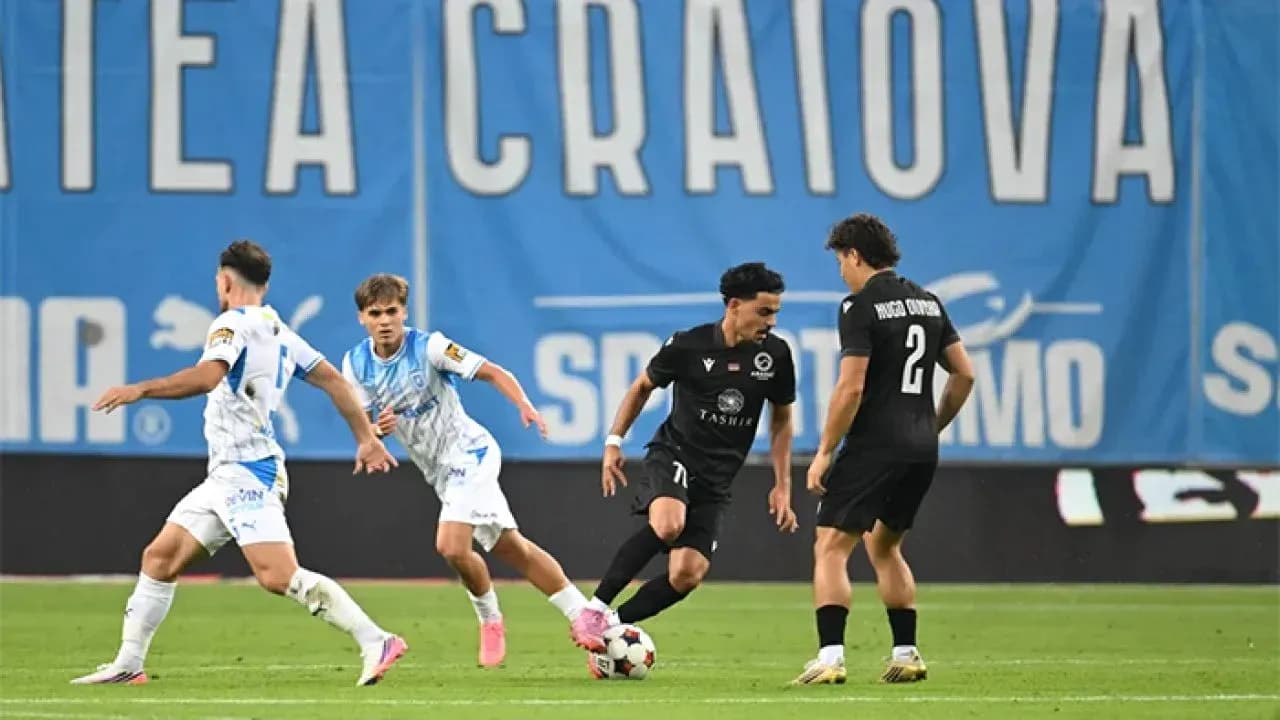
Universitatea Craiova vs Ararat-Armenia: Tactical Analysis of 1-1 Draw
Universitatea Craiova’s 3-4-3 and Ararat-Armenia’s 4-3-3 produced a balanced 1-1 draw at Stadionul Ion Oblemenco, but the underlying structure of the game was clear: Craiova tried to stretch and pin the visitors with width and numbers in the last line, while Ararat-Armenia relied on compactness, vertical defending and select counter-punches.
In possession, Craiova’s back three of V. Screciu, A. Rus and O. Romanchuk provided the platform. With no traditional full-backs, width was generated by the wide midfielders N. Bancu on the left and C. Mora on the right, supported by the advanced central midfielder D. Matei stepping into the half-spaces. The front three of S. Baiaram, A. Al Hamlawi and Matei (nominally listed as a midfielder but occupying very high positions) often formed a narrow triangle to attack the central channel, leaving Bancu and Mora to receive switches and deliver from wide.
The shot profile reflects that territorial intent: Universitatea Craiova registered 7 shots on goal and 7 shots off goal, with an additional blocked effort. That volume, compared to Ararat-Armenia’s 2 shots on goal and 4 off target with 2 blocked, underlines a home side that spent long phases in the attacking third, even if the final pass and finishing were inconsistent. The 8 corner kicks to Ararat-Armenia’s 4 further support the image of Craiova hemming the visitors in for stretches, especially after the equaliser.
Ararat-Armenia's Structure
Ararat-Armenia’s 4-3-3 was structurally conservative. The back four of E. Grigoryan, A. Malis, B. R. Wilson Valdez and Junior Julio stayed relatively narrow, with H. Oliveira often acting as a hybrid between full-back and additional screen in front of the defence. The midfield three of K. Muradyan (later replaced), Benny and A. Serobyan were tasked with closing central lanes rather than pressing high, forcing Craiova to circulate around the block and look for crosses or cut-backs rather than simple through balls. The front line, with Sandro Lima as the reference, offered sporadic pressure but mainly looked to spring forward when possession was won.
The early goal from Ararat-Armenia, scored by centre-back A. Malis and assisted by H. Oliveira at 20', highlighted their set-piece and second-phase threat. It came from a situation where Craiova’s three centre-backs were occupied and the marking detail in the box was not sufficiently aggressive. The equaliser at 33', finished by N. Bancu from an A. Cicaldau assist, showcased Craiova’s wing-oriented design: Bancu attacked from his advanced left-midfield lane, exploiting the space behind Ararat-Armenia’s right side once the defensive line had been drawn narrow.
Craiova’s Defensive Behaviour
Craiova’s defensive behaviour was more aggressive but also more exposed. The back three frequently held a high line to compress space, which contributed to a foul count of 15 compared to Ararat-Armenia’s 5. That disparity reflects both their counter-pressing intent and some tactical fouling to prevent transitions when the ball was lost in midfield. The four yellow cards for Universitatea Craiova – to David Matei (39'), Oleksandr Romanchuk (47'), Adrian Rus (69') and Monday Etim (78') – map almost perfectly onto phases where the home side were chasing turnovers or trying to sustain pressure after losing the ball. The accumulation of bookings across the defensive unit (Romanchuk and Rus) and in the midfield/attacking lanes (Matei and Etim) subtly constrained Craiova’s ability to maintain maximum intensity in duels late on.
Ararat-Armenia, by contrast, managed the game with notable discipline: 5 fouls, no yellow cards. That hints at a block that defended more by positioning than by direct contact, staying compact in front of the box and allowing shots from less favourable zones rather than diving into challenges. Their 4 corner kicks and limited shot volume suggest they were content to play a lower-possession, lower-event game, relying on efficiency rather than sustained pressure.
Substitution Patterns
The substitution patterns underline the tactical adjustments. At 62', Universitatea Craiova made a double attacking change: S. Nsimba (IN) came on for A. Al Hamlawi (OUT), and M. Etim (IN) came on for D. Matei (OUT). This freshened the front line and added more direct running, with Etim later receiving a yellow card as he pushed the physical edge in the final third. At 69', Teles (IN) replaced A. Cicaldau (OUT), a like-for-like change that maintained the creative role in midfield while adding fresh legs for the closing half-hour.
Ararat-Armenia’s response came slightly later and was more about energy management and preserving structure than changing the system. Franca Carlos (IN) for Benny (OUT) at 69' refreshed the midfield. At 75', J. A. Balanta (IN) replaced H. Oliveira (OUT), adjusting the defensive-midfield balance and adding ball-winning capacity. The triple change at 80' – Z. Shaghoyan (IN) for Z. Banjaqui (OUT), M. Carlier (IN) for K. Muradyan (OUT), and A. Tera (IN) for A. Serobyan (OUT) – effectively rotated the entire midfield and one wide role, ensuring the 4-3-3 could maintain its compactness and defensive work rate against a Craiova side still pushing for a winner.
Craiova’s final wave of substitutions at 85', with T. Baluta (IN) for A. Mekvabishvili (OUT) and L. Basceanu (IN) for S. Baiaram (OUT), further emphasised the hunt for a decisive goal. The pattern by then was clear: more runners between the lines, more attempts from range and from wide deliveries, but Ararat-Armenia’s refreshed block held.
Possession is listed as 0% for both sides in the data, so ball-control shares cannot be analysed. However, shot volume, corners and foul distribution collectively point to a match in which Universitatea Craiova carried the territorial initiative and attacking load, while Ararat-Armenia executed a disciplined, low-risk game plan built around defensive organisation and set-piece or transitional opportunities.
In the end, the 1-1 scoreline mirrors the tactical balance: Craiova’s structural ambition and pressure yielded chances but not a decisive breakthrough, while Ararat-Armenia’s compact 4-3-3 and carefully timed substitutions were sufficient to protect their early advantage and leave Craiova needing more precision rather than more volume in the final third.
Related News

Francesco Totti Reveals Offers from Top European Leagues at Age 48
Benfica Dominates AC Milan in UEFA Europa League Opener
Levski Sofia vs Red Bull Salzburg: Europa League Defeat Analysis
Five Europa League Players to Watch in the 2026/27 Season

Celje vs Red Bull Salzburg Predicted Lineups and Team News

NEC Nijmegen vs Benfica Predicted Lineups: Team News for UEFA Europa League