
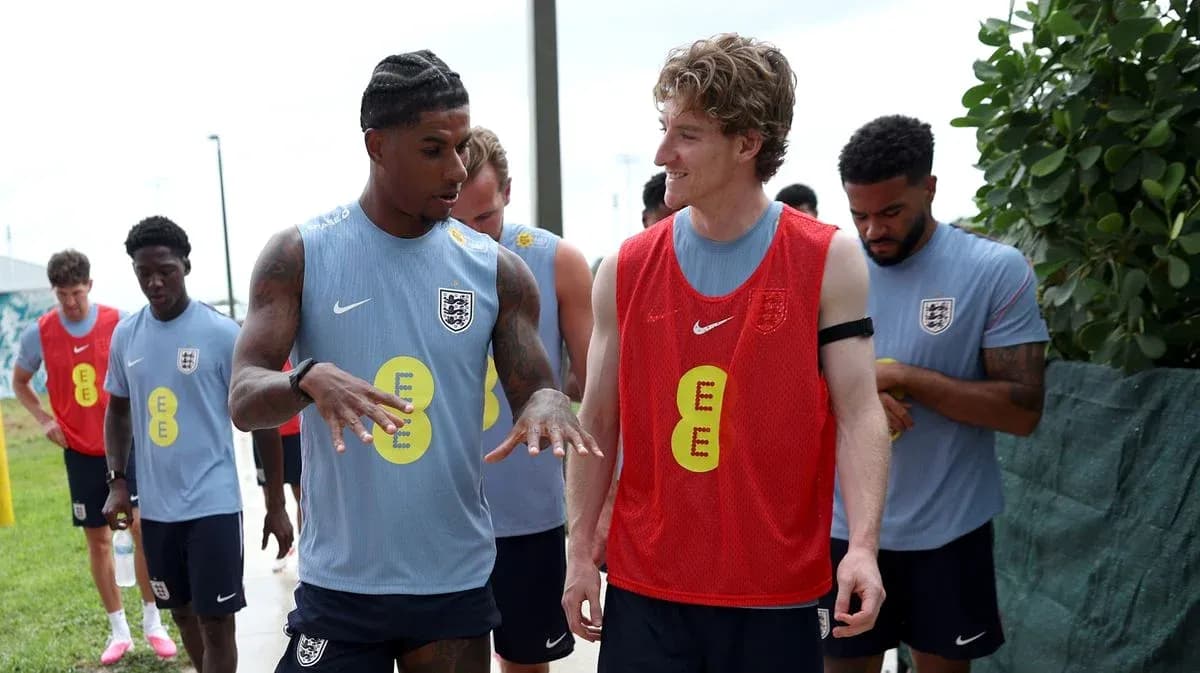
Tuchel Critiques England's Left Flank After Ghana Draw
Thomas Tuchel did not bother with diplomacy. England’s head coach took direct aim at his entire left flank – winger and full-backs alike – and left Anthony Gordon, Marcus Rashford, Nico O’Reilly and Djed Spence all feeling the heat.
The left wing, Tuchel admitted, “hasn't provided the same quality” since a slick final warm-up against Costa Rica. In his eyes, what once looked solved has quickly become England’s biggest tactical headache of this World Cup.
Left side under fire
Tuchel thought Gordon had cracked it. The Newcastle forward shone in that Costa Rica friendly, knitting together combinations, stretching the pitch, offering exactly the “connection and penetration” the coach craves on that side.
Then the tournament started.
Across England’s first two Group games, that fluency vanished. The patterns broke down, the passing lanes closed, the threat dulled. Tuchel did not spare anyone in that channel.
“It’s more a unit on the left side than it is individuals,” he said, making it clear this is not just a winger problem. “The unit on the left side hasn't provided the same quality as they did against Costa Rica.”
That includes Rashford. Tuchel praised the Manchester United forward’s attitude and impact from the bench, but was blunt about his starts.
“Marcus is in a good place, but when he started he was not as decisive as Anthony, that's just it.”
For a brief moment, Tuchel thought he had two functioning left-side combinations. Gordon with O’Reilly. Rashford with Eberechi Eze and Spence. Both looked sharp in the Costa Rica run-out.
“Then Marcus came on the left side, together with Eberechi Eze and Djed Spence, and they did so well. So I thought: ‘Oh, we have two units. They know what they're doing and they're clicking.’”
The reality of tournament football cut through that optimism. The first Group match came and went without the same rhythm. The second followed the same pattern.
“They're not clicking, I’m not even sure why,” Tuchel admitted. “It was not the same amount of connection, not the same amount of penetration, not the same amount of verticality, and this was the same in the second match.”
O’Reilly paid an immediate price, dropped for Spence against Ghana as Tuchel searched for a spark down that side. He still insists he trusts all of them, but the message is clear: whoever plays on the left has to offer more.
“Marcus is just also very good from the bench, and it's sometimes nice to hold someone back,” Tuchel said, hinting that Rashford’s role as an impact substitute may again be his most effective weapon. “He struggled to have the same influence for us from the start, and yet from the bench he was always pushing.”
Rashford remains “a candidate to start” against Panama. The position, though, now comes with a clear warning. “The left side in general, no matter who plays, needs to click a bit more and provide a bit more threat.”
No easy recipe against the low block
Tuchel’s frustrations do not end with the left wing. England’s goalless draw with Ghana has left them sweating over top spot in the Group and wrestling with a familiar modern problem: how to break down a deep, disciplined defensive block on the biggest stage.
“It is difficult to accelerate the match against these low blocks,” Tuchel said. He pointed to the Champions League and Premier League, where even the game’s superpowers often grind through nights like this.
Against Ghana, England had the ball, the territory, the control – but not the decisive moment. Tuchel knows exactly where they fell short.
“It needs this one moment of quality and a bit more precision with the crossing. A bit more timing with the crosses, maybe a bit more awareness with the crosses,” he said. Who attacks the delivery, how aggressively they arrive, and whether England can force chaos with shots from distance and deflections all sit high on his checklist.
“I haven’t found the recipe where ‘they do this, then we do this - and then we are fine.’”
Ghana, under Carlos Queiroz, relished the stalemate. Tuchel described how they celebrated every foray over halfway, then the final whistle, as if they had scored.
“Once Ghana came over the halfway line they celebrated like it was a goal,” he said. “They celebrated at the whistle a 0-0 like they had won. We were kind of disappointed and that shows it is just what it is.”
Tuchel does not see it as a disaster. He has lived this type of game in Champions League group stages “in Copenhagen or Leipzig against a good team” – cagey, tactical, awkward. “The highs should not get too high. The lows should not get too low. I don’t think it was a low.”
Still, the table does not lie. England now must beat Panama at the MetLife Stadium to be sure of winning the Group. Panama sit 42nd in the FIFA rankings, 23 places above Ghana, and Tuchel expects another long, tense evening against a team ready to sit deep and suffer.
“We will try to find a very active and aggressive approach now against Panama but we cannot just be stupid and naive,” he said. He is preparing for a back five that becomes a back six, even a back seven, as Panama pack bodies around their box.
Palmer, Foden, Alexander-Arnold – and a warning text
The draw with Ghana opened another familiar front: the selection debate. Why no Cole Palmer? Why no Trent Alexander-Arnold? Why not Phil Foden, a player capable of threading the pass that unlocks a packed defence?
The questions came quickly. Tuchel refused to be dragged into a post-draw inquest over players who are not here.
“I cannot engage this after a draw,” he said, noting that Spain, Brazil and Portugal have all had their own stumbles. The bigger influence on this game, he argued, came from the man in the opposite dugout.
Tuchel revealed he received a message from “a very famous colleague, a very well respected colleague” as soon as Ghana appointed Queiroz.
“He texted us: ‘Your most difficult game is now the second game, I tell you that.’”
Tuchel believes that prediction proved accurate. Ghana “made life very difficult” for England, and he is in no mood to tear up his squad list on the back of one tight Group match.
“It’s a reflex, things don’t go well and then the guys on the bench are suddenly the winners or the guys at home are the winners. That’s not it,” he said. “The game needs to be played how it’s played. It played out to be difficult.”
He insists the squad was picked on hard evidence, not on whims or hindsight. “It cannot be that you’re not selected as a player and suddenly you will be. This is not how it works.”
So the task is clear. The left side has to wake up. The crosses must carry more menace. The movement in the box needs more conviction. And against Panama’s likely deep block, England must find that “one moment of quality” Tuchel keeps talking about.
If they do not, the questions about this squad – and about his decisions – will only get louder.
Related News
Raphinha’s Hat-Trick Powers Barcelona to 7-2 Victory Over Racing Santander
Carabao Cup Fourth Round Draw: Liverpool Set to Clash with Chelsea, Arsenal to Face Fleetwood Town
Key Football Matches to Watch in Azerbaijan This Autumn
Raphinha's Hat-Trick Drives Barcelona to 7-2 Triumph Over Racing Santander
Hansi Flick Leads Barcelona to Record-Breaking Seven Wins in a Row
Gavi Reflects on Injury Return as Barcelona Dominate Racing Santander 7-2