
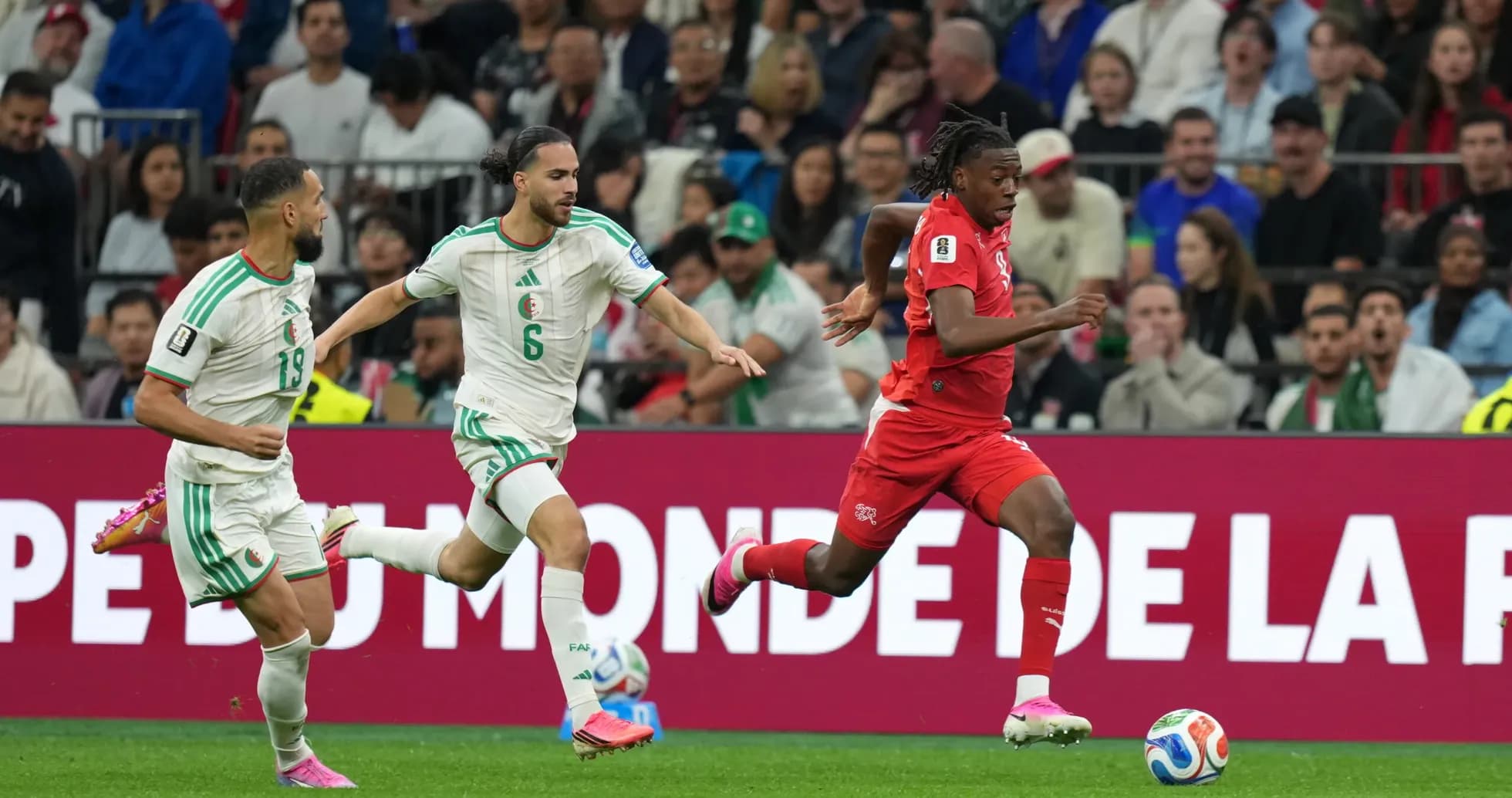
Switzerland's Tactical Mastery in 2-0 Win Over Algeria
Switzerland’s 2-0 win over Algeria at BC Place in this World Cup Round of 32 tie was a textbook example of control without the ball, vertical efficiency and game management once ahead. Despite having only 45% possession and completing fewer passes (436 vs Algeria’s 561), Murat Yakin’s side dictated the key zones and moments of the match, translating their structure into a far clearer attacking threat.
Switzerland set up in a 4-2-3-1 that functioned as a compact 4-4-1-1 without the ball. Manuel Akanji and Nico Elvedi formed a stable central pairing, with Ricardo Rodríguez and Denis Zakaria as full-backs. In front of them, the double pivot of Remo Freuler and Granit Xhaka was decisive: Xhaka orchestrated Switzerland’s circulation and pressing triggers, while Freuler provided the legs to jump out and close Algerian midfielders receiving between the lines. This screen effectively cut supply into Houssem Aouar and Farès Chaïbi in Algeria’s 4-3-3, forcing Vladimir Petkovic’s side to build in front of Switzerland’s block rather than through it.
The first goal on 10 minutes, finished by Breel Embolo and assisted by Johan Manzambi, encapsulated the Swiss plan. Switzerland were happy to let Algeria have the ball, then spring quickly once they regained it. With nine of their 11 shots coming from inside the box, Switzerland consistently turned transitions into high-quality territory, reflected in an xG of 2.56 from just 11 attempts. The second goal, by Dan Ndoye at 46', arriving immediately after half-time, underlined their ability to strike at psychologically key moments and then manage the game state.
Algeria’s 4-3-3, on paper, offered technical quality between the lines with Chaïbi, Nabil Bentaleb and Ramiz Zerrouki, plus wide threat from Riyad Mahrez and Aouar. In practice, Switzerland’s mid-block denied central progression. Algeria’s 55% possession and 561 passes (476 accurate, 85%) did not translate into penetration: they produced only eight shots, five inside the box, and a modest xG of 0.73. Too often the ball was circulated across the back line and into full-backs, where Switzerland’s wingers and full-backs could press in pairs and force play backwards.
Key to that security was Switzerland’s rest defence. When attacking, Xhaka held his position close to Freuler, with Rodríguez and Zakaria cautious in their forward runs. That left at least four, often five players behind the ball to deal with Algerian counters. As a result, Algeria rarely found Mahrez or Aouar isolated against a single defender; instead they met a prepared line of two or three red shirts, which blunted one-on-one situations and forced low-percentage crosses or shots from distance.
In goal, Gregor Kobel (Switzerland) was protected so well that he was required to make only two saves. The low Algerian shot volume and xG underline how effectively Switzerland controlled their own penalty area. At the other end, Luca Zidane (Algeria) also made two saves, but Switzerland’s finishing and shot quality meant he could not compensate for the defensive gaps in front of him. Notably, both goalkeepers’ “goals prevented” metrics sit at -0.29, indicating that, relative to shot quality faced, neither overperformed expectation; the result was driven more by structural superiority than goalkeeping heroics.
Switzerland’s attacking unit was built around Embolo’s ability to occupy centre-backs and run channels, with Manzambi operating between the lines and Ndoye and Rubén Vargas attacking the half-spaces. The 4-2-3-1 often morphed into a narrow front four in possession, overloading the central corridor and opening lanes for full-backs to advance selectively. With four corner kicks and no offsides, Switzerland’s attacks were measured rather than reckless, preferring controlled entries over speculative runs behind.
Algeria’s response came through a flurry of substitutions around the hour and into the final 20 minutes: Jaouen Hadjam, Amine Gouiri, Anis Hadj Moussa, Hicham Boudaoui and Adil Boulbina all entered, with Mahrez and Bentaleb among those withdrawn. These changes aimed to add freshness and directness, but they did not alter the underlying dynamics. Switzerland’s defensive shape remained intact, and Algeria’s increased individual dribbling attempts led more to “Roughing” and “Tripping” incidents, as reflected in their two yellow cards, than to clear chances.
Statistically, the match paints a clear tactical picture. Algeria’s higher possession and pass accuracy disguised their lack of incision; they were steered into low-yield zones and forced to shoot under pressure, as indicated by their eight total shots and three blocked efforts. Switzerland, conversely, were ruthlessly efficient: 11 shots, nine from inside the box, and a shot profile that fully justified their 2.56 xG. Their passing line of 436 total passes, 354 accurate (81%), was lower-volume but purposeful, always geared toward progressing into dangerous central areas rather than sterile circulation.
Discipline and duels also favoured Switzerland’s approach. They committed 10 fouls to Algeria’s 12, maintaining aggression without tipping into chaos. Algeria’s two yellow cards, one for “Tripping” and one for “Roughing”, highlighted their growing frustration as they chased the game against a well-organised block. With no cards for Switzerland, Yakin’s team combined intensity with control, avoiding the stoppages and emotional swings that might have given Algeria a route back.
In sum, Switzerland advanced from this Round of 32 clash not by dominating the ball, but by dictating where it was played and how dangerous each phase could become. Their compact 4-2-3-1, efficient use of transitions, and disciplined rest defence turned a possession deficit into a comfortable 2-0 win and a statistically coherent performance.
Related News
Thomas Tuchel Reflects on England's 10-Man World Cup Triumph and a Surprising Regret
Robert Moreno Takes Over as Interim South Korea Coach After World Cup Setback

Jude Bellingham Returns to Form with Real Madrid After World Cup Success

Chloe Kelly, Beth Mead & 13 Lionesses Who Must Shine in the Upcoming WSL Season for England’s 2027 World Cup Bid
Barcelona Cancels World Cup Tribute Amid Political Tensions
Messi Breaks Record for Most Penalties Taken and Missed in FIFA World Cup History