
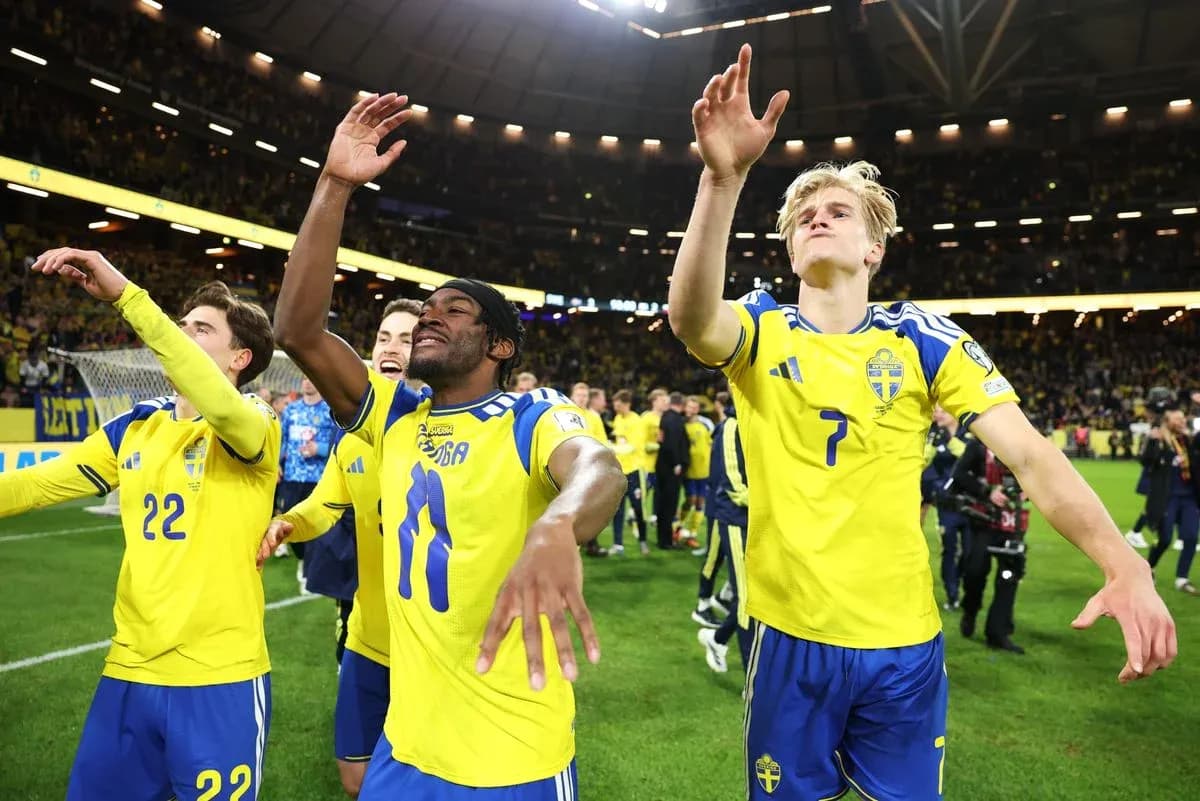
Sweden Dominates Tunisia 5-1 in World Cup Opener
Under the lights of Estadio BBVA in Monterrey, Sweden did far more than open their World Cup campaign; they unveiled a fully formed tactical blueprint in a 5–1 dismantling of Tunisia that now defines Group F’s early hierarchy. Following this result, Sweden sit 1st in the group on 3 points with a goal difference of +4 (5 goals for, 1 against overall), while Tunisia are bottom on 0 points with a goal difference of -4 (1 for, 5 against overall). It was a statement performance that fused structure, individual quality and ruthless efficiency.
I. The Big Picture – Sweden’s new identity
Graham Potter’s Sweden lined up in a bold 3-1-4-2, a system that asked his defenders to build, his wing-oriented midfield to stretch the pitch, and his twin forwards to constantly threaten the space behind Tunisia’s back five. With K. Nordfeldt in goal, the back three of V. Lindelof, I. Hien and G. Lagerbielke formed a calm, progressive platform. J. Karlstrom, stationed as the single pivot ahead of them, was the quiet metronome and first line of counter-press.
Ahead of that base, the four-man midfield band – G. Gudmundsson, Y. Ayari, B. Nygren and A. Bernhardsson – provided the game’s real texture. They rotated, underlapped and overloaded Tunisia’s flanks, constantly asking questions of the 5-3-2 block. Up front, V. Gyökeres and A. Isak were the twin spears, one a relentless runner and creator, the other a high-class finisher and facilitator.
The numbers underline how complete Sweden’s opening was. Heading into this game, they had no prior 2026 World Cup data; following this result, they have scored 5.0 goals per game at home and conceded 1.0 at home, with no clean sheets yet but also no failure to score. Their biggest win so far is this very 5–1, and their only recorded formation is the 3-1-4-2, played once and executed with conviction.
Tunisia, by contrast, arrived with a more conservative 5-3-2 under Sabri Lamouchi, built on the back line of A. Abdi, M. Ben Hamida, M. Talbi, O. Rekik and Y. Valery in front of goalkeeper A. Chamakh. The midfield trio of R. Khedira, E. Skhiri and H. Mejbri was tasked with both screening and sparking transitions, while E. Saad and A. Slimane led the line.
But on their travels, Tunisia’s numbers now paint a stark picture: 1 away match, 0 wins, 1 loss, 1 goal scored and 5 conceded, for an away goals-against average of 5.0 and away goals-for average of 1.0. Their heaviest defeat overall is this 5–1, and they have yet to keep a clean sheet.
II. Tactical Voids – where the structures cracked
Sweden’s shape revealed no obvious absences; with no missing-fixture data listed, Potter appeared to have the core of his plan available. The cohesion of the back three plus Karlstrom suggested a unit drilled over time rather than patched together.
Tunisia’s issues were less about who was missing and more about what was missing: compactness between lines and clarity in their wing responsibilities. The back five often became a flat line, leaving Khedira and Skhiri exposed as Sweden’s four-man midfield band pinned the wing-backs and dragged the outside centre-backs into uncomfortable zones.
Disciplinarily, the contrast was clear. Sweden’s season card data remains blank, implying a clean sheet in terms of bookings in this match. Tunisia, however, recorded a clear disciplinary spike: 100.00% of their yellow cards this World Cup have arrived between 46–60 minutes, a precise indicator of a side struggling to cope immediately after half-time, when intensity and frustration collide.
III. Key Matchups – Hunter vs Shield, Engine Room vs Enforcer
The most decisive duel was “Hunter vs Shield”: Sweden’s front and advanced midfield against Tunisia’s defensive block. Y. Ayari, already among the top scorers with 2 goals in 1 appearance and an 8.6 rating, operated as a late-arriving threat from midfield. His 27 passes with 2 key passes and 2 shots on target showed a player equally comfortable between the lines and in the box.
Alongside him, A. Isak – 1 goal, 2 assists, an 8.9 rating – was the complete forward. His 17 passes at 82% accuracy and 2 key passes underlined how he destabilised Tunisia not just with finishing but with link play. V. Gyökeres added another layer: 1 goal, 1 assist, 4 shots (2 on target), 19 passes with 4 key passes and 9 duels contested. Together, they overwhelmed the Tunisian “shield” of Talbi, Rekik and Ben Hamida, forcing them to defend wide, deep and often facing their own goal.
In the “Engine Room” duel, J. Karlstrom and Y. Ayari squared off indirectly against E. Skhiri and R. Khedira. Skhiri and Khedira were forced into almost permanent firefighting as Sweden’s midfield four stretched the pitch horizontally. With H. Mejbri tasked to link to the forwards, Tunisia’s three often found themselves outnumbered 4v3 in central and half-space zones. That imbalance allowed Sweden to control second balls and dictate where transitions started.
Potter’s bench only sharpened the edge. M. Svanberg came on to score 1 goal in 13 minutes with his only shot on target, while L. Bergvall added 1 assist in 25 minutes, completing 6 passes at 83% and winning 2 of 4 duels. The fact that Sweden’s substitutes are already on the assists leaderboard hints at a squad with depth and continuity of style.
IV. Statistical Prognosis – where this takes both sides
With no xG values provided, the prognosis must rest on structural and output data. Sweden’s overall averages – 5.0 goals for and 1.0 against per match so far – are inflated by a single game but supported by the quality spread: goals and assists from Isak, Gyökeres, Ayari and Svanberg, plus creative output from Bergvall. Their 3-1-4-2 has shown it can dominate territory and chance creation without sacrificing too much at the back.
Tunisia’s defensive solidity is an immediate concern: an overall average of 5.0 goals conceded per match, all on their travels, suggests that the 5-3-2 is currently more cosmetic than protective. The single yellow card spike between 46–60 minutes confirms that their most vulnerable window is the restart phase, when Sweden, in this match, were able to reassert control rather than suffer a lull.
Following this result, the trajectory is clear. Sweden look built for knockout football, with a defined structure, multiple scorers and creators, and a bench that maintains tempo. Tunisia, meanwhile, must tighten the distances between their lines and give Skhiri and Khedira more support, or risk their back five being carved open again by any side capable of overloading the flanks and half-spaces the way Sweden did in Monterrey.
Related News
Thomas Tuchel Reflects on England's 10-Man World Cup Triumph and a Surprising Regret

Robert Moreno Takes Over as Interim South Korea Coach After World Cup Setback

Jude Bellingham Returns to Form with Real Madrid After World Cup Success

Chloe Kelly, Beth Mead & 13 Lionesses Who Must Shine in the Upcoming WSL Season for England’s 2027 World Cup Bid
Barcelona Cancels World Cup Tribute Amid Political Tensions
Messi Breaks Record for Most Penalties Taken and Missed in FIFA World Cup History