
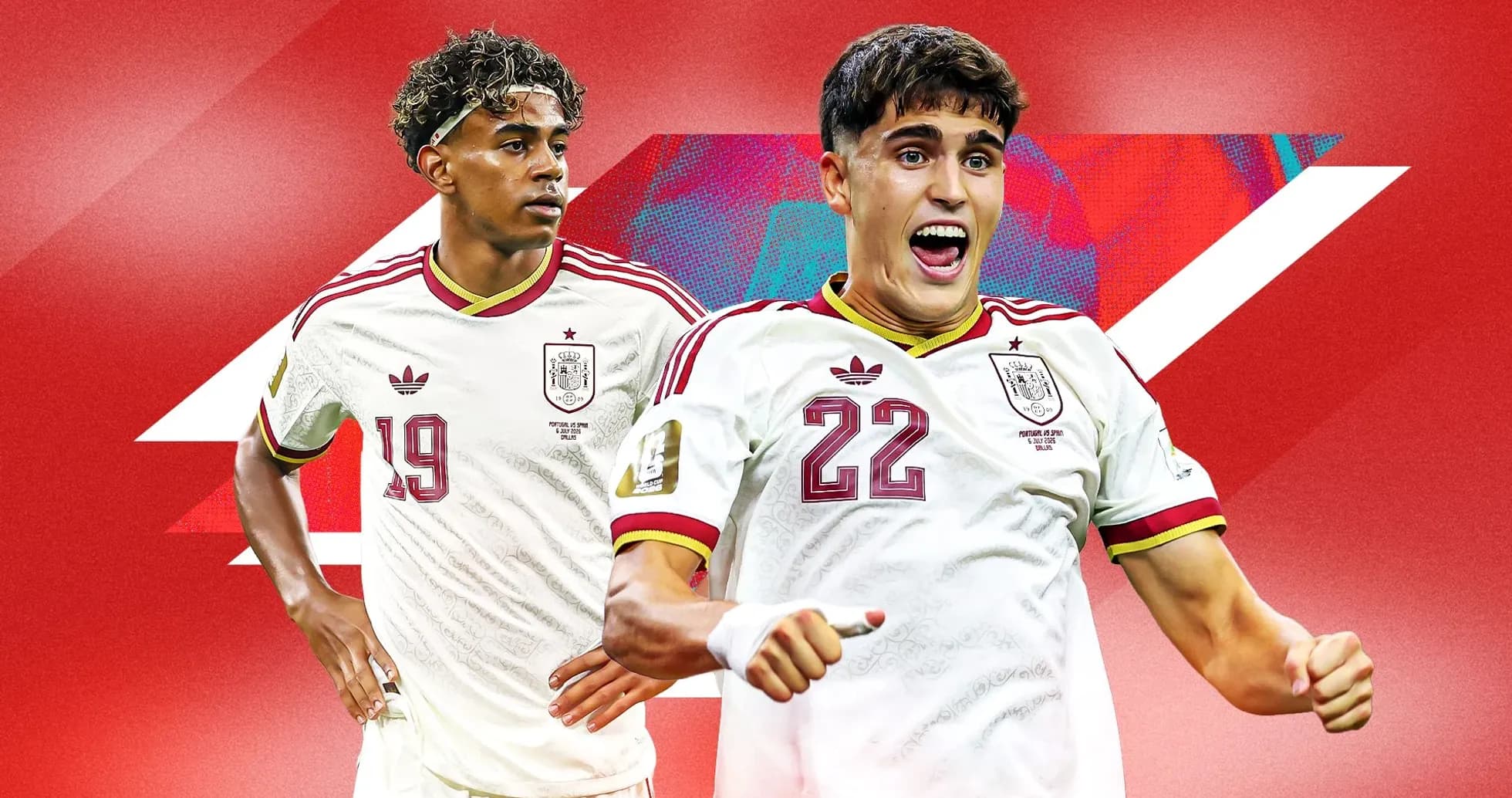
Spain’s Youthful Defence: The Rise of Pau Cubarsí and Lamine Yamal
Luis de la Fuente insisted last summer that Pau Cubarsí’s absence from Euro 2024 had nothing to do with age. He said he simply had four centre-backs he rated higher at the time.
Nobody could say that now. Not with a straight face.
In North America, at this World Cup, there are very few defenders operating at Cubarsí’s level. If any.
Spain’s wall of youth
Spain have reached the quarter-finals without conceding a goal. That kind of record never belongs to one man.
Mikel Oyarzabal chases lost causes and presses centre-backs into mistakes. Rodri patrols in front of the defence with that familiar air of inevitability, snuffing out danger before it forms. Behind them, a back five that looks as if it has been together for years rather than weeks.
Marc Cucurella is justifying every euro of the €60 million Real Madrid have committed after prising him from Chelsea. Unai Simón has shut down any debate with David Raya and Joan García by stringing together five straight clean sheets. Aymeric Laporte, at 32, is playing with the calm authority of a man who has seen every attacking trick in the book. Pedro Porro, so often erratic for Tottenham, looks reborn in red.
And then there is Cubarsí.
The teenager’s composure and clarity on the ball stand out even in this company. His positioning is sharp, his timing immaculate. He looks like he has been here for a decade, not a handful of caps.
The making of a centre-back
Maybe we shouldn’t be shocked. Barcelona had already fast-tracked him into the first team at 17. Xavi, never one for wild labels, called him “an era-defining player”. Carles Puyol went further, tipping him to be Barça’s main centre-back for the next 15 years.
Cubarsí himself insists he doesn’t feel pressure on the pitch. That may be true. It still doesn’t make what he is doing at a World Cup at 19 any less remarkable.
Defensively, he has barely put a foot wrong. Laporte’s presence alongside him has been crucial, a steadying hand and a voice in his ear. De la Fuente has highlighted that partnership as the backbone of Spain’s run.
“At crucial moments, a player like Laporte brings that experience Cuba needs [alongside him], and they complement each other fantastically,” the coach said. “We’ve achieved a phenomenal balance in the centre of defence.”
That balance is not just about tackling and clearances. With Cubarsí, Spain gain another playmaker. A La Masia graduate, he is steeped in the idea that attacks start at the back. It shows in the numbers: only Rodri has played more passes at this World Cup.
He is now non-negotiable. One of only four players in De la Fuente’s squad to have played every minute so far. For a defender who wasn’t deemed ready a year ago, that is quite a leap.
Yamal waiting to explode
On the other side of the pitch, the other teenage phenomenon has endured a different kind of tournament.
Lamine Yamal arrived in the United States under a cloud. A hamstring injury had cut short his 2025-26 season with Barcelona, raised doubts over his World Cup involvement, and robbed him of rhythm. He missed both warm-up games. When he finally appeared, it was for a 19-minute run-out in a goalless shock against Cape Verde.
Then came the reminder.
Yamal started the 4-0 dismantling of Saudi Arabia and instantly changed Spain’s attacking temperature. He opened the scoring in Atlanta and stretched the game in a way nobody else in the squad can, dragging defenders out of shape and inviting combinations around him.
Yet the spark has flickered rather than blazed since. His dribbling lit up the round-of-32 hammering of Austria, a match that saw Spain become the first team since Pelé’s Brazil in 1958 to start two teenagers in a World Cup knockout tie. But when he ran into Nuno Mendes again in the 1-0 win over Portugal, the duel went the same way as at Euro 2024: frustrating, tight, with little end product.
So the most feared winger in the game heads into Friday’s quarter-final against Belgium still without an assist in this World Cup, having created just five chances. On paper, underwhelming.
Yamal knows it. And he’s utterly unfazed.
“I’m very demanding of myself,” he told Mundo Deportivo. “I’m never satisfied with what I’m doing. Besides that, I just need to keep playing. I was out for almost two months, and it’s not the same as when you’ve already played seven games in a row.
“Keep touching the ball, keep playing, keep adding minutes and, obviously, that [big] match will come. In the end, people remember these moments, from the round of 16 and the quarter-finals onwards. That’s when I’m most motivated.
“I’ve taken this whole process calmly so I can arrive at this point in good shape. I feel great, eager to show what we are as Spain and what I am.
“I’ve never been the best player in the group stage. The closer the important matches get, the semi-finals or the final, the better I play.”
For Belgium, and everyone else still alive in this tournament, that is a chilling prospect. A fully fit, fully tuned Yamal in the knockout rounds is exactly what broke Euro 2024 open for Spain. There is no reason history cannot repeat itself on an even bigger stage.
A new spine for La Roja
The idea that Spain might now possess an “era-defining” figure at both ends of the pitch changes the conversation around this team.
At the back, Cubarsí has turned a supposed weakness into a strength. In midfield, Rodri dictates. Up front, Yamal waits to catch fire.
Spain already know what it feels like when their young winger catches the wind at the right moment. The question now is how far they can go with a 19-year-old centre-back quietly running the game from 60 yards behind him.
Related News
Ilia Topuria Accuses Justin Gaethje After UFC Defeat

Tyson Fury vs Anthony Joshua Fight Date and Venue Confirmed
Switzerland Calls Up In-Form Sion Striker Winsley Boteli for Nations League
Bournemouth Secures Historic 2-1 Win Over Real Sociedad in Spain
Portugal Announces Squad for 2026 UEFA Nations League; Cristiano Ronaldo Expected to Play
Raphinha Channels Ronaldo Nazario as Barcelona's Leading Striker After Position Change