
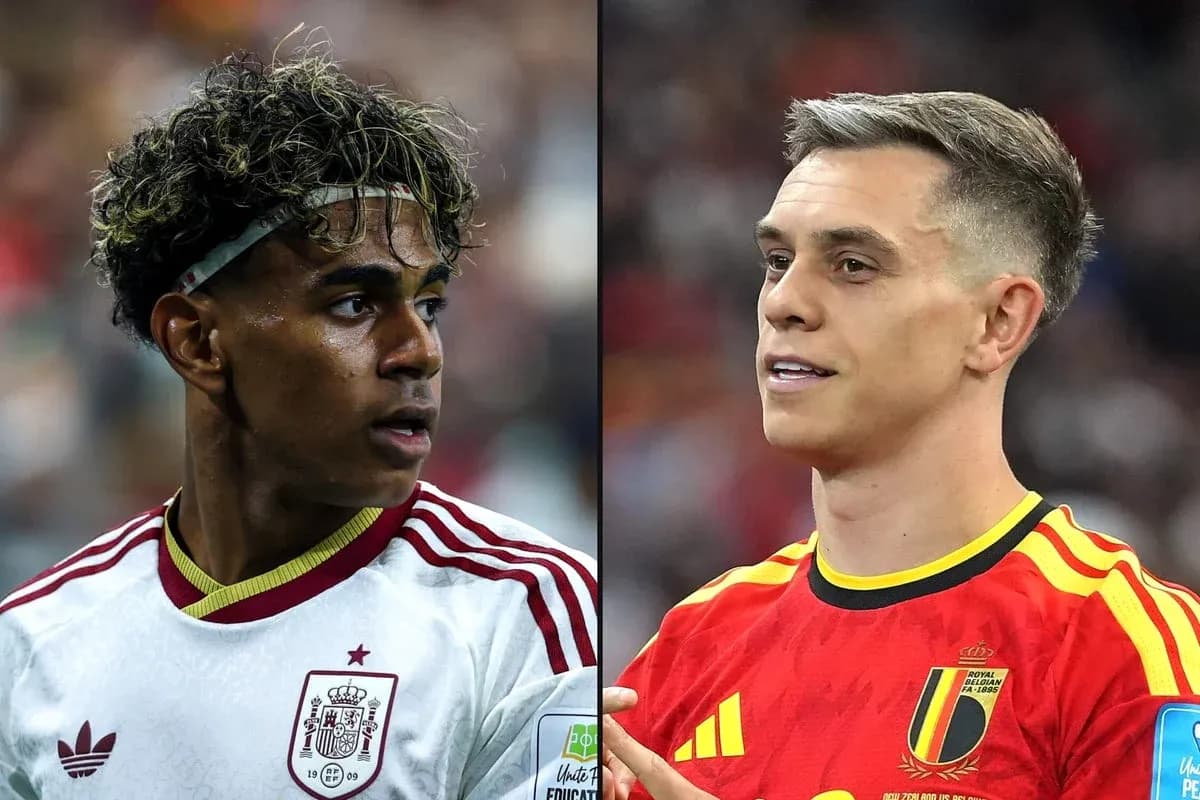
Spain vs Belgium: Clash of Styles and Talents at SoFi
Spain arrive in Inglewood with a perfect defensive record and an imperfect sense of satisfaction. Belgium land in California as the team that stunned the co-hosts and tore up their own hierarchy to stay alive. One side has cruised. The other has survived. Both now stand one game from a World Cup semi-final with France.
The setting is SoFi Stadium. The stakes need no embellishment.
Spain’s quiet march
Luis de la Fuente’s Spain have slipped into the last eight without ever needing to bare their teeth for long. They topped Group H with seven points, opening with a flat 0-0 against Cape Verde, then dismantling Saudi Arabia 4-0 and edging Uruguay 1-0. From there, they brushed aside Austria 3-0 in the round of 32 and finally broke Portugal with Mikel Merino’s stoppage-time header in the last 16.
The constant thread is obvious: nobody has scored against them.
Unai Simon has strung together five straight clean sheets, extending Spain’s record run to 609 World Cup minutes without conceding, stretching back to 2022. In front of him, Aymeric Laporte and Pau Cubarsi have formed a calm, ruthless pairing, protected by a structure that rarely loses the ball and reacts ferociously when it does.
Spain do not just defend deep; they defend by suffocating. They draw opponents offside more than anyone at this tournament — 18 times so far — and they win more possessions in the final third than any other side, 36. The high line and the counter-press are not ornaments. They are the foundation.
The flip side? The attack has stuttered in patches. Mikel Oyarzabal’s doubles against Saudi Arabia and Austria showcased a sharp No 9, but long stretches against Uruguay and Portugal passed without incision. The ball circulated, the control remained, yet the killer pass or run often lagged behind the idea.
Spain’s biggest attacking wildcard, Lamine Yamal, is still waiting for his World Cup to ignite. The Barcelona winger, who turns 19 on Monday, has offered flashes rather than full storms. Nuno Mendes and then Nelson Semedo kept him quiet against Portugal, and the teenager has yet to dominate a knockout game as many expected.
De la Fuente’s main dilemma sits behind the striker. Dani Olmo has been tidy and influential since coming into the XI, one of the few who truly threatened Portugal’s back line. Merino, though, changed the last-16 tie from the bench, timing his late run perfectly to head Spain into this quarter-final. Fabian Ruiz lurks as another option if Pedri’s underwhelming form finally costs him his place.
On the left, Alex Baena has earned the coach’s trust with hard running and smart combinations, often doubling up with Marc Cucurella to overload flanks and slip runners in behind. The pattern is clear: Spain want the wings, the cut-backs, the low crosses. They just haven’t quite found the ruthless version of themselves yet.
Belgium’s reinvention
Belgium’s route has been anything but smooth. They topped Group G with five points — laboured draws with Egypt (1-1) and Iran (0-0), then a 5-1 release against New Zealand. The performances looked disjointed, heavy-legged, and dangerously reliant on individual flashes.
Then came Senegal, and the turning point.
Trailing 2-0 with five minutes of normal time left in the round of 32, Rudi Garcia made the kind of calls that define a tournament. Off came Jeremy Doku. Off came Kevin De Bruyne. On came Dodi Lukebakio from Benfica and Nicolas Raskin from Rangers, a winger and a ball-winner in place of two superstars.
On paper, it looked conservative. On the pitch, it changed everything.
Romelu Lukaku and Youri Tielemans dragged Belgium level before the whistle, forcing extra time. Tielemans then converted a late penalty to seal a 3-2 comeback that felt like a reset of the entire project. Belgium suddenly had legs in midfield, structure without the ball, and a platform for their attackers.
Garcia kept faith with that new core against the United States in the last 16. Tielemans, Raskin and Amadou Onana formed a combative, functional midfield. Tragedy struck Onana early — an ACL injury ended his first start in the 21st minute — but Hans Vanaken stepped in and Belgium never lost control. They overpowered the co-hosts 4-1, with Doku and Lukaku used later, when space opened up and the game tilted their way.
That is the blueprint for Spain.
De Bruyne and Doku are likely to start on the bench again, just as they did against the U.S. Garcia has leaned into cohesion over reputation. He knows his side cannot match Spain’s pressing or passing if they scatter across the pitch. He wants a compact, disciplined block that can suffer, then suddenly spring.
Leandro Trossard has become the quiet star of that approach, leading the entire tournament with 17 chances created. Tielemans has added late runs and calm finishing. Lukaku remains the reference point up front, even if some argue Charles De Ketelaere offers a smoother fit. Behind them, Belgium’s full-backs make relentless off-the-ball runs to overload wide areas and fire in the low crosses that define their attack.
There is a catch. Belgium have allowed 53 shots so far, nearly double Spain’s 29, and committed six errors leading to shots — only the United States and Brazil have more. Their defensive base looks sturdier, but it is not watertight.
Where it will turn
This game feels destined to be decided on the flanks and in the first three seconds after the ball changes hands.
Out wide, Yamal’s duel with Belgium’s left side will be a focal point. His one-on-one threat remains one of the tournament’s most potent theoretical weapons. Even in quieter outings, his link-up with right-back Pedro Porro has hinted at something explosive. On the opposite wing, Cucurella and Baena have already shown how effectively Spain can overload and slice through when their timing is right.
Belgium mirror that emphasis. Under Garcia, their full-backs surge beyond wingers to deliver low, whipped balls into the box — the kind that created chaos in the 5-1 demolition of New Zealand. Both teams sit among the best in the competition for chances from low crosses, three each, level with the Netherlands and Switzerland. Belgium lead all sides for first-time shots with 58; Spain are third with 46. If the ball reaches the box early, expect bodies flying at it.
Then there is the pressing battle.
Spain’s counter-press has strangled opponents. Lose the ball, swarm the space, win it back high. Belgium, by contrast, have struggled at times to stop teams playing through their midfield. That fragility, combined with their shot volume conceded, is exactly the kind of weakness Spain’s structure is built to punish.
Yet Belgium carry a different kind of threat. They shoot often, and though many of their efforts are blocked — 32, the most of any team — their conversion when they do find a clear sight of goal is remarkable. Of their 107 total shots, only 14 have been “clear” attempts, with zero or one defender in the way. They have scored 13 of those. That ratio beats France, England and even Spain.
Give them space, just once, and they rarely miss.
History and weight
Spain and Belgium have been crossing paths for more than a century. The first meeting came at the 1920 Olympics in Antwerp, where Belgium won 3-1 on home soil. Their most famous clash arrived in the 1986 World Cup quarter-final in Mexico, when Jan Ceulemans’ diving header and Juan Senor’s 30-yard rocket dragged the tie to penalties. Jean-Marie Pfaff’s save from Eloy Olaya sent Belgium through and helped cement Spain’s long, painful relationship with shootouts.
Spain took their revenge at Italia 1990 with a 2-1 group-stage win that nudged them to the top of the group and left Belgium second. Since the turn of the century, though, the fixture has been one-way traffic: five Spanish wins from five, including a 5-0 qualifying statement in La Coruna on the road to their 2010 World Cup triumph.
The last meeting, a 2-0 Spanish win in Brussels in 2016, featured Thibaut Courtois, Lukaku, Thomas Meunier and De Bruyne. That was another era of Belgium’s golden generation. This version is more patched-together, more pragmatic, more willing to sacrifice names for balance.
The stakes now
The numbers, the history, and the form lines all tilt Spain’s way. They have not conceded. They dominate territory. They draw offsides, win the ball high, and glide through games with a sense of inevitability. Most of the experts see a Spanish win by two goals, many of them by the same 2-0 scoreline.
Yet there is a tension around this Spain side. They have not yet “gone to town” on anyone of real stature. Their attack has flickered more than burned. Yamal, in particular, feels like a story waiting to be written rather than one already told.
Belgium, on the other hand, have already lived several lives in this tournament. From a team without identity to a side that benched its icons and roared back from the brink. They have more scars than Spain, more chaos in their matches, and perhaps more comfort if this quarter-final turns wild.
The winner will step into a semi-final against France at AT&T Stadium in Arlington. For Spain, that would be another step in a methodical march, a chance to prove their control can hold against the most ruthless of opponents. For Belgium, it would be the greatest vindication yet of Garcia’s gamble, and a doorway to something no generation of Belgian football has ever achieved.
Spain’s defence against Belgium’s punch. Yamal’s promise against Tielemans’ timing. A team gliding versus a team clinging on and swinging back.
At SoFi, only one version of this story will survive.
Related News
Ilia Topuria Accuses Justin Gaethje After UFC Defeat

Tyson Fury vs Anthony Joshua Fight Date and Venue Confirmed
Switzerland Calls Up In-Form Sion Striker Winsley Boteli for Nations League
Bournemouth Secures Historic 2-1 Win Over Real Sociedad in Spain
Portugal Announces Squad for 2026 UEFA Nations League; Cristiano Ronaldo Expected to Play
Raphinha Channels Ronaldo Nazario as Barcelona's Leading Striker After Position Change