
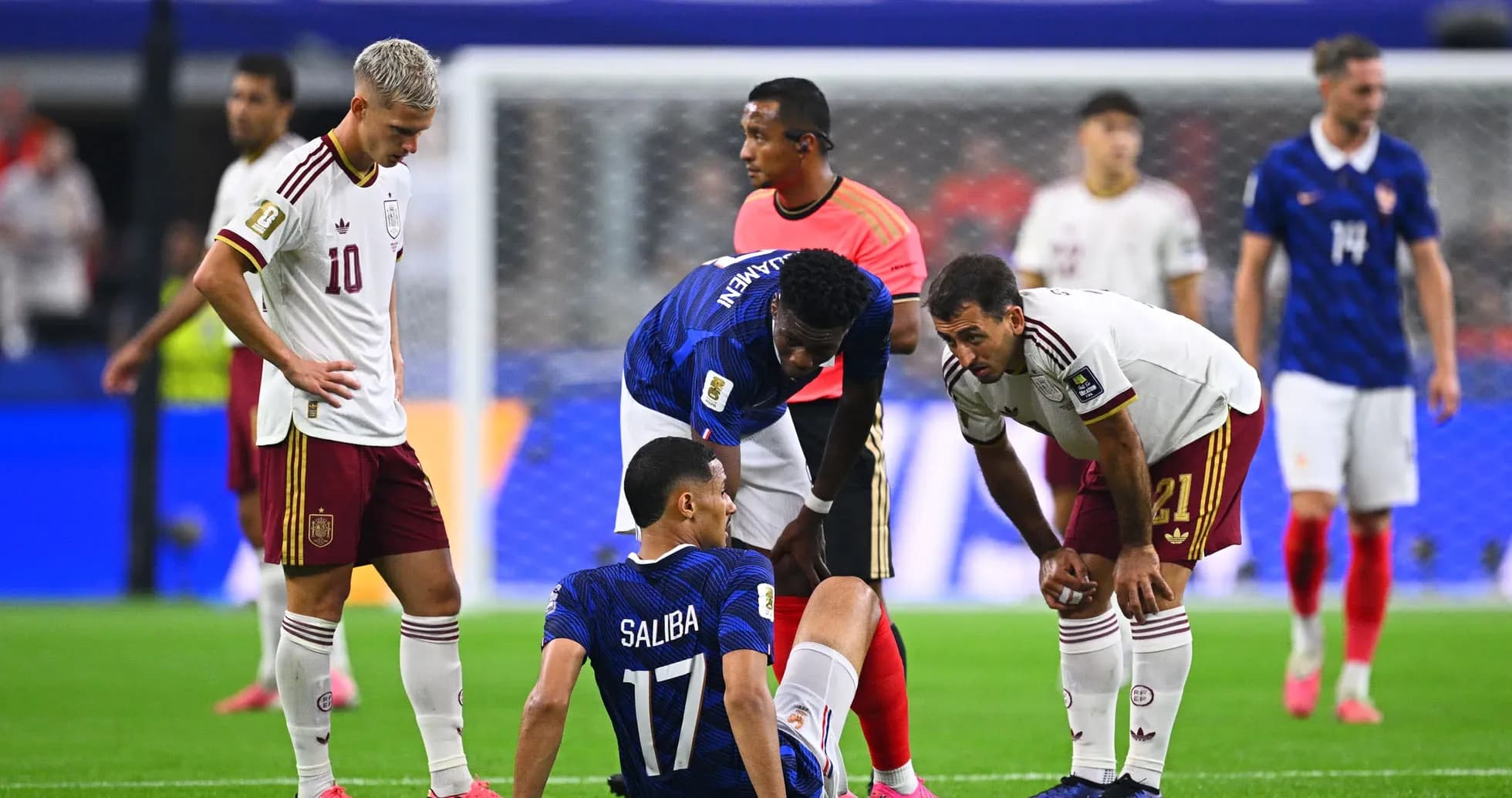
Spain's Tactical Superiority Over France in Semi-Final
France and Spain mirrored each other structurally in a 4-2-3-1 at Dallas Stadium, but the semi-final was defined by Spain’s superior control of key zones and efficiency in both boxes. Despite a near-even share of the ball (France 49% vs Spain 51%) and identical total shot volume (10-10), Spain translated their possession into higher-quality chances and a 2-0 win, while France’s structure never truly released its front four into threatening positions often enough.
France's Formation
France’s base shape under Didier Deschamps was a classic 4-2-3-1: Mike Maignan (France) behind a back four of Jules Koundé, Dayot Upamecano, William Saliba and Lucas Digne, screened by Aurélien Tchouaméni and Adrien Rabiot. Ahead, Ousmane Dembélé and Bradley Barcola started wide, Michael Olise as a central creator and Kylian Mbappé as the lone forward. In theory this offered strong ball progression through the double pivot and 1v1 threat on both flanks; in practice, Spain’s pressing and rest-defense repeatedly isolated Mbappé and forced France into lower-value shooting positions.
Spain's Formation
Spain’s 4-2-3-1 under Luis de la Fuente was more fluid. Rodri and Fabián Ruiz anchored midfield, with Lamine Yamal and Alex Baena stretching the half-spaces, Dani Olmo floating between the lines and Mikel Oyarzabal up front. Their 500 passes (France 473) with a slightly higher accuracy (86% vs France’s 84%) underline how they controlled tempo rather than simply recycling possession. Spain’s structure allowed them to find interior pockets between France’s lines, especially around Tchouaméni and Rabiot, dragging the French double pivot out and opening lanes for third-man runs.
Tactical Changes
The first major tactical hinge came early: at 9', Adrien Rabiot’s yellow card for “Foul” nudged him into a more conservative stance. Already cautious, France’s left-sided pivot became less aggressive stepping out to Rodri or Dani Olmo, which in turn gave Spain more freedom to circulate centrally. That central dominance was soon reflected on the scoreboard. At 22', Mikel Oyarzabal converted from the spot for Spain to make it 0-1, a moment that crystallised the difference in penalty-box composure. Spain, with only 2 shots on goal all match, made one of those count from 12 yards.
Defensively, Spain’s back four of Pedro Porro, Pau Cubarsí, Aymeric Laporte and Marc Cucurella was compact and well-protected. They conceded 10 shots but allowed only 4 inside the box, forcing France into 6 efforts from outside. The French xG of 0.3 reflects how rarely Deschamps’ side penetrated into truly dangerous areas. Spain’s 3 blocked shots to France’s 2 also show their willingness to step out and contest shots at source, particularly from the edge of the area when Mbappé or Dembélé cut inside.
The first major structural change from France came at 30', when Maxence Lacroix (IN) came on for William Saliba (OUT). Rather than a systemic overhaul, it was a like-for-like at centre-back, but it hinted at concern over Spain’s manipulation of the back line. At 31', Marc Cucurella’s yellow card for “Foul” underlined Spain’s readiness to break France’s rhythm with tactical infringements when their press was bypassed.
Deschamps pushed for more verticality after the break. At 46', Manu Koné (IN) replaced Adrien Rabiot (OUT), injecting more ball-carrying and forward passing from midfield. Later, at 57', Désiré Doué (IN) replaced Bradley Barcola (OUT), seeking more direct dribbling and unpredictability between the lines. Yet within a minute, Spain struck the decisive blow: at 58', Pedro Porro surged forward from right-back to score a “Normal Goal” assisted by Dani Olmo, extending the lead to 0-2. Tactically, this was emblematic: France’s attempt to open up and chase the game left their full-back zones more exposed, and Spain punished the space with a full-back arriving late into the final third.
From there, France’s changes at 72' were aggressive but structurally coherent: Theo Hernández (IN) for Lucas Digne (OUT) and Rayan Cherki (IN) for Michael Olise (OUT) added attacking thrust from left-back and a creative, ball-to-feet profile in the half-spaces. France’s 7 corners to Spain’s 1 show they did eventually pin Spain back territorially, but their attacking patterns remained predictable: lots of wide deliveries and half-chances rather than coordinated cut-backs or overloads in the box.
Spain’s substitution wave between 74' and 84' was about energy management and game-state control rather than changing shape. Ferran Torres (IN) for Mikel Oyarzabal (OUT) at 74' gave fresh legs to press France’s build-up. At 78', Pedri (IN) for Fabián Ruiz (OUT) and Mikel Merino (IN) for Dani Olmo (OUT) rebalanced midfield with more defensive awareness and ball retention. Finally, at 84', Marcos Llorente (IN) for Pedro Porro (OUT) and Nico Williams (IN) for Alex Baena (OUT) added running power and counter-attacking threat on both flanks, ensuring Spain could still stretch France in transition rather than simply sitting deep.
Goalkeeping Performance
In goal, Mike Maignan (France) had a statistically stark evening: 0 saves recorded, underlining that Spain’s 2 shots on goal both ended in the net despite his 0.07 goals prevented figure. At the other end, Unai Simón (Spain) made 3 saves, matching France’s 3 shots on goal, and his own 0.07 goals prevented underscores a quietly efficient display. Spain’s rest-defense, with Rodri dropping between or in front of the centre-backs, meant Simón was rarely exposed to high-xG situations.
Discipline and Statistics
Discipline further tilted the tactical picture. France finished with 2 yellow cards (Rabiot for “Foul” at 9', Mbappé for “Violent conduct” at 86'), while Spain had 1 (Cucurella for “Foul” at 31'; totals: France 2, Spain 1, Total 3). Mbappé’s late card reflected frustration more than tactical foul play, but it symbolised a France side increasingly chasing shadows as Spain circulated possession.
Statistically, Spain’s 1.63 xG versus France’s 0.3 is the clearest summary of the tactical balance. The shot count was level, but Spain generated more and better looks inside the box (5 shots inside the box to France’s 4) and maximised their moments. France’s 4 offsides to Spain’s 5 show both teams tried to threaten in behind, yet Spain’s timing and support structure were sharper. In a semi-final of fine margins, Spain’s superior positional play, midfield control and box efficiency turned a near-even statistical canvas into a controlled 2-0 progression.
Related News
Thomas Tuchel Reflects on England's 10-Man World Cup Triumph and a Surprising Regret
Robert Moreno Takes Over as Interim South Korea Coach After World Cup Setback
Jude Bellingham Returns to Form with Real Madrid After World Cup Success

Chloe Kelly, Beth Mead & 13 Lionesses Who Must Shine in the Upcoming WSL Season for England’s 2027 World Cup Bid
Barcelona Cancels World Cup Tribute Amid Political Tensions
Messi Breaks Record for Most Penalties Taken and Missed in FIFA World Cup History