
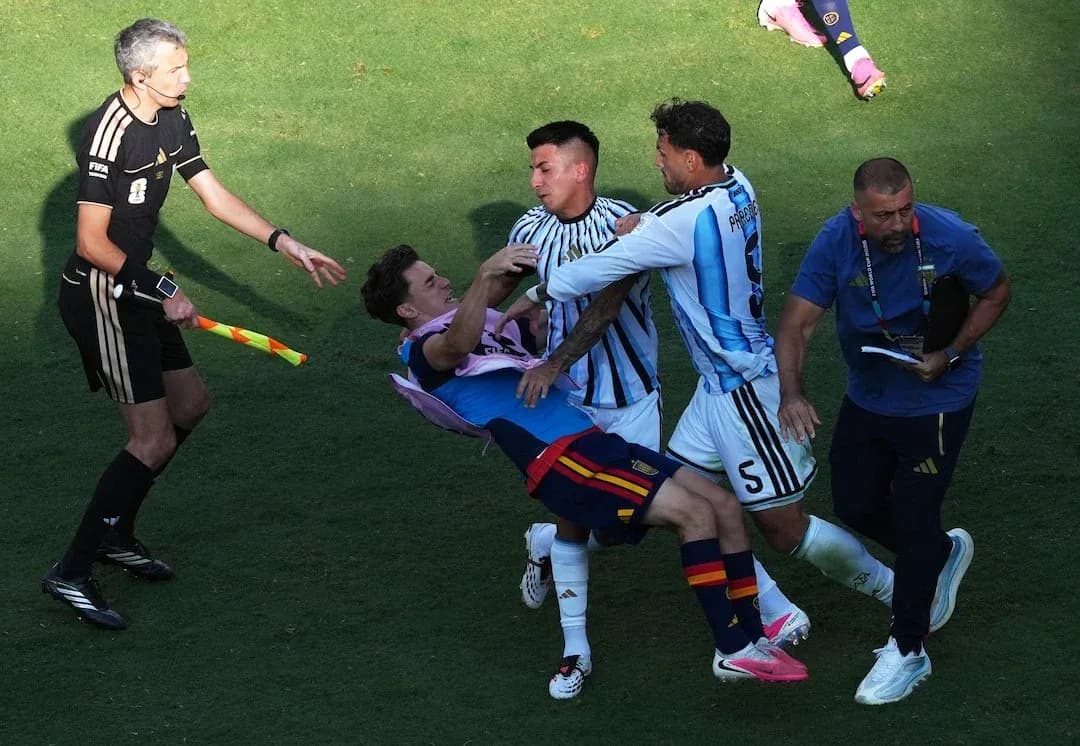
Spain’s Tactical Dominance Over Argentina in World Cup Final
Spain’s 1-0 extra-time win over Argentina at MetLife Stadium was a tactical strangulation more than a spectacle. Across 120 minutes of the World Cup Final, Spain’s 4-2-3-1 under Luis de la Fuente imposed an almost total technical and territorial control, while Lionel Scaloni’s 4-4-2 gradually collapsed into a low block that stopped competing for the ball and focused purely on survival.
Spain’s structure with Rodri and Fabián Ruiz as the double pivot was the platform for dominance. With 65% possession and 852 passes (762 accurate, 89%), Spain built patiently from the back, using Pau Cubarsí and Aymeric Laporte as wide ball-playing centre-backs and full-backs Pedro Porro and Marc Cucurella to stretch Argentina’s first line. The nominal 4-2-3-1 often morphed into a 3-2-5 in settled possession: one full-back tucked in to form a back three, Rodri anchored central circulation, and the advanced line of Lamine Yamal, Dani Olmo, Alex Baena and Mikel Oyarzabal (later Ferran Torres and Nico Williams) occupied all five vertical lanes.
The effect was relentless pressure on Argentina’s mid-block. Spain generated 20 total shots, 12 on goal, with 9 efforts inside the box and 3 blocked. Their xG of 1.94 reflects both volume and quality: repeated cut-backs, half-spaces entries and second-ball wins around the area. The absence of any saves for Unai Simón (Spain) and Argentina finishing with 0 shots on goal, 2 total attempts and xG of just 0.22 underline how comprehensively Spain controlled defensive transition; counter-pressing from Rodri, Fabián Ruiz and later Martín Zubimendi suffocated any outlet towards Lionel Messi and Julián Alvarez.
The key tactical hinge came after the break with Scaloni’s changes. Lisandro Martínez, already on a first-half yellow for “Foul”, was replaced by Nicolás Otamendi on 44', and Nicolás González made way for Leandro Paredes at 46', effectively reinforcing central protection and ceding even more initiative. Later, Gonzalo Montiel was swapped for Nahuel Molina, and Cristian Romero for Facundo Medina, as Argentina’s back line became taller and more conservative, focusing on defending the box rather than engaging Spain higher.
Spain’s substitutions sharpened, rather than altered, their plan. Pedri for Fabián Ruiz and Ferran Torres for Oyarzabal on 62' added more vertical running and late box arrivals. Nico Williams for Alex Baena and Mikel Merino for Dani Olmo on 75' maintained the high technical level while refreshing the press. In extra time, Zubimendi for Rodri and Eric García for Laporte on 99' ensured Spain could keep their line high and aggressive without losing composure in build-up.
The decisive moment on 106' came straight from this structural superiority. Nico Williams, introduced from the bench, assisted Ferran Torres for the only goal. It was emblematic: a wide overload, a runner attacking the space between full-back and centre-back, and a clean finish against a retreating, numerically inferior defence. Given Spain’s 11 shots on target faced by Emiliano Martínez (Argentina) and his 11 saves, the winning strike was less a sudden blow than the inevitable reward for sustained territorial siege.
Defensively, Spain’s back four plus double pivot were rarely stretched. Argentina’s 4-4-2 with Messi and Alvarez up front never established stable possession (463 passes, 357 accurate, 77%) and relied on sporadic direct balls and second phases. Rodrigo De Paul and Enzo Fernández were forced deep and wide, chasing shadows rather than dictating. When Argentina did try to step higher, Spain’s press-resistance through Rodri, Pedri and Merino simply played through them, re-establishing control.
Discipline became a structural problem for Argentina. They accumulated 25 fouls and 6 yellow cards plus 1 red, compared to Spain’s cleaner profile with no cards. Cristian Romero’s early “Argument” booking set the tone, and the introduction of Paredes added bite but also risk; his own yellow for “Unsporting behaviour” on 52' highlighted Argentina’s growing frustration at chasing the ball. The late sequence for Enzo Fernández was decisive: a first yellow for “Argument” on 83', then another for “Foul” at 90+3', immediately followed by a red card for “Foul” at the same time, reduced Argentina to ten men for extra time. Down a midfielder, Scaloni’s side could no longer contest central zones, and Spain’s passing carousel became almost unopposed.
Alexis Mac Allister’s late yellow for “Foul” on 111' further underlined the physical toll of Argentina’s reactive game plan. Their 1 red and 6 yellows were not incidental; they were the inevitable outcome of a side defending ever deeper, ever later, against a technically superior opponent that refused to lower the tempo.
In statistical terms, the match is a blueprint of a one-sided final decided late. Spain’s 65% possession, 20 shots to 2, 12 on target to 0, and 9 corners to 4 map perfectly onto their 1.94 xG and 1.81 goals prevented figure, reflecting how they both created and denied chances at an elite level. Argentina, with 0.22 xG and no shots on target, never built sustained attacking platforms; their 25 fouls and 7 total cards were the cost of survival.
The goalkeeper numbers crystallise the story. Unai Simón (Spain) did not need to make a single save; his role was almost entirely in build-up and sweeping behind a high line. Emiliano Martínez (Argentina), by contrast, made 11 saves and matched Spain’s goals prevented value of 1.81, single-handedly extending the contest into extra time. But once Spain finally broke him with Ferran Torres’ strike, the tactical balance that had been clear from the first whistle was finally reflected on the scoreboard.
Related News

Thomas Tuchel Reflects on England's 10-Man World Cup Triumph and a Surprising Regret

Jude Bellingham Returns to Form with Real Madrid After World Cup Success

Chloe Kelly, Beth Mead & 13 Lionesses Who Must Shine in the Upcoming WSL Season for England’s 2027 World Cup Bid
Barcelona Cancels World Cup Tribute Amid Political Tensions
Messi Breaks Record for Most Penalties Taken and Missed in FIFA World Cup History
FIFA Removes COO Kevin Lamour After Criticism of Infantino’s World Cup Investment Plan