
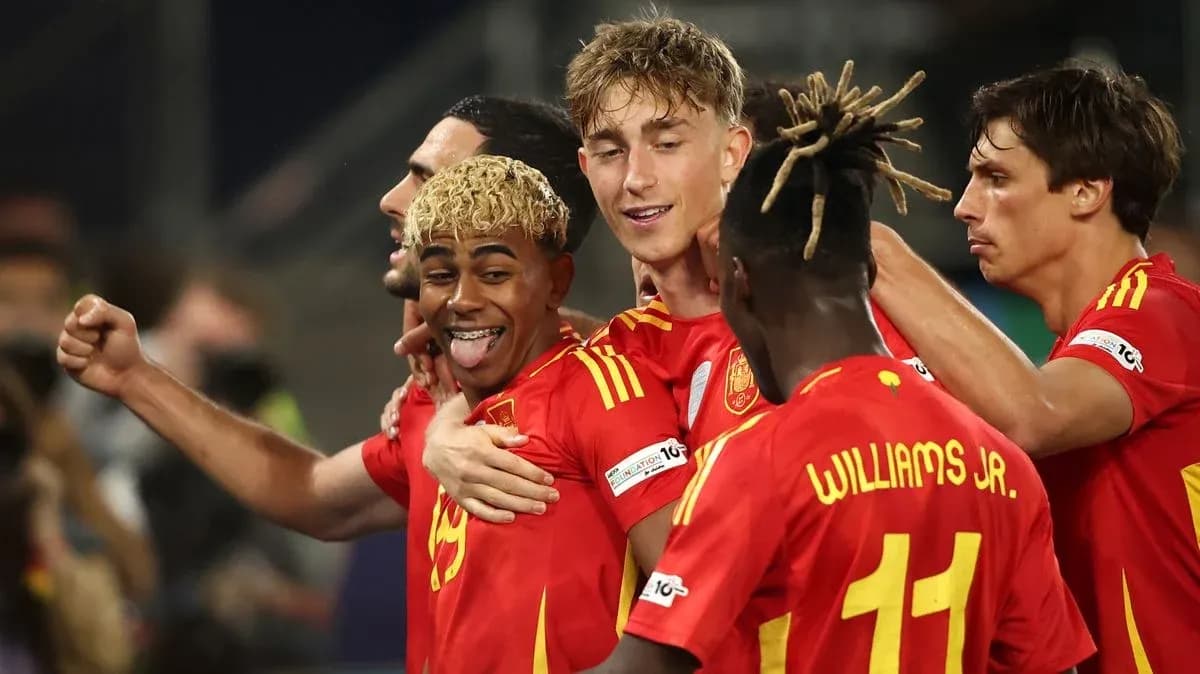
Spain’s Football Evolution: From Glory to Grit
There was a time when Spain walked into every tournament as if the trophy already had their name engraved on it. From 2008 to 2012, La Roja didn’t just win; they rewrote the sport’s instruction manual. Two European Championships. One World Cup. A style that turned opponents into training cones.
Then the crash came. Brutal. Prolonged. A decade of failed resets, early exits and a fanbase forced to swallow its own arrogance.
Now, on the eve of the 2026 World Cup in North America, the mood is different. Not muted. Not fearful. Just…grown up.
This is a Spain that knows exactly what it is.
From suffocating pressure to a healthier belief
The “win or bust” hysteria that once strangled Spanish squads has loosened its grip. The Euro 2024 triumph didn’t just bring a trophy; it reset the relationship between team and country.
Luis de la Fuente’s side cut through Croatia, Italy, Germany, France and England to take the European crown. No flukes. No soft path. They were, across the month, the best team in the tournament.
Spanish-American journalist and ITV World Cup presenter Semra Hunter has watched that shift up close. She describes a fanbase that finally understands its own excess.
Supporters went into Euro 2024 deeply sceptical of De la Fuente. Many didn’t want him. Many didn’t believe in the squad. That doubt became fuel. The players played with a chip on their shoulder, and by the time they lifted the trophy, the mood had flipped. Confidence is back, but it no longer comes with the threat of public execution if they fall short.
Spain arrive at this World Cup not as a fragile superpower clinging to past glories, but as a “beautifully structured” footballing machine, as Hunter puts it, built for another deep run.
Yamal and Williams: the anxiety on the flanks
If Spain are to go all the way again, they need their wingers. Not just available. Devastating.
Lamine Yamal and Nico Williams have become the wild cards that tilt tight games. Both are nursing hamstring problems. Both sit at the heart of Spain’s biggest pre-tournament worry.
Yamal, still only 18, went down in April. He is expected to make the World Cup, but no one can say with certainty how sharp he will be when the first ball is kicked. His role has already started to evolve. He no longer hugs the touchline; he drifts inside, operating in pockets that once belonged to Lionel Messi, slipping through lines and bending games to his will. He destabilises defences, creates chaos, and can conjure a moment of genius when Spain’s passing carousel needs an edge.
On the opposite flank, Williams emerged as arguably Spain’s standout performer at Euro 2024. Direct. Fearless. Relentless. His own hamstring issue in May triggered fresh alarm, though the early signs are kinder and he is expected to return to training in time.
Spain can function without them. The structure is too strong, the midfield too rich, for the whole plan to collapse if one or both are missing. But to dominate the latter stages, to break open the best defences on the planet, they need Yamal and Williams at full tilt. Anything less, and the margins start to tighten.
Midfield riches – and one painful loss
If there is one area where Spain still live like it’s 2010, it is in the middle of the pitch. The names read like a coach’s fantasy draft.
- Rodri, the metronome and enforcer rolled into one, fresh from another towering season at Manchester City.
- Pedri, the elegant Barcelona conductor.
- Gavi, all bite and bravery.
- Dani Olmo, the line-breaker who drifts between midfield and attack.
- Arsenal’s Martin Zubimendi and Mikel Merino.
- PSG’s Fabian Ruiz.
Hunter is clear: two of those are untouchable.
As long as Rodri and Pedri are fit, they start. Everything else is arranged around them. Gavi brings aggression and physical presence. Olmo offers goals and penetration, operating almost as a forward when required. Zubimendi stands by as a rare luxury – a direct, like-for-like understudy for Rodri, the kind of depth most nations can only dream of.
Yet even in this embarrassment of riches, there has been a sting. Barcelona’s Fermin Lopez, who produced 30 goal contributions this season, misses the tournament with a broken foot after undergoing surgery. He had all the makings of Spain’s breakout star of the summer. That door has slammed shut.
Spain can absorb the blow because their midfielders are so versatile, so comfortable sliding into different roles and zones. But Lopez’s absence removes one more unpredictable threat from a team that thrives on variety between the lines.
The same old question up front
For all the innovation, for all the tactical sophistication, one problem refuses to go away.
Spain still do not have a ruthless, old-school No.9.
It has been that way since David Villa and Fernando Torres. The country keeps producing extraordinary midfielders, wingers, ball-players. The penalty-box predator, the one-touch finisher, never seems to arrive.
Hunter doesn’t sugar-coat it. The lack of a lethal “fox in the box” is, for her, Spain’s most obvious weakness. Alvaro Morata has carried the shirt with dignity and scored big goals, but he has never fit that pure killer profile. The talent pipeline continues to flood the centre of the pitch, not the six-yard box.
Mikel Oyarzabal, the Real Sociedad forward who scored the winner against England in the Euro 2024 final, is expected to lead the line. Intelligent, technically sharp, tactically disciplined – but he does not terrify defenders in the way Spain’s midfield does. The goals will need to be shared, the threat spread across the front line and from deep.
Spain have learned to live with that reality. The system is built to create waves of chances, to find goals from different sources. Still, when the knockout rounds tighten and one chance decides everything, the absence of a born finisher lingers like a question mark.
A nation of football philosophers
Spain’s footballing renaissance is not just about players. It is about ideas.
The country has become an export hub for elite coaches: Pep Guardiola, Mikel Arteta, Unai Emery, Xabi Alonso, Andoni Iraola. Different personalities, different styles, but all shaped by a culture that treats tactics as a second language.
“In Spain, football is a language,” Hunter says. From childhood, players are taught to think the game, not just play it. Whiteboards, patterns, positional play – it seeps into the national psyche. Everyone, it seems, fancies themselves a strategist.
When Spanish managers arrive in the Premier League, they bring that obsession with them. Guardiola and Xabi Alonso were effectively coaches on the pitch long before they stood on the touchline. The emphasis is on the collective, on collaboration, on the idea that the system elevates the individual, not the other way round.
That mentality runs through this Spain squad. Hardworking. Humble. Committed to the group. It is visible in their pressing, their rotations, the way they close out games. The romance of the ball is still there, but now it is fused with a harder edge.
The path through North America
Spain’s group offers both comfort and a warning.
- Cape Verde, World Cup debutants.
- Saudi Arabia, organised and disciplined.
- Uruguay, snarling and dangerous.
On paper, Spain should control the group. Hunter expects them to do exactly that. Cape Verde and Saudi Arabia may be awkward, but Spain’s structure and talent should carry them through those fixtures without major drama.
Uruguay are different. They are intense, aggressive, streetwise, and technically sharper than many give them credit for. They can spoil, they can scrap, and if they decide to turn the game into a fight, they have the tools to make Spain uncomfortable.
Still, Hunter sees Spain taking seven to nine points, topping the group and moving on with authority. From there, she believes, the run will not stop at the semi-finals.
She sees them in the final.
Pressed to go one step further, she doesn’t hesitate.
Her pick to win the 2026 World Cup?
Spain.
Related News
Raphinha’s Hat-Trick Powers Barcelona to 7-2 Victory Over Racing Santander
Carabao Cup Fourth Round Draw: Liverpool Set to Clash with Chelsea, Arsenal to Face Fleetwood Town
Key Football Matches to Watch in Azerbaijan This Autumn
Raphinha's Hat-Trick Drives Barcelona to 7-2 Triumph Over Racing Santander
Hansi Flick Leads Barcelona to Record-Breaking Seven Wins in a Row
Gavi Reflects on Injury Return as Barcelona Dominate Racing Santander 7-2