
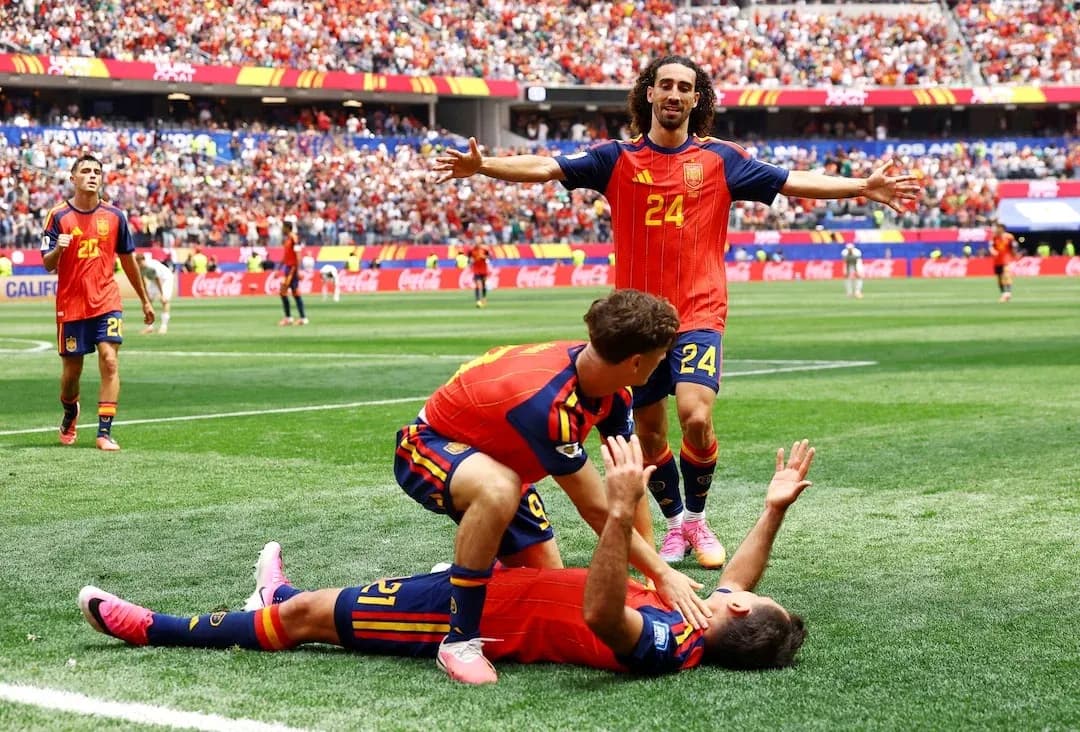
Spain Dominates Austria 3-0 in World Cup Round of 32
Spain’s 3-0 win over Austria at SoFi Stadium in this World Cup Round of 32 tie was a controlled, territorially dominant performance built on structural superiority and relentless ball circulation. The scoreline mirrored the underlying dynamics: Spain monopolised possession, generated sustained pressure, and never allowed Austria a single shot on target, turning the evening into a one-sided tactical exercise.
Executive Summary
From the opening whistle, Spain imposed a high-possession, position-heavy game that pinned Austria deep and forced them into a reactive, low-block posture. With 65% of the ball, 23 total shots (10 on target) and 9 corners, Spain translated territorial control into a steady accumulation of chances. Austria, by contrast, mustered only 5 shots, none on goal, and no corners, their attacks suffocated by Spain’s rest-defence and counter-press.
The 1-0 half-time lead flattered Austria. As they tried to adjust with a double change at the break, Spain simply raised the tempo, adding two more goals and managing the closing stages with composure. The tactical story is of a side fully aligned with its possession identity against an opponent unable to escape its own defensive shell.
Scoring Sequence & Disciplinary Log
The breakthrough came on 36': Mikel Oyarzabal (Spain) scored, assisted by Marc Cucurella (Spain), capping Spain’s first-half pressure and sending them into the interval 1-0 up.
Austria’s response was structural rather than immediate in chance creation. At 46', they made two substitutions: Carney Chukwuemeka (IN) came on for Nicolas Seiwald (OUT), and Florian Grillitsch (IN) came on for Xaver Schlager (OUT), an attempt to add more progression and ball security in midfield.
On 60', Austria reshaped their front line: Marko Arnautović (IN) came on for Michael Gregoritsch (OUT), and Saša Kalajdžić (IN) came on for Romano Schmid (OUT), signalling a push for more penalty-box presence and direct options. It changed the profile up front but not the overall pattern; Spain’s control persisted.
Spain’s second goal on 66' effectively killed the contest: Pedro Porro (Spain) scored, assisted by Alex Baena (Spain). This was emblematic of Spain’s full-back involvement and layered attacks from wide zones.
Luis de la Fuente then turned to his bench to preserve energy and maintain intensity without losing structure. At 71', Mikel Merino (IN) came on for Dani Olmo (OUT), and Ferran Torres (IN) came on for Alex Baena (OUT), refreshing both the interior and wide attacking lanes.
Discipline surfaced on 83': Stefan Posch (Austria) received a yellow card — “Foul”. This was Austria’s only card of the match, reflecting their struggle to contain Spain’s circulation and movements, especially in the channels.
Spain continued to rotate on 85', with Pablo Gavi (IN) coming on for Lamine Yamal (OUT), while Austria replaced Posch with Alexander Prass (IN) for Stefan Posch (OUT), a like-for-like defensive change that did little to alter the flow.
Spain’s third goal, again from Oyarzabal, arrived on 89', assisted once more by Cucurella, sealing a 3-0 scoreline and underlining the productive left-sided combination. In the final minute of normal time, Marc Pubill (IN) came on for Aymeric Laporte (OUT), and Fabián Ruiz (IN) came on for Pedri (OUT), allowing Spain to close out the match with fresh legs and maintained positional discipline.
Card totals were: Spain 0, Austria 1, Total 1.
Tactical Breakdown & Personnel
Spain’s structure, while listed without a formal formation, clearly functioned as a possession-dominant system with Rodri as the central reference. The passing metrics underline this: 629 total passes, 570 accurate, at 91% accuracy. This high precision enabled Spain to constantly shift Austria’s block, probe between lines, and create multiple shooting opportunities (23 total shots, 15 from inside the box).
The full-backs, Pedro Porro and Marc Cucurella, were decisive. Spain’s 9 corner kicks and 7 blocked shots speak to the volume of attacks reaching the final third, often via overlaps and underlaps. Cucurella’s two assists to Oyarzabal illustrate how the left flank became a primary creative corridor, with Oyarzabal’s movement between centre-back and full-back repeatedly exploited.
In midfield, Rodri and Pedri stabilised possession and controlled tempo, while Lamine Yamal and Dani Olmo provided width and interior rotations. The high passing accuracy allowed Spain to counter-press immediately after losses, preventing Austria from transitioning. Austria’s 346 passes (284 accurate, 82%) were respectable in isolation but largely confined to deeper zones; they rarely connected into threatening areas, as evidenced by just 5 shots and no attempts on target.
Defensively, Spain’s control meant Unai Simón (Spain) faced no shots on goal and therefore registered 0 saves. The negative goals prevented figure (-0.57) for Spain indicates that, relative to the very limited xG Austria produced (0.32), Spain’s defensive unit slightly underperformed expected prevention, but the reality is Austria seldom entered zones where they could truly test the goalkeeper.
Austria’s approach under Ralf Rangnick leaned towards compactness and vertical transitions. However, with 35% possession, 0 corners, and 15 fouls, they spent long stretches chasing Spain’s circulation. The back line anchored by David Alaba and Kevin Danso was constantly stretched laterally, and the midfield duo, initially Nicolas Seiwald and Xaver Schlager, struggled to apply pressure without leaving exploitable gaps.
Alexander Schlager (Austria) was heavily involved, making 6 saves. Despite conceding three times, he prevented further damage against a Spain side that produced 10 shots on target and an xG of 2.84. The fact that Spain scored three from that xG reflects clinical finishing rather than wastefulness, while Austria’s attackers, including Michael Gregoritsch and later Marko Arnautović and Saša Kalajdžić, were starved of service.
The Statistical Verdict
The statistical profile aligns closely with the 3-0 outcome. Spain’s xG of 2.84 versus Austria’s 0.32 captures a gulf in chance quality, not just volume. Spain’s 23 shots to Austria’s 5, combined with 10 shots on goal against 0, show a game where one side attacked in waves and the other barely threatened.
Possession (65% to 35%) and passing numbers confirm Spain’s territorial and technical superiority. The 91% pass accuracy allowed them to sustain pressure, while Austria’s 82% under duress led to frequent turnovers and a reliance on last-ditch defending, reflected in their 15 fouls and lone yellow card.
Defensively, Spain’s ability to hold Austria to no shots on target is as significant as their attacking output. Unai Simón (Spain) was essentially a spectator, while Alexander Schlager (Austria) had to intervene repeatedly, his 6 saves preventing an even heavier defeat despite a goals prevented value of -0.57.
In sum, this was a tactically coherent, statistically dominant Spain performance: control of space and ball, high-quality chance creation, and total suppression of Austria’s attacking threat, translating cleanly into a 3-0 scoreline and a confident progression from the Round of 32.
Related News

Thomas Tuchel Reflects on England's 10-Man World Cup Triumph and a Surprising Regret

Robert Moreno Takes Over as Interim South Korea Coach After World Cup Setback

Jude Bellingham Returns to Form with Real Madrid After World Cup Success

Chloe Kelly, Beth Mead & 13 Lionesses Who Must Shine in the Upcoming WSL Season for England’s 2027 World Cup Bid
Barcelona Cancels World Cup Tribute Amid Political Tensions
Messi Breaks Record for Most Penalties Taken and Missed in FIFA World Cup History