
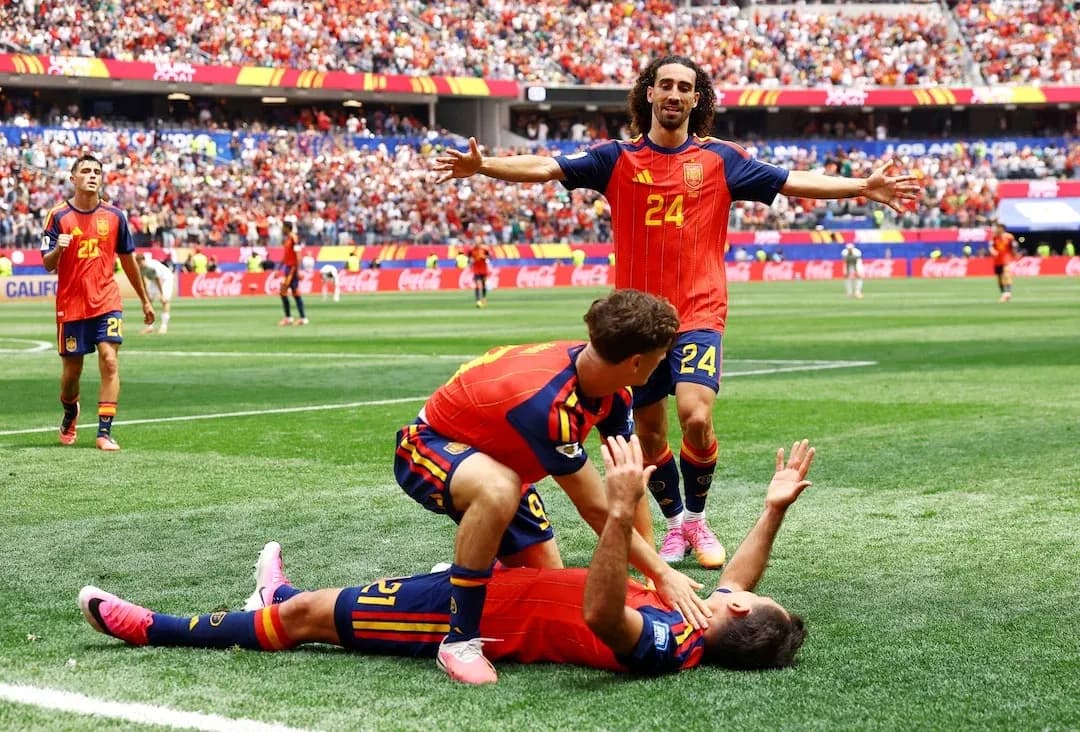
Spain vs Austria: A Clash of Footballing Ideologies
SoFi Stadium in Inglewood stages a Round of 32 meeting that feels like a clash of footballing ideologies as Spain face Austria. The World Cup group phase has already sketched the outlines of both teams’ identities. Spain arrive as group winners from Group H, ranked 1st after taking 7 points from 3 matches with a formidable overall goal difference of +5, built on 5 goals scored and none conceded. Austria come in as Group J runners‑up, ranked 2nd in their section with 4 points from 3 matches and a perfectly balanced overall goal difference of 0, having scored 6 and conceded 6.
Spain’s seasonal DNA is one of control and clean sheets. Across the tournament so far they have played 4 matches in total, winning 3 and drawing 1, without a single defeat. At home venues they have played 3 times, winning 2 and drawing 1, while on their travels they have 1 win from 1. Their attacking output is steady rather than wild: in total this campaign they have scored 8 goals, with 7 at home and 1 away. The scoring profile is efficient: an overall average of 2.0 goals per game, rising to 2.3 at home and 1.0 on their travels. The more striking number lies at the other end – Spain are yet to concede a goal, either at home or away, giving them an overall defensive average of 0.0 goals against per match. Four clean sheets in four underline a side that rarely loses structure, even as they change shape between a 4‑3‑3 and the 4‑2‑3‑1 that Luis de la Fuente has again selected for this knockout tie.
Austria’s path has been more turbulent. They have played 4 matches in total, with 1 win, 1 draw and 2 defeats. At home they have 1 win from 1, but on their travels they have struggled: 3 away games have yielded 2 defeats and 1 draw. In total this campaign they have scored 6 goals, split evenly between 3 at home and 3 on their travels. The attack’s overall average is 1.5 goals per match, with a prolific 3.0 at home but only 1.0 away. Defensively, the contrast is stark: in total they have conceded 9 goals – 1 at home and 8 on their travels – for an overall average of 2.3 goals against per game, with 1.0 at home and a worrying 2.7 away. They have yet to keep a clean sheet, and have already failed to score twice away from home, a combination that hints at fragility when forced to chase matches.
Team Lineups
Both sides line up in a 4‑2‑3‑1, but the personnel choices colour that symmetry. For Spain, Unai Simón anchors a back four of Pedro Porro, Pau Cubarsí, Aymeric Laporte and Marc Cucurella. Ahead of them, Rodri and Pedri form a double pivot designed to control rhythm and resist Austria’s counter‑press. The attacking line of three – Lamine Yamal to the right, Dani Olmo central, Álex Baena to the left – supplies Mikel Oyarzabal, who leads the line.
Oyarzabal is Spain’s sharpest weapon and one of the tournament’s headline forwards. Heading into this game he has 4 goals and 1 assist in total this campaign, from 4 appearances and 301 minutes, with a rating of 7.7. His 15 total shots, 8 of them on target, speak to a player who consistently finds space for attempts rather than relying on isolated moments. In the “Hunter vs Shield” duel, Oyarzabal’s penalty‑box craft meets an Austrian defence that has conceded 9 goals overall and has not yet managed a single clean sheet. The numbers suggest that if Spain can funnel possession into the half‑spaces around the Austrian centre‑backs, Oyarzabal will find chances.
Austria’s back line is built around Stefan Posch, Kevin Danso, David Alaba and Konrad Laimer in front of goalkeeper Alexander Schlager. Posch, however, embodies both their aggression and their disciplinary risk. Across the tournament he has collected 2 yellow cards and also appears among the red‑card leaders, underlining how close to the edge he plays. He has committed 7 fouls and drawn 3, while engaging in 35 duels and winning 16. His 10 interceptions show good reading of the game, but with Austria’s yellow‑card distribution skewed heavily late – 60.00% of their yellows arrive between 76‑90 minutes – fatigue and desperation often drag this back line into risky territory. If Spain are patient, the final quarter of an hour becomes fertile ground for drawing fouls around the box or forcing errors under pressure.
Midfield Battle
In midfield, the “Engine Room” confrontation will pivot on Rodri and Pedri against Austria’s Nicolas Seiwald and Xaver Schlager. Spain’s pair are tasked with both shielding Cubarsí and Laporte and feeding the creative trio ahead. Austria’s double pivot must compress space, break up combinations and spark transitions for the advanced line of Romano Schmid, Paul Wanner and Marcel Sabitzer behind Michael Gregoritsch. With Austria averaging 1.5 goals overall but conceding 2.3, their best route is to turn this into a transition game rather than a positional one – something Spain’s structure is designed to deny.
Disciplinary patterns add another layer. Spain’s yellow cards are rare and oddly timed: 50.00% between 46‑60 minutes and 50.00% between 91‑105 minutes, suggesting they generally manage the first and last phases of regular time calmly. Austria, by contrast, start and finish halves on the edge, with 20.00% of yellows between 0‑15 minutes, another 20.00% between 31‑45, and that heavy 60.00% spike in the 76‑90 window. In a tight knockout, this makes Austria especially vulnerable to late free‑kicks and potential dismissals just as legs and minds tire.
Statistical Prognosis
From a statistical prognosis, Spain’s overall average of 2.0 goals for and 0.0 against, combined with four clean sheets, paints the picture of a side whose xG profile would likely show consistent chance creation layered on top of elite defensive control. Austria’s blend of 1.5 goals scored and 2.3 conceded overall, with 0 total clean sheets and 2 total matches without scoring, suggests a more volatile xG curve: dangerous enough to trouble anyone, but too porous to withstand sustained pressure.
Tactical Expectations
Tactically, expect Spain to monopolise the ball, using Rodri as the metronome and Lamine Yamal’s width to stretch Austria’s back four, while Oyarzabal roams between Danso and Alaba. Austria’s best hope lies in compressing the central lanes, springing Sabitzer and Gregoritsch early in transitions, and exploiting any rare Spanish overcommitment. Yet the weight of the numbers leans heavily towards Spain: an unbeaten, unbreached side whose balance between control and incision seems tailor‑made for knockout football, facing an Austrian team whose courage and verticality may simply have to punch above the underlying defensive statistics to survive.
Related News
Thomas Tuchel Reflects on England's 10-Man World Cup Triumph and a Surprising Regret

Robert Moreno Takes Over as Interim South Korea Coach After World Cup Setback

Jude Bellingham Returns to Form with Real Madrid After World Cup Success

Chloe Kelly, Beth Mead & 13 Lionesses Who Must Shine in the Upcoming WSL Season for England’s 2027 World Cup Bid
Barcelona Cancels World Cup Tribute Amid Political Tensions
Messi Breaks Record for Most Penalties Taken and Missed in FIFA World Cup History