
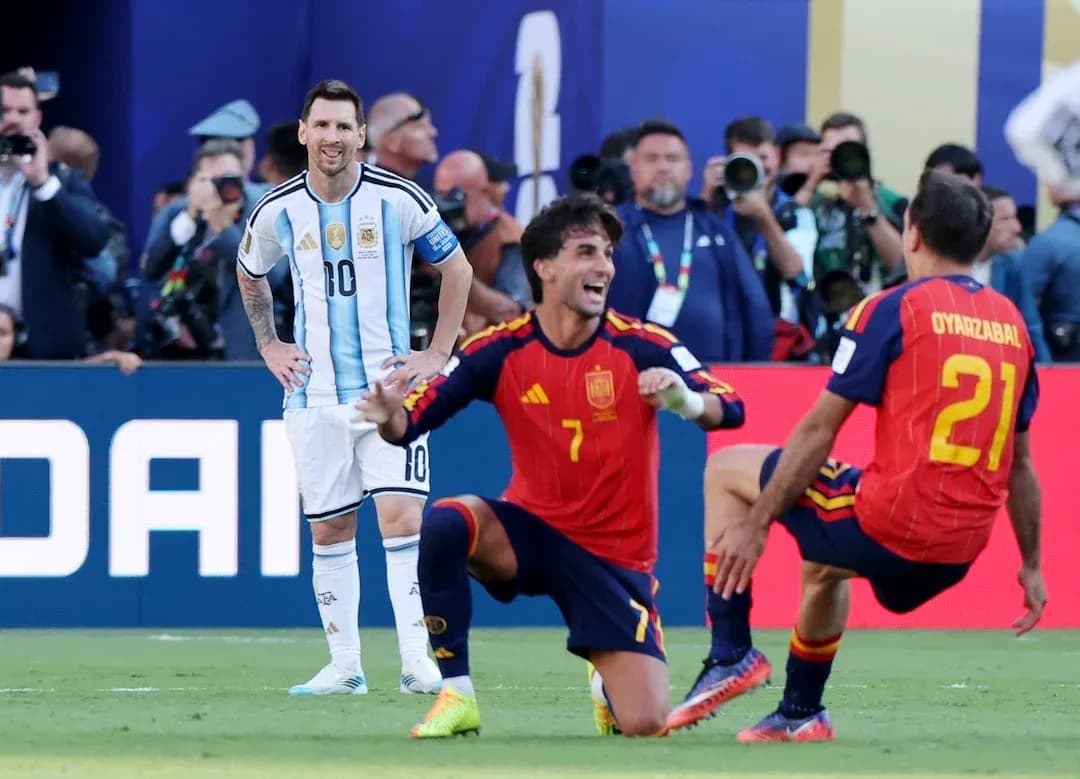
Spain Crowned World Champions After 1-0 Victory Over Argentina
Spain 1-0 Argentina (after extra time) at MetLife Stadium crowns Spain as world champions, decided by Ferrán Torres’ extra-time strike. Spain, group winners already assured of a path from the Round of 32, complete a flawless defensive tournament run, while Argentina, also group winners coming into the knockouts, fall at the final hurdle despite a resilient defensive display.
Match Report
The final unfolded as a long tactical siege rather than a spectacle of chances, with the key moments clustered around Argentina’s defensive reshuffles and Spain’s gradual injection of attacking depth.
At 41', Argentina picked up the first booking when Lisandro Martínez (Argentina) received a yellow card (Foul), signalling the growing physical edge as Spain dominated the ball.
Three minutes later, at 44', Nicolás Otamendi replaced Lisandro Martínez (Argentina), an early forced reshuffle at centre-back that hinted at physical issues or a tactical recalibration against Spain’s fluid front line.
On the stroke of half-time at 45', Argentina adjusted again in the front line as Leandro Paredes replaced Nicolás Iván González (Argentina), adding control in midfield and sacrificing some verticality on the left.
Early in the second half, at 52', Paredes (Argentina) was booked with a yellow card (Argument), underlining Argentina’s frustration as they struggled to retain possession.
At 58', Argentina made a change at right-back: Nahuel Molina replaced Gonzalo Montiel (Argentina), seeking fresher legs to cope with Spain’s left-sided overloads.
Spain responded with a double attacking change at 62'. Ferrán Torres replaced Mikel Oyarzabal (Spain), adding more direct movement in behind, while Pedri replaced Fabián Ruiz (Spain), aiming to sharpen Spain’s control between the lines.
Argentina then reshaped their back line and midfield at 70'. Facundo Medina replaced Cristian Romero (Argentina), and Giuliano Simeone Baldini replaced Rodrigo De Paul (Argentina), moves that both refreshed the defensive unit and added energy higher up the pitch to chase transitions.
Spain answered with their own double switch at 75'. Nico Williams replaced Alejandro Baena Rodríguez (Spain), introducing one‑v‑one pace on the flank, and Mikel Merino replaced Daniel Olmo Carvajal (Spain) to add late-running power from midfield.
Argentina’s discipline continued to fray under pressure. At 82', Enzo Fernández (Argentina) was shown a yellow card (Dissent), and at 90+2', Cristian Romero (Argentina) also received a yellow card (Dissent), both bookings reflecting mounting protest rather than tactical fouls.
In extra time, Spain refreshed their spine at 99'. Martín Zubimendi replaced Rodrigo Hernandez Cascante (Spain) at the base of midfield, and Eric García replaced Aymeric Laporte (Spain) in central defence, maintaining intensity and security against any late Argentine counters.
Argentina’s last major reshuffle came at 102', when Marcos Senesi replaced Julián Álvarez (Argentina), a defensive-minded move that effectively accepted deeper territory in exchange for aerial security and set‑piece strength.
At 104', even the technical area felt the strain: Lionel Sebastián Scaloni (Argentina) was booked with a yellow card (Dissent), emblematic of Argentina’s frustration at being pinned back.
The decisive moment arrived at 106'. Spain goal — Ferrán Torres (assisted by Nico Williams). Williams, introduced to stretch the game, broke down the flank and squared for Torres, whose movement between tiring centre-backs was rewarded with a calm finish. The strike finally translated Spain’s territorial dominance into a 1-0 lead after extra time.
Argentina’s late push brought more aggression than structure. At 111', Alexis Mac Allister (Argentina) collected another yellow card (Foul), as Spain managed the closing stages and saw out the contest to secure the World Cup.
Fixture Statistics & Tactical Audit
- xG: Spain vs Argentina — not provided in the available statistics
- Possession: Spain 65% vs 35% Argentina
- Shots on Target: Spain 12 vs 0 Argentina
- Goalkeeper Saves: Spain 0 vs 11 Argentina
- Blocked Shots: Spain 3 vs 1 Argentina
The statistical profile underlines Spain’s territorial and attacking control. With 65% possession and a 20–2 shot advantage, including 12–0 in shots on target, Spain’s performance was dominant (12 shots on target to 0) even if the scoreline remained narrow. Argentina’s 11 saves, all from Emiliano Martínez, and their 25 fouls compared to Spain’s 21 show a reactive, backs‑to‑the‑wall strategy: deep block, heavy contact, and reliance on their goalkeeper. Spain’s high volume of efforts inside (9) and outside (11) the box suggests sustained pressure rather than isolated bursts, while Argentina’s two attempts all game reflect a conservative approach that prioritised defensive stability and counter‑threat but ultimately left them without an attacking foothold. The 1-0 scoreline arguably flatters Argentina given the shot and on‑target disparity; Spain’s wastefulness and Martínez’s shot-stopping kept the contest alive until extra time.
Standings Update & Seasonal Impact
Spain entered the knockout phase as Group H winners with 7 points, 5 goals scored and none conceded. Adding this 1-0 victory in the final moves them to 10 points overall in the tournament’s cumulative record, with 6 goals for and 0 against, extending an impeccable defensive record and confirming their status as world champions with a positive goal difference of +6. Argentina, who arrived from Group J as perfect group winners with 9 points and a +7 goal difference (8 scored, 1 conceded), finish the campaign on 9 points with 8 goals for and now 2 against, their goal difference trimmed to +6. Spain’s win closes any debate over supremacy between the two most efficient group‑stage performers, while Argentina’s defeat turns an otherwise near‑flawless run into a story of coming up one goal short on the biggest stage.
Lineups & Personnel
Spain Starting XI
- GK: Unai Simón
- DF: Pedro Porro, Pau Cubarsí Paredes, Aymeric Laporte, Marc Cucurella
- MF: Rodri, Dani Olmo, Fabián Ruiz, Álex Baena
- FW: Lamine Yamal, Mikel Oyarzabal
Argentina Starting XI
- GK: E. Martínez
- DF: G. Montiel, C. Romero, Lisandro Martínez, N. Tagliafico
- MF: R. De Paul, E. Fernández, A. Mac Allister
- FW: N. González, L. Messi, J. Álvarez
Post-Match Verdict
Spain’s triumph was built on structural control and relentlessness in the final third: they were dominant (65% possession and 20–2 shots) and eventually found the margin their performance merited through the Torres–Williams combination. Luis de la Fuente’s use of the bench — particularly the introductions of Pedri, Nico Williams and Ferrán Torres — steadily increased incision against a tiring, increasingly reconfigured Argentine back line. Argentina, by contrast, delivered a resilient but ultimately one‑dimensional display, defined by defensive resistance rather than balance: they were vulnerable offensively (0 shots on target and just 2 attempts overall), and their dependence on Emiliano Martínez’s 11 saves and frequent tactical fouling could not be sustained over 120 minutes. In the end, the final became a test of whether Argentina’s low‑block resistance could outlast Spain’s positional play; the numbers and the decisive extra‑time goal confirm that Spain’s proactive approach deservedly carried the day.
Related News

Thomas Tuchel Reflects on England's 10-Man World Cup Triumph and a Surprising Regret

Jude Bellingham Returns to Form with Real Madrid After World Cup Success

Chloe Kelly, Beth Mead & 13 Lionesses Who Must Shine in the Upcoming WSL Season for England’s 2027 World Cup Bid
Barcelona Cancels World Cup Tribute Amid Political Tensions
Messi Breaks Record for Most Penalties Taken and Missed in FIFA World Cup History

FIFA Removes COO Kevin Lamour After Criticism of Infantino’s World Cup Investment Plan