
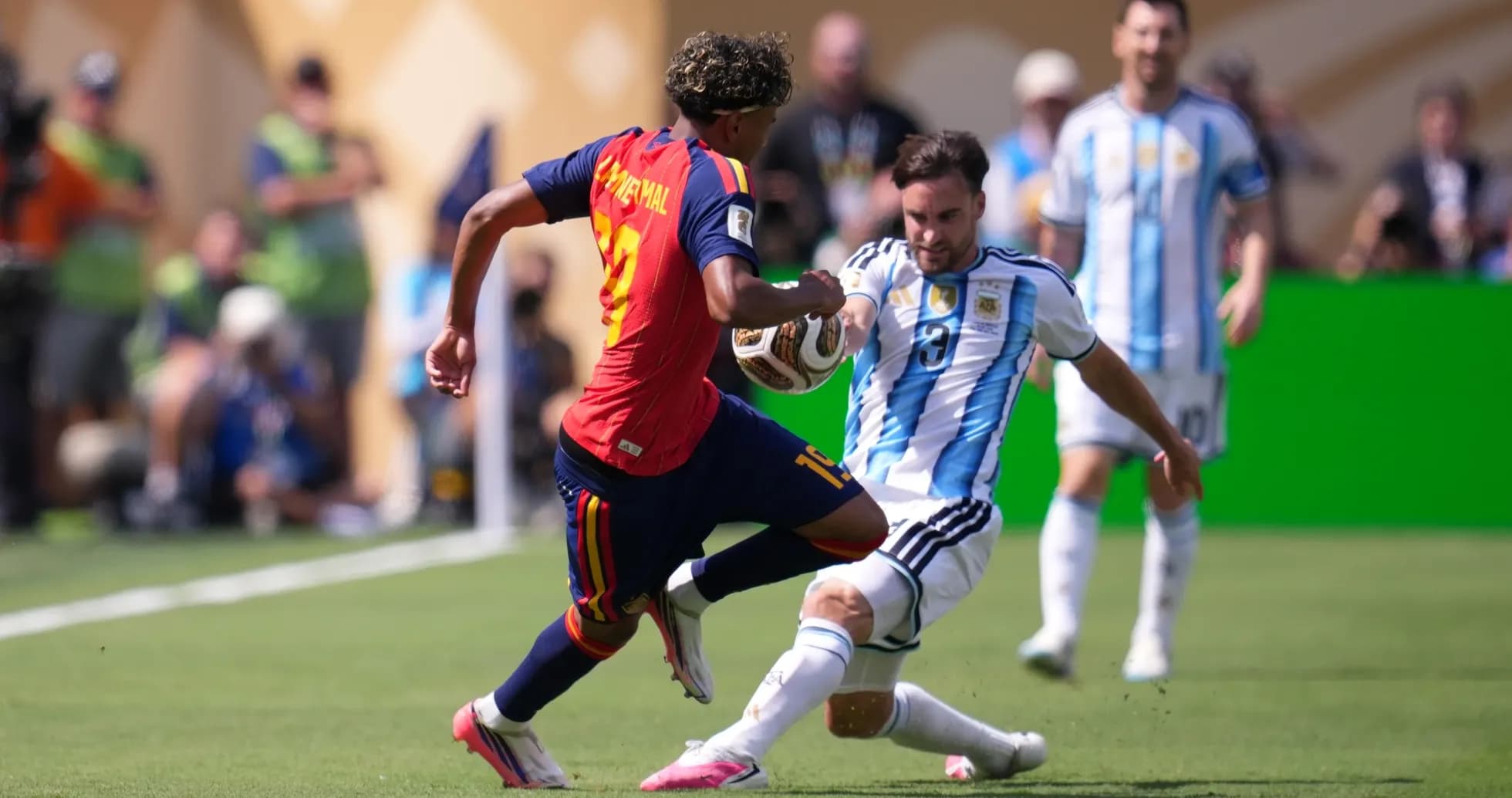
Spain vs Argentina: World Cup Final Tactical Preview
MetLife Stadium becomes the axis of the football world as Spain and Argentina walk out for a World Cup Final that feels as much like a clash of eras as a clash of styles. The scoreboard will eventually read Spain 1–0 Argentina after extra time, but the story of this game is already written in the numbers and the shapes before a ball is kicked.
I. The Big Picture – Two Perfect Machines, Different Operating Systems
Heading into this game, both sides arrive with records that border on immaculate. Spain’s campaign has been defined by control and suffocation. Overall this tournament, they have played 8 matches, winning 7 and drawing 1, without a single defeat. They have scored 14 goals in total and conceded just 1, giving them an extraordinary overall goal difference of +13. At home venues they have averaged 2.0 goals scored and 0.2 conceded; on their travels that drops slightly to 1.3 for and 0.0 against, but the defensive perfection away from home underlines their identity: they simply do not give chances away.
Argentina’s path has been more explosive and more exposed. Across 8 matches, they have 7 wins and 1 loss, with 19 goals scored and 8 conceded overall, for a goal difference of +11. At home they average 2.8 goals scored and 1.0 conceded; away, 1.7 scored and 1.0 conceded. They are more open, more chaotic, but also more devastating in the final third.
The group-stage standings hint at how both teams translated those profiles into tournament reality. Spain topped Group H with 7 points, 5 goals scored and none conceded in 3 matches. Argentina won all 3 in Group J, taking 9 points with 8 goals for and 1 against. Both arrived in the knockouts as group winners, both carried the label “Round of 32” contenders, but their seasonal DNA is starkly different: Spain the metronomic strangler, Argentina the high-wire act powered by genius.
II. Tactical Voids and Discipline – Edges in the Margins
There are no confirmed absentees listed for either side, which means both Luis de la Fuente and Lionel Scaloni can lean on their strongest versions of themselves. For Spain, that means their favoured 4-2-3-1, used in 6 matches this tournament. For Argentina, the 4-4-2 that has been their primary structure in 5 games returns again.
Discipline could quietly tilt the balance. Spain’s yellow-card pattern is revealing: 33.33% of their cautions arrive between 31-45 minutes, and a hefty 50.00% in the 91-105 window. They are generally clean, but when the match stretches into extra time, their aggression spikes. Yet they have not seen a red card all tournament.
Argentina’s card map is far more volatile. Their yellows are spread across the second half and extra time, with 13.33% between 31-45, 13.33% between 46-60, 13.33% between 76-90, 33.33% from 91-105, and 20.00% from 106-120, plus a stray 6.67% in an unspecified range. Crucially, they have shown a red card in the 91-105 window, underlining how their intensity can tip over in the most pressurised phase of games.
Individually, Argentina’s spine carries disciplinary risk. Leandro Paredes has 2 yellow cards and commits 9 fouls, while Cristian Romero and Lisandro Martínez also sit on 2 yellows each, with 9 and 7 fouls committed respectively. Enzo Fernández adds another layer of edge with 12 fouls and a yellow-yellow-red sequence this tournament. If this final tilts into a war of attrition, Argentina walk a disciplinary tightrope.
III. Key Matchups – Hunter vs Shield, Engine Room vs Engine Room
The headline duel is irresistible: L. Messi, the tournament’s leading light, against the most miserly defence in the competition. Messi has 8 goals and 4 assists, 28 shots with 18 on target, 348 completed passes at 81% accuracy, and 27 successful dribbles from 38 attempts. He has drawn 20 fouls and lost only 3 in return. He is both hunter and architect.
Yet Argentina’s penalty record exposes a rare vulnerability. Overall this campaign, they have taken 3 penalties, scoring just 1 and missing 2. Messi himself has missed 2 penalties this tournament, a psychological wrinkle Spain will not ignore around the box.
Spain’s answer is collective rather than individual. Aymeric Laporte and P. Cubarsi anchor a back four that has allowed only 1 goal in 8 matches. With Rodri and F. Ruiz screening in front, Spain compress central spaces where Messi likes to receive and turn. Their defensive record away from home—0.0 goals conceded on their travels—speaks to a system that travels well and is built to withstand pressure.
Further forward, Mikel Oyarzabal becomes Spain’s quiet assassin. With 5 goals and 1 assist, 21 shots and 12 on target, he is their most reliable finisher. His movement from the front in this 4-2-3-1, supported by the creativity of D. Olmo and the unpredictability of Lamine Yamal, tests the channels between Romero and Lisandro Martínez, who are already burdened by heavy defensive workloads: Romero has 15 tackles, 3 blocks, 10 interceptions; Lisandro Martínez adds 12 tackles and 6 interceptions.
In midfield, the “engine room” battle is almost philosophical. Rodri and F. Ruiz seek to impose order, recycle possession, and squeeze Argentina’s transitions. On the other side, R. de Paul, Enzo Fernández and Alexis Mac Allister bring energy, verticality, and late runs. Enzo’s 512 completed passes at 93% accuracy and 12 fouls committed sum him up: a high-volume, high-risk fulcrum who can both build and break.
IV. Statistical Prognosis – Control vs Chaos
From a pure numbers perspective, this final is a collision between the tournament’s most efficient defence and its most prolific attack. Spain’s overall average of 1.8 goals scored and 0.1 conceded per match suggests their xG profile is built on control, territory, and chance suppression. Argentina’s 2.4 goals scored and 1.0 conceded overall hint at high xG in both directions: they create plenty, but they also allow enough to keep every game alive.
Factor in the penalty narratives—Spain perfect from the spot overall with 1 penalty scored from 1, Argentina with 2 misses from 3—and the late-game card spikes, and the extra-time arc of this final begins to make sense. As fatigue sets in, Spain’s discipline and structure hold; Argentina’s emotional, high-intensity game starts to fray at the edges.
In the end, the tactical preview and the statistical forecast converge on the same conclusion: Spain’s collective control is just enough to smother Argentina’s individual brilliance over 120 minutes. The hunter meets the shield, and in East Rutherford, the shield holds.
Related News

Thomas Tuchel Reflects on England's 10-Man World Cup Triumph and a Surprising Regret

Jude Bellingham Returns to Form with Real Madrid After World Cup Success

Chloe Kelly, Beth Mead & 13 Lionesses Who Must Shine in the Upcoming WSL Season for England’s 2027 World Cup Bid
Barcelona Cancels World Cup Tribute Amid Political Tensions
Messi Breaks Record for Most Penalties Taken and Missed in FIFA World Cup History

FIFA Removes COO Kevin Lamour After Criticism of Infantino’s World Cup Investment Plan